
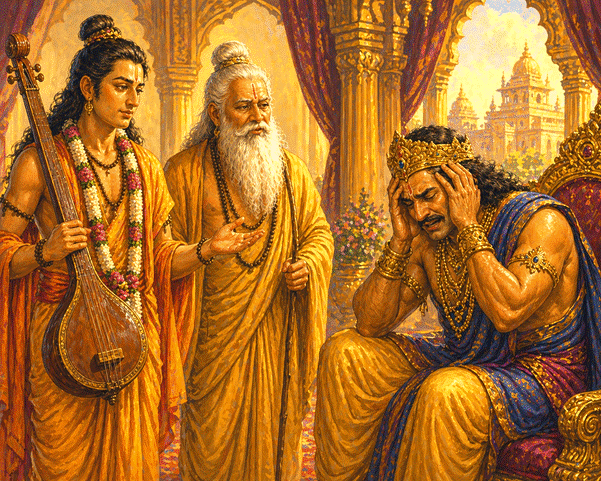
After revealing to Parikshit that the mighty demon Vritrasur had been the great King Chitraketu in his past life, Shukadev began recounting the king’s story. Chitraketu was an immensely prosperous ruler. He was renowned far and wide, blessed with robust health, and surrounded by many queens. Yet one sorrow eclipsed all his blessings: he had no child.
Such is the paradox of life; forever a mix of joy and sorrow. Too much of either overwhelms the heart. For Chitraketu, the blemish in that mix was his childlessness. It consumed him. Despite his opulence, he remained deeply unhappy.
As if drawn by his silent agony, the Sages Narad and Angira arrived at his palace one day. Chitraketu welcomed them with reverence. And when they inquired about his distress, he finally gave voice to the sorrow he had long carried—the ache of being without a child.
Prophecy of Joy & Sorrow
The sages counseled King Chitraketu to remain content with the prosperity he had been endowed with.
As the timeless maxim goes,
स हि भवति दरिद्रः यस्य तृष्णा विशाला।
मनसि च परितुष्टे कोऽर्थवान् को दरिद्रः॥
One whose desires are endless is truly poor. One who is content at heart rises beyond the measures of wealth and poverty.
Yet Chitraketu’s yearning for a child blazed too fiercely to be quenched. Heedless of their guidance, he pressed on. Finally, the sages blessed him, assuring that he would soon beget a child. However, they forewarned, “This child will be both the cause of your happiness and misery.”
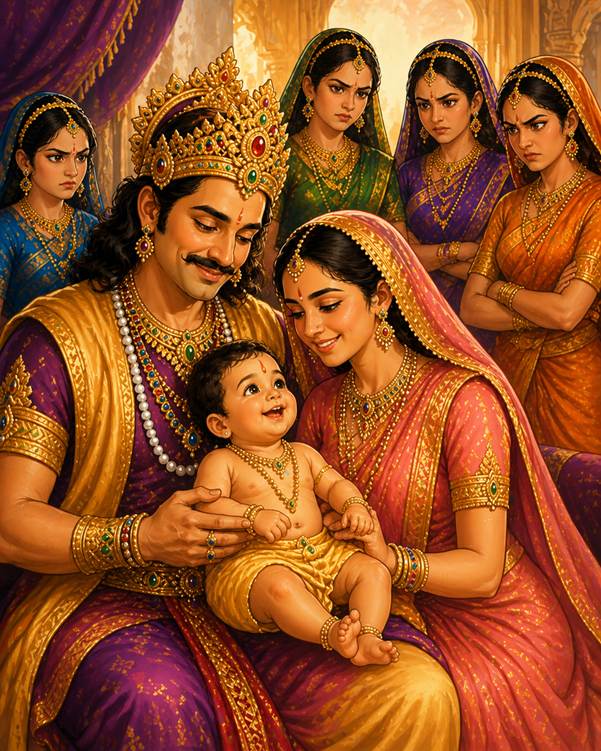
In due course, Chitraketu’s chief Queen, Kritadhyuti, bore a son. The boy became the very cynosure of Chitraketu’s eyes. Utterly enraptured, he devoted nearly every waking hour to the child. Yet, in doing so, he grew oblivious to the shadows lengthening in the corners of his court. While Chitraketu and Kritadhyuti basked in their newfound bliss, the other queens looked on from the margins. Stung by neglect, their wounded hearts slowly curdled into a cold, lethal malice. And in a cruel twist of fate, they poisoned the child.
The boy died.
When Chitraketu learned of this, it was as if his whole world had buckled. The same child who had once been his greatest joy now became the very source of unbearable grief. From the heights of jubilation, he plunged into the depths of heartbreak, mourning day and night.
Such is the fragile bargain of worldly attachment.
As Jagadguru Shree Kripaluji Maharaj says,
जग महँ सुख दुःख दोउ नहीं, ऐसा उर धारिए ज्ञान।
सुख माने दुःख मिलत है, सुख न जगत महँ मान॥
There is, in fact, neither happiness nor distress in the things of the world. It is our own mind that assigns value to them. The moment we label something as our source of happiness, we unknowingly sign a contract with sorrow. For when that very object is taken away—as all things in time are—the pain is as deep as the delight once was.
This is evident in everyday life. You hear a news report that a dozen people have perished in a distant tragedy. You may feel a flicker of pity and move on. It does not truly affect you. But if you learn that someone dear to you was at the scene, anxiety grips you instantly. Why? Because you had attached your happiness to that person. The intensity of attachment determines the intensity of suffering.
So, it was with Chitraketu. Having invested his deepest sentiments in his son, the loss struck him with equal, devastating force.
Truth That Sets Free
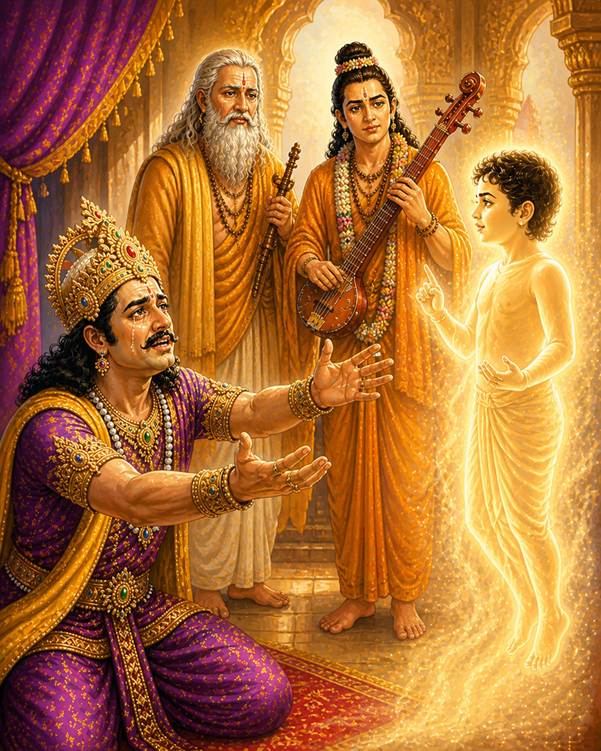
Time passed, and the Sages Narad and Angira once again arrived at the palace of King Chitraketu. They found their disciple still weeping bitterly, his grief as raw as ever. As they stood before him, the dam of his anguish burst. Through sobs and tear-laden words, Chitraketu lamented, “My beloved child is no more. The pain of separation from my son is unbearable. I cannot endure it.” Narad ji, however, did not soothe him with words; he offered something far deeper. Invoking his spiritual powers, he summoned the soul of the deceased child.
Just as the soul appeared, Chitraketu surged forward in desperation, “My child! My child!”
But the soul spoke firmly, “Whom do you call your child?
“You… you are my son,” Chitraketu stammered.
The soul responded chillingly, “I am not your son. In truth, I was your enemy from a past life. You had tormented me, and I was born to you only to settle those scores. That is why I came—to take revenge.
At once, the scales fell from Chitraketu’s eyes. He realized the futility of worldly bonds and ambitions. It revealed a harsh but liberating truth: what we cling to as ‘ours’ may not be what it appears to be. Chitraketu rose from the ashes of attachment into the light of Brahm Gyan, the knowledge of the Absolute Truth. He turned away from worldly illusions and embarked on the spiritual path. Through sincere spiritual practice, he underwent such a transformation that, within that very lifetime, he ascended to a higher state of existence. He became a Gandharva—a celestial angel.
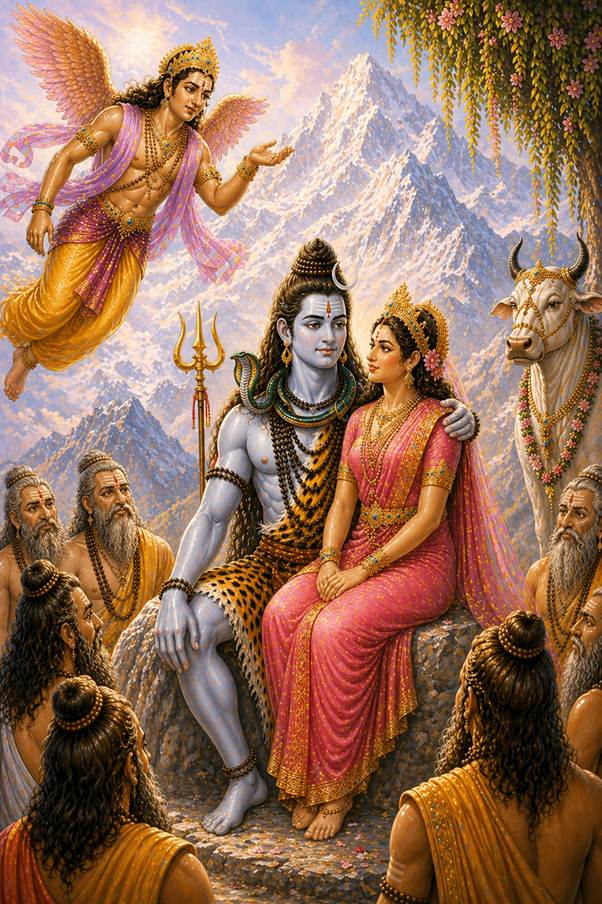
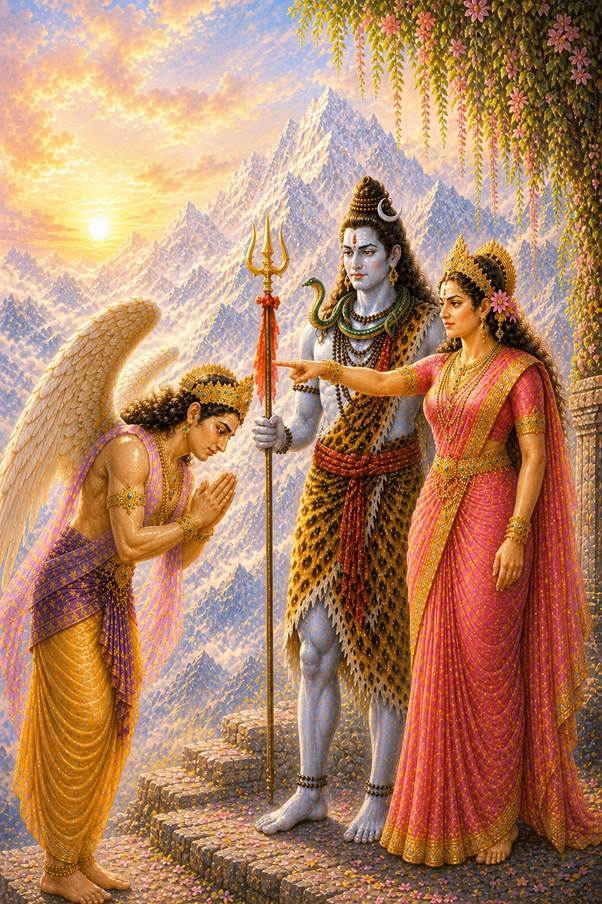
As a Gandharva, he soared across the skies, traversing the aerial pathways. In time, his wanderings brought him to Kailash: the sacred Abode of Lord Shiv and Parvati.
Error of Judgement
On that day, Mahadev sat amidst an assembly of venerable sages. Beside Him was His consort, Parvati, resting gracefully upon His lap.
Bhagavan exists beyond the confines of worldly convention. His actions, unfettered by human norms, are always guided by a higher purpose. Thus, even as discussions with the sages were underway, He expressed affection towards Parvati. None among those present found it in the least improper.
Except one.
Chitraketu, soaring above in his Gandharva form, allowed a trace of irreverence to slip into his words. With a mocking smile, he remarked: “Mahadev is Bhagavan, yet He does not even know how to behave.”
Lord Shiv, serene as the still sky, remained unmoved. But Parvati was displeased.
Her voice rang firm: “Mahadev may reside in cremation grounds, may wear a garland of skulls around His neck, yet He is supremely pure. Even a single petal that falls from His feet is treasured by great rishis, who place it upon their heads as a blessing. And you, Gandharva, dare to speak thus?” Her words grew sharper: “You fail to grasp that God is beyond lust, anger, greed, and desire. You impose the rules of dharma meant for mortal souls on the Lord of the Universe Himself.”
A profound spiritual principle emerges here. Chitraketu’s mistake was not merely one of disrespect—it was misunderstanding of the nature of divinity itself. He sought to evaluate God using worldly standards.
For instance, every country has its own laws. One cannot apply one nation’s rules to another. Similarly, the laws of dharma governing beings under maya do not apply to God. Bhagavan is transcendental, untouched by the modes of material nature. Whatever God does is never driven by personal desire, but always for the welfare of all.
Pointing to this transcendence of the Divine, the Kathopanishad states,
अन्यत्र धर्मादन्यत्राधर्मादन्यत्रास्मात्कृताकृतात्।
अन्यत्र भूताच्च भव्याच्च यत्तत्पश्यसि तद्वद ॥ ~ Verse 14
Tell me about that 'Paratattva' which you see beyond religion (Ayatra), beyond Adharma, beyond this created (Krit) and uncreated (Akrit), beyond the past and future.
Expression of Selflessness
Parvati then pronounced a stern curse upon Chitraketu. “You have misbehaved, Gandharva. In your next life, become a demon.”
The words fell with weight, yet Chitraketu did not shudder. There was no trace of fear on his face, no ripple of resentment in his heart. With composure and hands folded in deep reverence, he bowed before the Mother of the Universe. “Dear Mother, I have erred. I am willing to suffer the consequences.” With that, he departed, walking calmly towards what lay ahead.
Witnessing such poise, Shiv ji turned to Parvati, drawing her attention to the elevated state of Chitraketu’s soul. He spoke of the sublime nature of those selflessly devoted to the Lord.
नारायणपरा: सव न कुतश्चन बभ्यत ।
स्वर्गापवगनरके ष्वप तुल्याथदशंन: ॥ Verse 6.17.28 ॥
Devotees fully absorbed in the devotional service of the Supreme Divine Personality, Narayan, remain fearless in all circumstances. For them, the heavenly realms, liberation, and even the hellish planets hold no distinction, as their sole interest lies in rendering service to the Lord.
Such devotees do not haggle with God for comfort. Whether they are lifted to swarg (heaven), cast into narak (hell), or granted moksh (liberation), it makes no difference to them. Their happiness is not tethered to anything, but solely to the happiness of the Lord. This is the hallmark of a Nishkam devotee—one free from selfish desires. And Chitraketu exemplified this spirit perfectly. Even when cursed to be born a demon, he remained undisturbed. His response reflected no protest or resistance, only acceptance.
As the wheel of time turned, Chitraketu was reborn as Vritrasur. Yet, beneath the terrifying exterior of a demon, his soul remained anchored in devotion. He underwent the ordained consequences of his past karma and, in the end, attained liberation.
Moved by Vritrasur’s story, Parikshit then turned to Shukadev with yet another question—standing at the cusp of a deeper revelation… unfolding next.
Frequently Asked Questions
Question: If attachment brings sorrow, should we stop loving altogether? Will this not make us emotionally numb?
Answer: Detachment does not mean becoming cold or distant; it means loving with wisdom rather than blind attachment.
Once, a widowed mother saw her young son steal a pencil but chose to remain silent. Her duty was to guide and correct him, yet she ignored the mistake. What began as petty theft slowly grew into serious crime. As an adult, he committed murder and, before his execution, blamed his mother for not correcting him at the start. Why was she unable to fulfill her duty? Over-attachment clouded her intellect, robbing it of clear, impartial discernment.
With detachment, one can act wisely and in the best interest of others. The belief that “If I am not attached, I will not be able to fulfill my duty” is, in fact, the very opposite of the truth. Detachment does not diminish our ability to care—it enhances it. A nurse tending to a patient illustrates this well. She has no personal attachment, yet she performs her duties with utmost care and precision. In the same way, detachment enables us to fulfill our worldly responsibilities with clarity, compassion, and efficiency. It allows us to see loved ones not as possessions, but as souls entrusted to our care by the Divine. Such love is higher, freer, and purer.
Question: What does it mean to accept God’s will, and how can one cultivate such surrender in life?
Answer: To accept God’s will is not passive resignation but an active alignment of heart, intellect, and will with the Divine. It is a state of consciousness that flows from deep understanding and commitment. The Hari Bhakti Vilas (11.676) beautifully distills this wisdom into six principles of surrender, offering a practical framework to cultivate this inner state. For inspiration through stories and real-life examples, you may read: In the Hands of God: Essence of Surrender.
Video Resource
Beyond Heaven and Hell - The Path to your True Liberation | Bhagavatam Ep 16 by Swami Mukundananda