
The Question That Challenges Devotion

What truly draws the soul toward God? Is it karma, the path of action; jnana, the path of knowledge; or yoga, the path of disciplined union? Or is it something far more subtle, something that escapes all structured paths and definitions? The sages of India did not confine the journey to a single method. Instead, they pointed toward a deeper truth: the human mind, in all its movements and emotions, is both the barrier and the bridge to the divine.
In the Bhagavad Gita, Lord Krishna explains that people approach Him through different inclinations. Some are driven by suffering, some by curiosity, some by desire, and some by wisdom. These diverse approaches reflect the classical paths of karma, jnana, and yoga. Yet beneath all these paths lies a unifying principle: where the mind rests, there the soul begins to transform. The Gita does not insist that one must perfect karma, master jnana, or achieve the highest state of yoga before turning to God. It begins with connection.
The Narad Bhakti Sutra takes this insight even deeper. It transcends the structured paths and reveals that intense attachment to God, in any form, has the power to elevate the soul. This is a bold and liberating idea. It suggests that divine grace is not limited to those who walk the formal paths of karma, jnana, or yoga, but is equally accessible to anyone whose mind becomes fully absorbed in the divine.
This leads us to a profound paradox. Can action without awareness lead to liberation? Can incomplete understanding still result in divine connection? Can even confusion or ignorance become a doorway to grace?
The stories of the Gopis and Kansa challenge our assumptions and invite us to rethink devotion itself. They reveal that God is not reached merely through structured paths, but through absorption of the mind. Whether through love, fear, longing, or even opposition, the moment the mind becomes centered on the divine, something extraordinary begins to unfold.
This is the mystery of grace. It does not wait for perfection in karma, completeness in jnana, or mastery in yoga. It begins the moment the mind turns towards God
Vastu Shakti: Grace Beyond Understanding
One of the most striking insights from Swami Mukundananda’s teachings is the concept that divine grace operates independently of human intellect. This principle is known as Vastu Shakti, meaning the inherent power within an object or being. Just as fire burns regardless of whether you understand combustion, God’s grace transforms regardless of whether you fully comprehend divinity.
This idea challenges a common assumption. Many believe that spiritual progress requires deep philosophical knowledge or scriptural mastery. However, the teachings reveal something different. What truly matters is the absorption of the mind.
This truth is beautifully illustrated in the dialogue between King Parikshit and Sage Sukdev. The Gopis of Braj were purely enchanted by Krishna’s physical beauty and charm. Many of them were entirely unaware that He was the Supreme Lord in human form This prompts King Parikshit to raise a profound question before Sage Sukdev: how could the Gopis attain divine liberation without recognizing Krishna’s true divine nature?
This leads us to a profound spiritual principle: “na vastu shaktir buddhim apekshate”, which means that when we connect with an entity, it bestows its result irrespective of our intellectual understanding of it.
Sage Sukdev explains this through simple yet powerful analogies.
Analogies of Unconditional Grace

Sage Sukdev answers by explaining the concept of Vastu shakti—the inherent power of an object that does not depend on human intellect. He provides several analogies:
- The Medicine: A patient does not need to know the chemical composition of a pill (like aspirin) for the medicine to cure their illness.
- The Fire: Fire will burn and consume you whether you knowingly step into it or accidentally touch it.
- The Philosopher's Stone (Paras): A Paras turns iron into gold whether you touch it lovingly, bump into it accidentally, or smash it in a fit of anger.
Similarly, when the mind comes into contact with God, transformation occurs. The nature of that contact may vary, but the effect remains profound.
The Gopis: Love That Transcends Knowledge
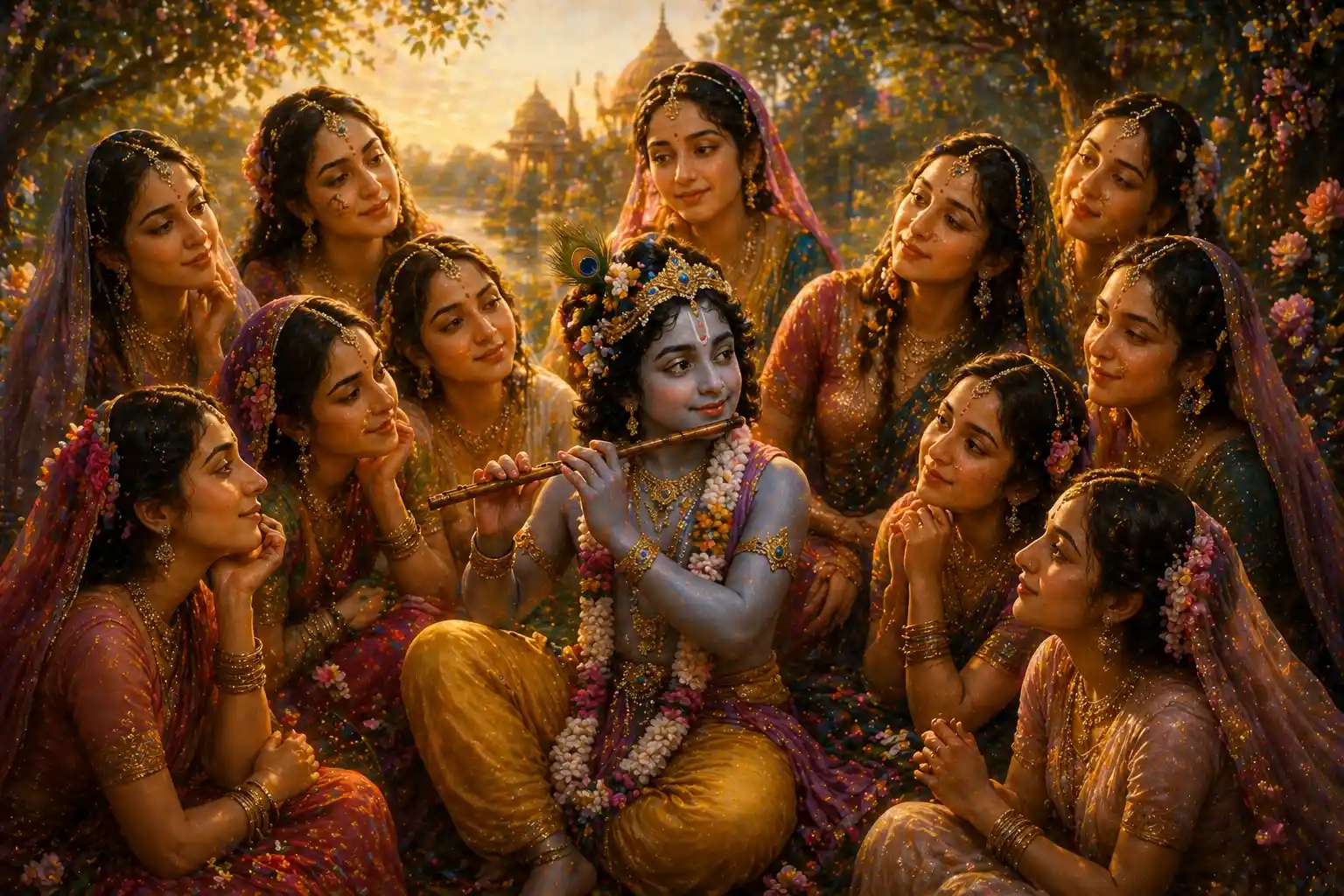
The Gopis of Braj present one of the most profound examples of devotion. Yet their story is not as simple as it appears.
In the Narad Bhakti Sutra, Sage Narad even refers to them as the acharyas of Bhakti. However, it is important to understand that he is specifically referring to a particular category of Gopis. These were the Gopis who were aware of the divinity of Shree Krishna, yet in the intensity of their love, they would forget His Godhood. When love swells to its highest state, knowledge dissolves into devotion. The gyan shakti merges into the prema shakti, and the devotee no longer relates to God through reverence alone, but through intimate love. In that state, Krishna is no longer experienced as the distant Supreme Lord, but as the beloved.
At the same time, the scriptures also describe another category of Gopis. As explained by Sage Sukdev, some Gopis possessed what is called jaar buddhi. They did not recognize Krishna as the Jagadguru or the Supreme Divine Being. Instead, they were purely enchanted by His physical beauty and charm, relating to Him as an extraordinarily attractive human. Yet, even this seemingly ordinary attraction resulted in total absorption of the mind.
This distinction is crucial. Narad glorifies those Gopis whose knowledge dissolved into love, while Sukdev explains that even those with jaar buddhi were elevated due to the intensity of their attachment. Together, these perspectives reveal a profound spiritual truth: whether through enlightened love or innocent attraction, when the mind becomes completely absorbed in Krishna, it transcends worldly limitations and moves toward the divine.
If their attraction appeared ordinary, how could it lead to liberation?
This subtle distinction between divine love and material attraction can easily be misunderstood, and it is precisely this confusion that Sage Narad addresses in his teachings.
This is beautifully clarified in the Narad Bhakti Sutra, Sutra 23:
“तद्विहीनं जाराणामिव”
(tad vihīnaṁ jārāṇām iva)
Meaning :The love of the gopis who did not have knowledge ofthe divinity of Shree Krishna was selfish and changeable
It means: without awareness of God’s divine greatness, such love appears like worldly passion between paramours. In the explanation given by Swami Mukundananda, this sutra does not diminish the Gopis’ devotion but instead protects it from misunderstanding. Even when some Gopis seemed to possess jaar buddhi, their attraction was not ordinary. It was supported by deep past sanskars and an inner spiritual connection with Krishna.
Narad is cautioning us not to mistake divine love for material desire. True bhakti is not based on selfish enjoyment, but on complete absorption in God’s happiness, God’s beauty, and God’s divine nature. This is why the Gopis are revered as the highest teachers of devotion, while ordinary worldly attachment continues to bind the soul.
This leads to an important distinction between jaar buddhi and pure devotion.
Jaar Buddhi Versus Pure Devotion
The concept of jaar buddhi offers a subtle distinction. It refers to a material or simplistic understanding, where one does not recognize the divine nature of God.
The Gopis with jaar buddhi did not know Krishna as God. Yet, their minds were completely absorbed in Him.
Pure devotion, on the other hand, involves awareness of God’s divinity along with deep love.
So what is the difference?
- Jaar buddhi leads to connection through attraction without knowledge.
- Pure devotion combines knowledge and love, leading to a richer experience.
Both can lead to transformation, but pure devotion offers greater depth and sweetness.
The Role of Past Impressions
The attraction of the Gopis was not accidental. It was rooted in deep spiritual impressions, known as sanskars, accumulated over many lifetimes. Their seemingly simple love was actually the result of profound spiritual effort in previous births.
This explains why their minds could focus so completely on Krishna. What appears as ordinary attraction is often the surface expression of extraordinary inner evolution.
In spiritual life, nothing is wasted. Every act of devotion, every moment of remembrance, contributes to the formation of these impressions. Over time, they shape the direction of the mind.
While the Gopis represent love, the story of Kansa presents a startling contrast. Kansa, the tyrannical king, is known for his intense fear and hatred of Krishna. Yet, paradoxically, he too attained a form of God realization.
To understand this, we must examine his journey.
Kansa was not always cruel. In fact, he deeply loved his sister Devaki. On the day of her wedding, he personally drove her chariot, displaying great affection and care. This moment reveals his original nature as loving and protective.
However, everything changed when a divine prophecy ঘোষণা that Devaki’s eighth child would be the cause of his death. Fear took hold of his mind, and his love turned into paranoia.
In a moment of terror, Kansa raised his sword to kill Devaki. He was stopped only when her husband Vasudev promised to hand over each child at birth.
Initially, Kansa showed restraint. When the first child was born, he spared the baby, reasoning that only the eighth child posed a threat. But this moment of kindness did not last.
This deeper absorption was not accidental, but the result of something far more profound.
The Mind: The Engine of Spiritual Transformation

To understand how both the Gopis and Kansa could attain such deep connection with Krishna, we must look at the role of the mind itself.
The mind is not just a passive observer. It is the driving force behind spiritual transformation. Whatever the mind repeatedly thinks about, it gradually becomes absorbed in. Over time, this repeated focus shapes perception, emotion, and ultimately one’s inner reality.
This is why remembrance holds such importance in spiritual life. The more the mind returns to a single object, the stronger that connection becomes. Whether through love, fear, longing, or even opposition, the mind begins to take the form of what it constantly contemplates.
In the case of the Gopis, their minds were filled with Krishna through love. In the case of Kansa, his mind was filled with Krishna through fear. Though the emotions differed, the mechanism was the same.
The mind, once fully absorbed, does not distinguish between positive and negative emotions. It simply holds on to its object with increasing intensity.
This is the deeper reason behind the principle of Vastu Shakti. When the mind connects deeply with the divine, transformation follows naturally. Not because of intellectual effort, but because of sustained inner absorption.
Narad’s Strategic Intervention
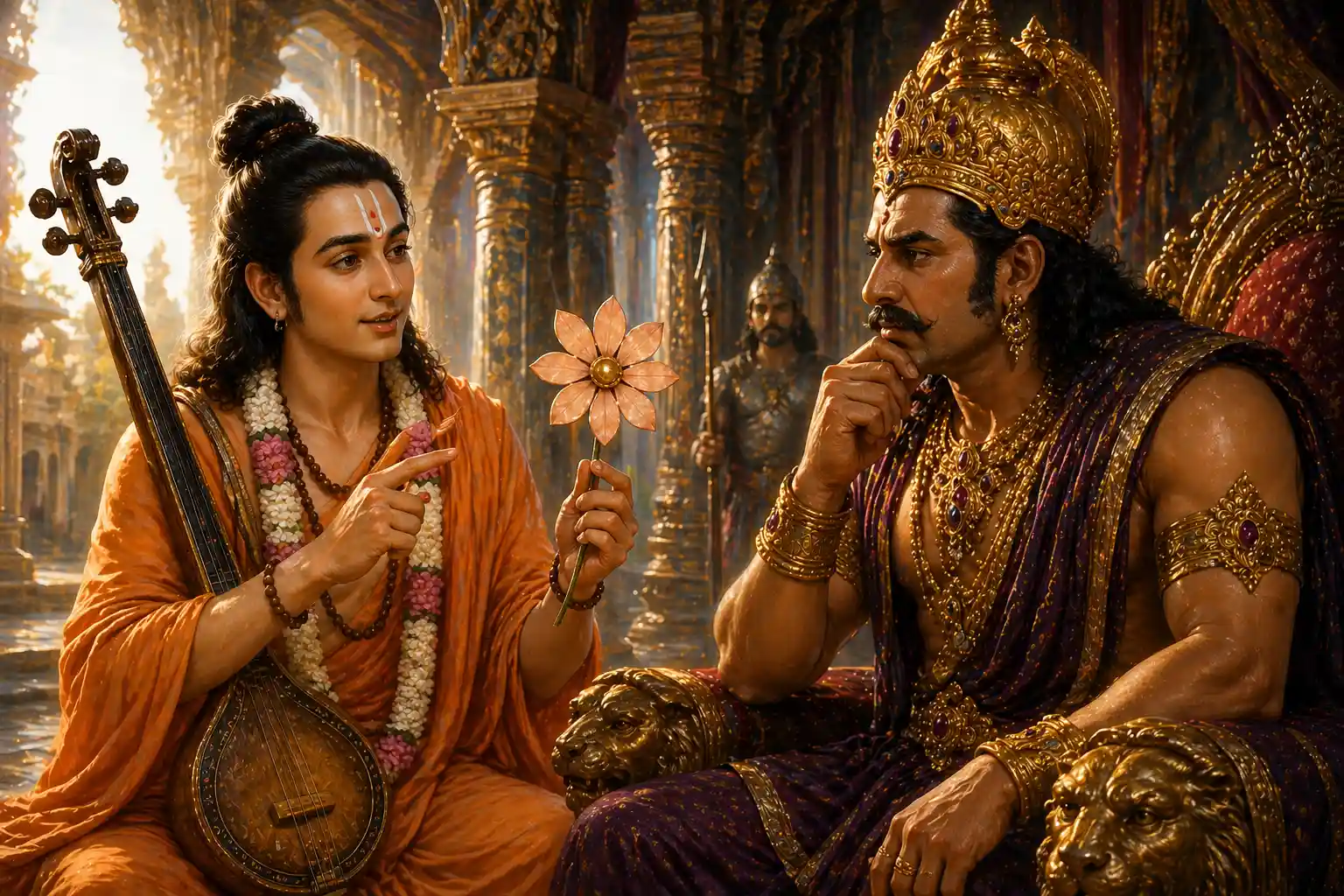
Narad, a great spiritual master, understood that divine plans often require human catalysts. He feared that Kansa’s compassion might delay the incarnation of Krishna.
To change Kansa’s thinking, Sage Narad used a simple yet clever demonstration. He showed him an eight petaled flower and explained that the identity of the “eighth” petal depends entirely on where one begins counting.
This argument planted doubt in Kansa’s mind. What if any child could be the eighth? Consumed by fear, Kansa abandoned his earlier mercy. He imprisoned Devaki and Vasudev and began killing each of their children.
At first glance, these actions appear cruel and unjust. However, within the larger spiritual perspective, they also played a role in the unfolding of a divine plan. More importantly, they triggered a transformation within Kansa himself. His fear, once awakened, did not remain occasional. It became constant. His mind, which was once attached to power and relationships, became completely absorbed in Krishna.
This is the deeper principle at work. Even though Narad’s intervention intensified fear, it ultimately directed Kansa’s consciousness toward the divine. In doing so, it demonstrated that the mind, when fully absorbed, begins to move toward God regardless of the emotion that initiated that connection.
Why Did Narad Encourage Fear?
At first glance, Narad’s actions may seem questionable. Why would a sage encourage fear and violence?
The answer lies in a broader perspective. Narad was not acting out of malice. He was facilitating the conditions necessary for the divine incarnation of Krishna.
By intensifying Kansa’s fear, Narad ensured that Kansa’s mind would remain fixed on Krishna. This constant remembrance ultimately led to Kansa’s spiritual transformation.
In this way, even negative emotions can be redirected toward a higher purpose.
Obsession as a Path to God
At one point, when King Kansa began to show signs of kindness, Sage Narad became concerned that if Kansa remained gentle, the divine incarnation might not fully unfold. To redirect the course of events, Narad once again approached him. Years later, when Shree Krishna had grown, Narad informed Kansa that the very child destined to end his life was already living in Braj. This revelation intensified Kansa’s fear to an extreme degree.
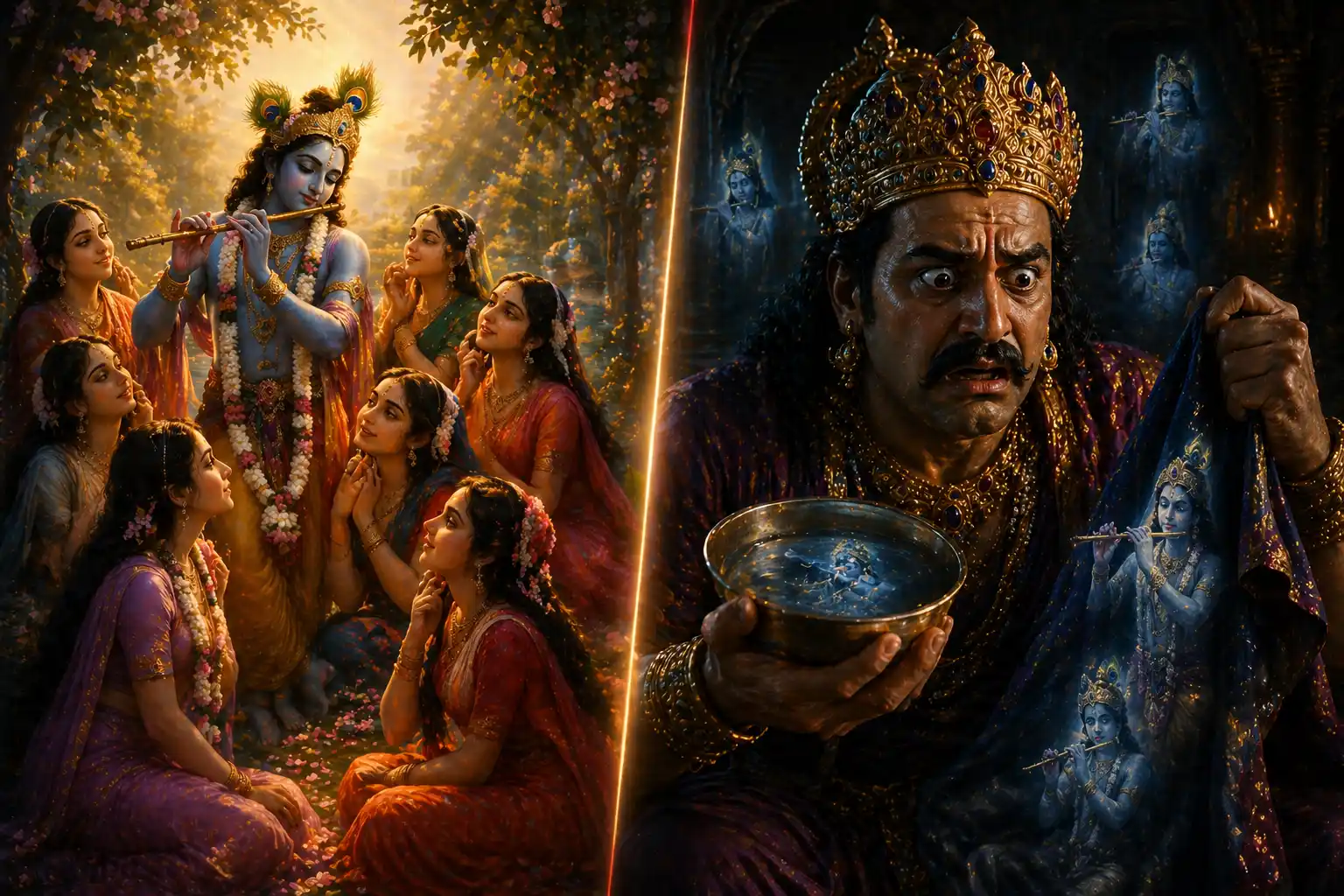
From that moment, Kansa’s mind became completely consumed. He constantly thought, “Krishna, Krishna.” Just as the Gopis saw the entire world filled with Krishna out of love, Kansa began to see the entire world filled with Krishna out of fear.
He saw Krishna everywhere:
- in his food
- in his water
- in his surroundings
- even within himself
This constant remembrance, though driven by fear, resulted in total mental absorption. This state is described as “bhayāt Kaṁsaḥ”, meaning Kansa attained absorption in Krishna through fear.
This condition is beautifully described in the Bhagavatam:
āsīnah samvishamstisṭhan bhuñjānaḥ paryaṭan mahīm
chintayāno hṛṣhīkeśham apaśhyat tanmayam jagat
(Bhagavatam 10.2.24)
Here lies the paradox. The Gopis remembered Krishna out of love, while Kansa remembered Him out of fear. The emotion was different, but in both cases, the mind became completely absorbed in the divine. However, the quality of their experiences differed. The Gopis experienced the sweetness of divine love, while Kansa remained immersed in fear and anxiety. The destination may converge, but the journey unfolds in entirely different ways.
Every Emotion as a Path
Swami Mukundananda ji presents a striking insight into the nature of devotion. The human mind does not approach God through a single doorway. It moves through many emotions such as love, fear, anger, envy, friendship, and duty. Each of these, though different in quality, has the potential to turn the mind toward the divine.
The essence of spiritual transformation lies not in the emotion itself, but in the continuity of remembrance. When the mind repeatedly returns to God, it gradually becomes colored by that presence. In this sense, even those who oppose or fear God remain inwardly connected, because their thoughts do not leave Him.
Yet, the inner experience of this connection varies. Love softens the heart and brings joy, while fear disturbs and unsettles the mind. Both can create absorption, but they do not create the same inner state.
This becomes evident in the life of King Kansa. His fear did not fade with time. Instead, it deepened until it filled his entire awareness. Krishna became unavoidable to him. Every perception, every thought, carried the imprint of that fear driven remembrance.
In contrast, the Gopis experienced that same all-pervading presence through love. These two examples reveal a subtle truth. It is not the nature of the emotion, but the depth of absorption, that determines spiritual movement.
This understanding finds resonance in the Bhagavad Gita, where Krishna accepts all who turn toward Him, regardless of their initial motivation.
Why Love Surpasses All Paths
All paths can connect.
But not all paths fulfill.
Fear binds the mind.
Love liberates it.
Fear forces remembrance.
Love makes it effortless.
Kansa reached Krishna.
But the Gopis lived Krishna.
The Gita’s Answer to All Paths
This principle finds direct support in the Bhagavad Gita, particularly in verses 7.16 and 7.17.
Verse 7.16:
चतुर्विधा भजन्ते मां जना: सुकृतिनोऽर्जुन |
आर्तो जिज्ञासुरर्थार्थी ज्ञानी च भरतर्षभ || 16||
chatur-vidhā bhajante māṁ janāḥ sukṛitino ’rjuna
ārto jijñāsur arthārthī jñānī cha bharatarṣhabha
Translation
BG 7.16: O best amongst the Bharatas, four kinds of pious people engage in My devotion—the distressed, the seekers of knowledge, the seekers of worldly possessions, and those who are situated in knowledge.
This verse acknowledges that people approach God for different reasons. Some seek relief from suffering, others seek knowledge, some desire material benefits, and a few pursue pure wisdom.
Verse 7.17:
तेषां ज्ञानी नित्ययुक्त एकभक्तिर्विशिष्यते |
प्रियो हि ज्ञानिनोऽत्यर्थमहं स च मम प्रिय: || 17||
teṣhāṁ jñānī nitya-yukta eka-bhaktir viśhiṣhyate
priyo hi jñānino ’tyartham ahaṁ sa cha mama priyaḥ
Translation
BG 7.17: Amongst these, I consider them to be the highest, who worship Me with knowledge, and are steadfastly and exclusively devoted to Me. I am very dear to them and they are very dear to Me.
These verses highlight an important truth. While all forms of devotion are valid, the highest form is steady, loving connection. It is not driven by fear or desire, but by pure love.
In verse 7.16, Lord Krishna acknowledges that people approach Him with different motivations. Some turn to Him in distress, seeking relief from suffering. Others seek knowledge, trying to understand the nature of reality. Some approach Him with desires for material gain, while a few come with genuine wisdom. All these approaches are accepted, because they represent a turning of the mind toward the divine.
However, verse 7.17 goes deeper. Krishna explains that among all these seekers, the one who remains constantly united with Him in loving devotion is the highest. This is because their connection is not dependent on circumstances. It does not arise from need, fear, or curiosity. It flows from love itself.
Such a devotee does not remember God only in times of difficulty or desire. Their mind naturally rests in Him at all times. This steady connection transforms devotion from a temporary act into a continuous state of being.
This is the difference between approaching God occasionally and living in constant relationship with Him. While all paths begin the journey, it is love that completes it.
Training the Mind: The Path to Continuous Remembrance”
All these stories point to one central truth: the mind is the key to spiritual progress.
Where the mind goes, energy flows. When the mind becomes absorbed in the divine, transformation becomes inevitable.
This is why spiritual practices emphasize:
- Meditation
- Chanting
- Prayer
- Remembrance
These practices are not merely rituals. They are tools to train the mind.
The goal is not just to think about God occasionally, but to cultivate continuous awareness.
Practical Lessons for Modern Life
These teachings are not limited to ancient stories. They have practical relevance for modern life.
- Focus matters more than perfection
You do not need perfect knowledge to begin your spiritual journey. Start with sincerity. - Emotions can be transformed
Even negative emotions can be redirected toward growth if they lead to deeper reflection. - Consistency is key
Occasional remembrance is helpful, but continuous engagement brings transformation. - Love is the highest path
While many paths exist, love offers the most fulfilling experience.
The Journey from Fear to Love
The stories of the Gopis and Kansa represent two ends of a spectrum. One is rooted in love, the other in fear.
Both lead to connection, but their experiences differ vastly.
Spiritual growth involves moving from lower emotions to higher ones. From fear to trust. From desire to contentment. From attachment to love.
This journey is gradual, shaped by practice and grace.
Key Takeaways
- The mind is the gateway to God
Spiritual transformation begins when the mind becomes deeply absorbed in the divine, regardless of how that connection starts. - Vastu Shakti works beyond intellect
The principle “na vastu shaktir buddhim apekshate” teaches that divine grace does not depend on intellectual understanding, but on connection. - Different emotions can lead to the same destination
Love, fear, anger, or even curiosity can all direct the mind toward God, as seen in the lives of the Gopis and Kansa. - Absorption matters more than intention
The intensity and constancy of remembrance are more important than the initial motivation behind devotion. - Not all paths feel the same
While both love and fear can lead to God, love brings peace and sweetness, while fear brings anxiety and unrest. - Gopis represent the highest form of devotion
Their love transcended knowledge, where gyan shakti merged into prema shakti, making their devotion pure and selfless. - Kansa illustrates the power of negative absorption
His fear led to constant remembrance of Krishna, demonstrating that even विरोध or भय can bind the mind to God. - Narad Bhakti Sutra clarifies true devotion
It warns against mistaking divine love for material attachment and emphasizes God-centered love over selfish desire. - Bhagavad Gita validates multiple approaches
As stated in Bhagavad Gita (7.16–7.17), people approach God for different reasons, but the highest path is steady, loving devotion. - The journey evolves toward love
Even if one begins with fear or desire, the ultimate goal is to develop pure, loving connection with God.
Conclusion
The divine power of God (Vastu shakti) completely transcends human intellect, intention, and spiritual understanding
Just as a patient does not need to understand the composition of a medicine for it to work, and just as a philosopher’s stone transforms iron into gold regardless of how it is touched, the grace of Lord Krishna's grace transforms any soul that completely absorbs its mind in Him.
This truth is illustrated through two striking examples The Gopis immersed in love, experienced such intense devotion that some even forgot Krishna’s divinity in their longing. Others, seemingly drawn by His beauty, attached their minds to Him through jaar buddhi. In contrast King Kansa's ,mind was consumed by fear and obsession after repeated warnings from Sage Narad. Yet ,Despite their drastically different driving emotions—pure love versus sheer fear—both the Gopis and Kansa saw the entire world filled with Krishna. Because their minds were completely fixated on the Supreme Lord, both ultimately achieved liberation and God realization
This reveals a profound principle. It is not the emotion itself, but the depth of absorption that determines spiritual transformation. However, while fear can bind the mind, love elevates it with sweetness and joy.
As Swami Mukundananda ji explains, even seemingly ordinary attraction toward God is not accidental. like the Gopis' physical attraction, is not a simple coincidence. Their deep devotion was actually propelled by tremendous past spiritual impressions (sanskars) and great austerities (tapasya) performed over many lifetimes, which allowed them to completely fix their intellect on the Lord and transcend the material world
Ultimately, the journey of devotion is not defined by how one begins, but by how deeply one connects. When the mind turns fully toward God, His grace begins to act, quietly transforming the soul and leading it beyond the limitations of the material world.
Call To Action
🌟 Final Call to Action
👉 For more life-changing teachings, subscribe to the official YouTube channels:
👉 Watch the complete Narad Bhakti Sutra series on the Bhagavad Gita Krishna Bhakti Channel:
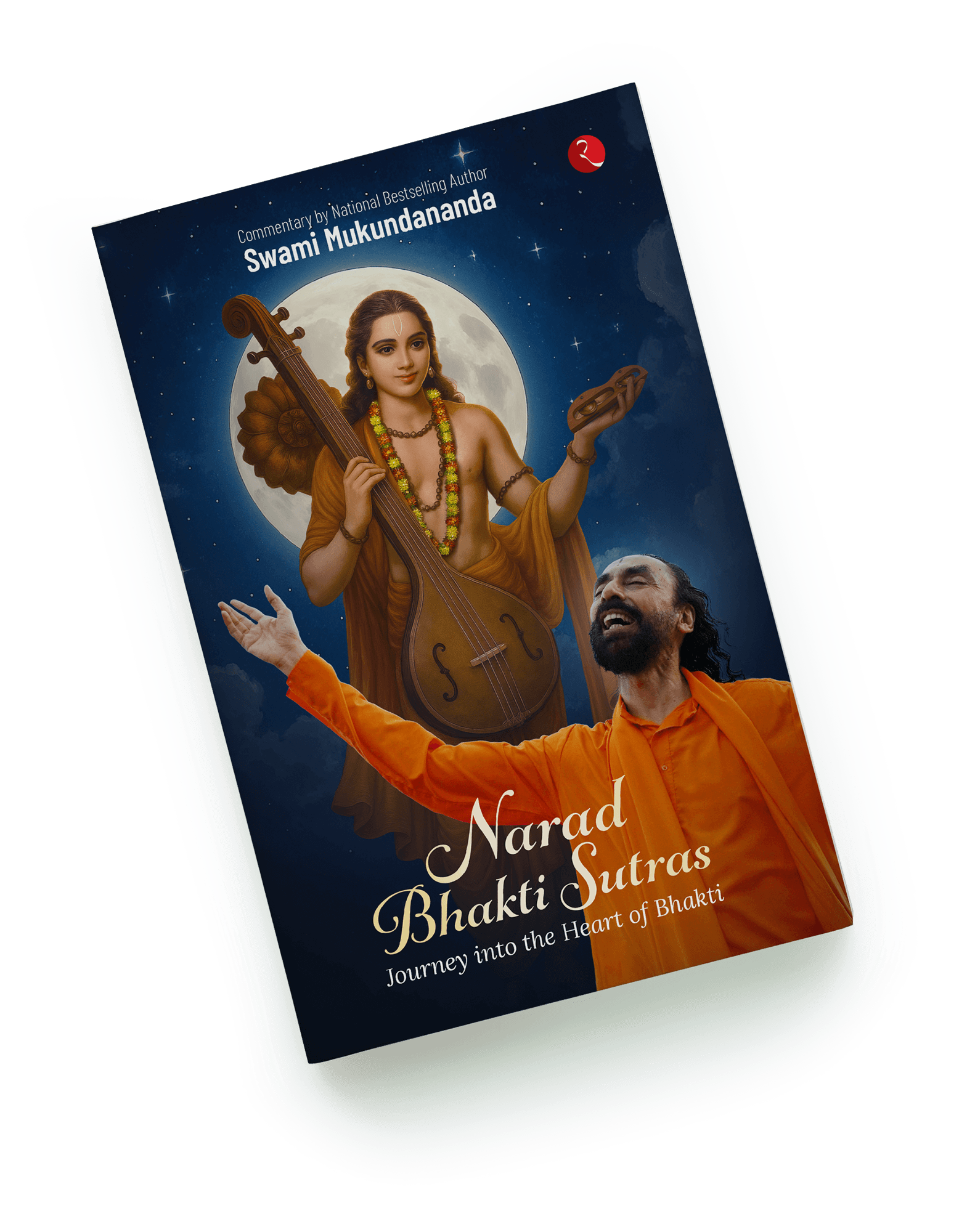
Buy the "Narad Bhakti Sutras" by Swami Mukundananda
Now that we’ve explored the divine wisdom of the Narad Bhakti Sutras, it’s time to take the next step on your spiritual journey. To deepen your understanding of the Narad Bhakti Sutras, we highly recommend Swami Mukundananda’s commentary, which beautifully unpacks each mantra providing a clear and practical guide for modern seekers.
Order the Book: Swami Mukundananda’s Commentary
Unlock the deeper wisdom of the Narad Bhakti Sutras with this insightful commentary by Swami Mukundananda. Perfect for modern seekers who wish to explore the divine teachings in greater depth.
Order the Book Now (India)Order the Book Now (USA)
FAQs
1. What is Vastu Shakti and why is it important in devotion?
Vastu Shakti refers to the inherent power of the divine that operates independently of human understanding. It means that when the mind connects with God, transformation occurs regardless of intellectual awareness. This principle explains how both the Gopis and Kansa attained divine connection through different emotions.
2. How could the Gopis attain liberation without knowing Krishna’s divinity?
Some Gopis were not intellectually aware of Krishna’s supreme nature and were attracted to Him through jar buddhi. However, their deep past sanskars and intense mental absorption allowed them to transcend material attachment and experience divine realization.
3. Why did Sage Narad encourage fear in King Kansa?
Narad’s actions were not driven by malice but by a higher spiritual purpose. By intensifying Kansa’s fear, he ensured that Kansa’s mind remained constantly fixed on Krishna, ultimately leading to continuous qremembrance and spiritual transformation.
4. Can negative emotions like fear or anger lead to God?
Yes, according to the teachings explained by Swami Mukundananda, any emotion that deeply absorbs the mind in God can become a pathway to Him. However, while fear can create connection, love remains the most fulfilling and peaceful path.
5. What do Bhagavad Gita 7.16 and 7.17 teach about devotion?
The Bhagavad Gita explains that people approach God for different reasons such as distress, desire, curiosity, or wisdom. Among them, the one who remains constantly connected in loving devotion is considered the highest, emphasizing the importance of steady and deep attachment to God.
For Further Reading
To deepen your understanding of devotion, the nature of the mind, and the path of Bhakti, you may explore the following blogs
 JKYog Team
 JKYog Team