
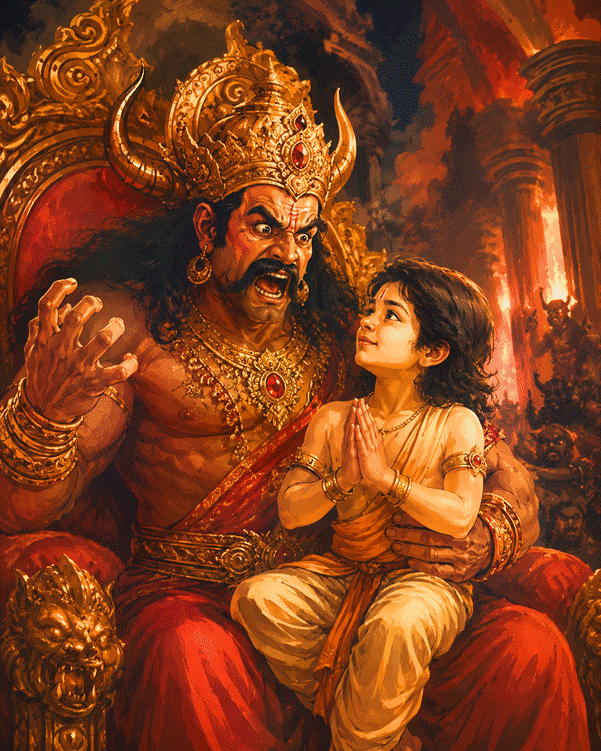
Hiranyakashipu sat eager to hear what demonic arts his five-year-old son Prahlad had mastered under the tutelage of Shand and Amark. Drawing the boy affectionately onto his lap, he asked “My child, tell me, what have you learned?” Prahlad replied earnestly, “Pitaji, I have learned Navadha Bhakti—the ninefold devotion to Lord Vishnu.”
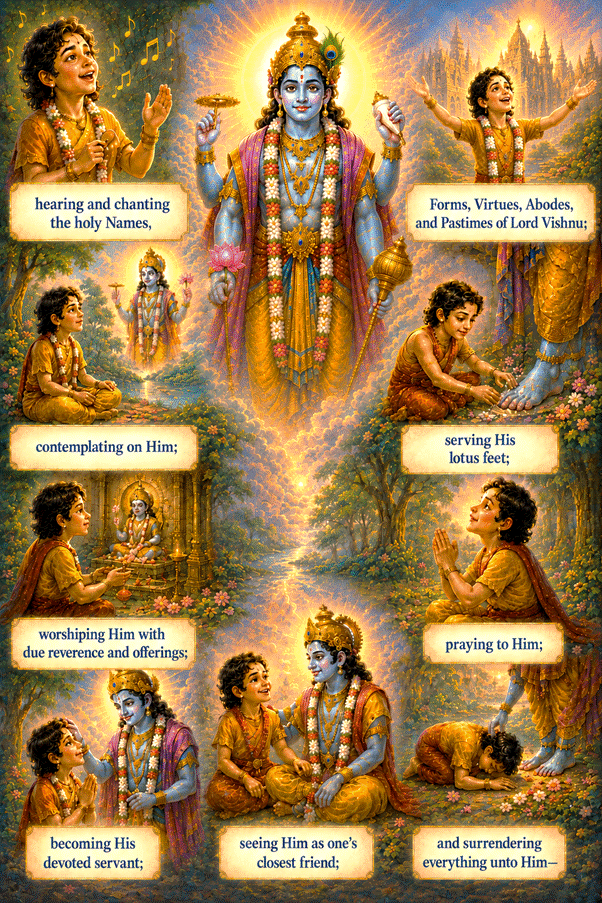
श्रवणं कीतनं वष्णो: स्मरणं पादसेवनम् अचनं वन्दनं दास्यं सख्यमात्मनवेदनम् इत पुंसापंता वष्णौ भक्तश्चेन्नवलक्षणा ~ Verse 7.5.23
Hearing and chanting the holy Names, Forms, Virtues, Abodes, and Pastimes of Lord Vishnu; contemplating on Him; serving His lotus feet; worshiping Him with due reverence and offerings; praying to Him; becoming His devoted servant; seeing Him as one’s closest friend; and surrendering everything unto Him—constitutes the essence of true devotion.
The moment Hiranyakashipu heard the name of Vishnu, his affection vanished. “My own son… lauding my sworn enemy!” he seethed. At once, he lifted Prahlad and threw him onto the floor.
Navadha Bhakti later became revered throughout the bhakti tradition. Chaitanya Mahaprabhu glorified it, “भजनेर मध्ये श्रेष्ठ नव-विधा भक्ति”—Among all devotional practices, the ninefold devotion is supreme.
Bhakti Unshaken
Hiranyakashipu bristled with fury as he turned to Shand and Amark. “What is wrong with you two? Is this what you have taught my son?” he thundered. Before the terrified teachers could answer, Prahlad intervened with a serenity far beyond his years. “Father, do not blame them. Can bhakti merely be taught? It is received by the grace of God.”
Shand and Amark folded their hands before their king, “Maharaj, please give us one more chance.” Still fuming, Hiranyakashipu reluctantly permitted them to instruct Prahlad again. But all their efforts were in vain. They taught him politics, diplomacy, warfare, yet Prahlad’s lips uttered only the Lord’s Name, while his heart remained absorbed in divine remembrance. Turning him away from God was like separating fragrance from a flower.
One day, when Shand and Amark had briefly stepped away, the other young demon princes gathered around Prahlad and urged him to join their games. He only smiled. Worldly amusements held no charm for him. “Let me show you another kind of game,” he said, “the one my Guru taught me.” The boys blinked in confusion. “Your Guru? Aren't Shand and Amark your teachers?” Prahlad shook his head, “My Guru is Sage Narad. While I was still in my mother’s womb, I received knowledge from him. Let me tell you what I learned.”
कौमार आचरेत्प्राज्ञो धमान्भागवतानह ।
दुलभं मानुषं जन्म तदप्यध्रुवमथदम् ॥ 7.6.1 ॥
A wise person should utilize the rare gift of the human form—right from its early stages—to engage in devotional service, setting aside all other pursuits. The human body is merited rarely to a soul and although this is also temporary like other bodies, it holds unique significance as it offers the opportunity to serve the Lord. Even a small measure of sincere devotion can make one progress towards perfection.
Many believe bhakti is meant for old age, as though God should be remembered only after worldly ambitions are exhausted. But who is truly old? Anyone standing near death. Since death keeps no calendar, a child may stand closer to it than a centenarian. Therefore, Prahlad advised: devotion should never be postponed. The call of God is not for tomorrow; it is for now.
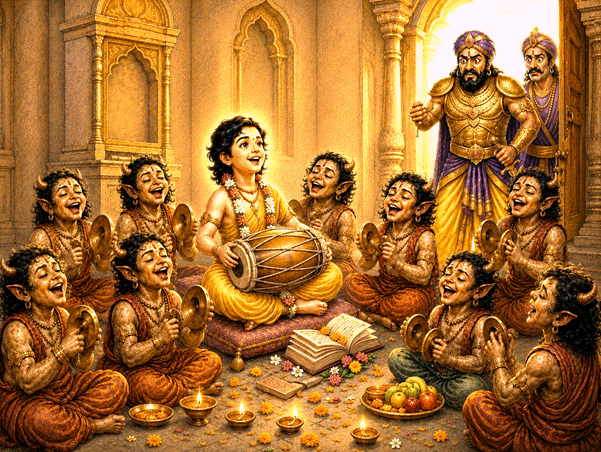
As Prahlad spoke, he handed manjiras to the boys and taught them kirtan. Before long, the gurukul that once rang with lessons of conquest resounded with the Names of the Lord. When Shand and Amark returned, they froze in disbelief. Before them stood an entire gurukul immersed in chanting. “One rotten potato spoils the whole basket,” they muttered, before rushing to report the matter to Hiranyakashipu.
The band of little demon children marched behind Prahlad all the way to the palace, singing the glories of God. Bitter and defeated, Shand and Amark said to their king, “Maharaj, your son is incorrigible. He will never change.” At that, the last strand of Hiranyakashipu’s patience snapped. His face darkened with brutal resolve as he pronounced the order:
“Enough. Get him killed.”
The Pillar That Roared
Hiranyakashipu’s servants tried every cruel means to end Prahlad’s life. They tried crushing him beneath the feet of elephants, plunging him into pits of venomous serpents, flinging him from towering cliffs. Yet every attempt failed. Even when Holika, Hiranyakashipu’s sister, sat with Prahlad upon a blazing pyre, the flames consumed her while he emerged unscathed.
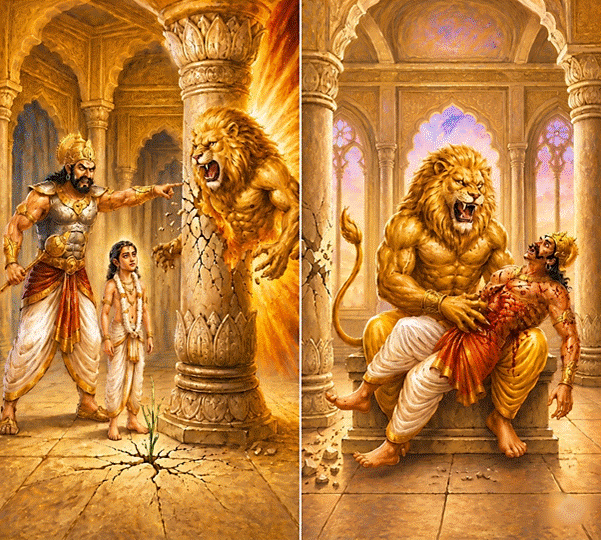
At last, the weary attendants returned to their king: “What kind of child is this? We have tried everything, yet we cannot kill him.” Enraged, Hiranyakashipu turned to his son. “This Narayan you worship,” he challenged, “where is He?” Prahlad answered, "Father, He is ‘Sarvatra’—He is everywhere. He dwells within you, giving you the power to speak. He is within me, within this blade of grass… and even within this stone pillar.”
Hiranyakashipu scoffed, “God is in this pillar? Why can I not see Him then?” With a clenched fist, he boxed the pillar. In that instant, the stone pillar split apart. From within emerged the ferocious Form of Narsingh Bhagavan—half-lion, half-man.
Through this avatar, the Lord revealed: Yes, I am in the temple, but do not think I exist only there. The entire world is My temple; I am everywhere. Thus, He is called Ghat-Ghat Vasi—the One who dwells within every atom of creation.
The Ishavasya Upanishad states,
ईशावास्यमिदं सर्वं यत्किञ्च जगत्यां जगत्॥ ~ Verse 1
God is everywhere in the world.
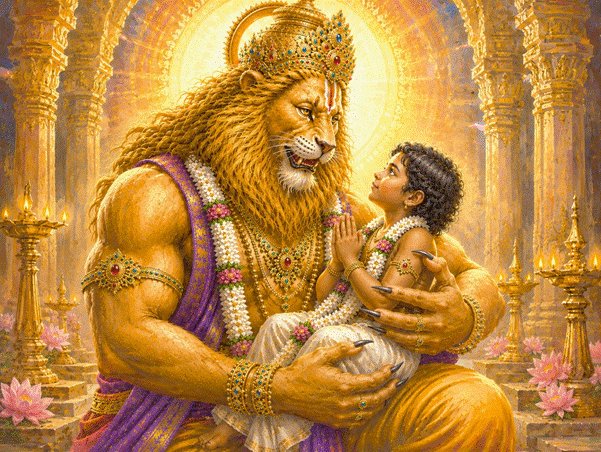
Narsingh Bhagavan grabbed Hiranyakashipu and placed him upon His lap. Then, shattering every clause of the boon the demon had so cunningly crafted, He declared,
“Look, it is neither day nor night; it is sandhya.”
“I am neither man nor beast; My head is that of a lion, My body that of a human.”
“You are neither in sky nor on earth; you are upon My lap.”
“And I am not killing you with any astra or shastra; but with My own nails.”
With that, He ripped Hiranyakashipu apart. As the tyrant fell, the celestial devatas showered flowers from above. Yet the slaying of Hiranyakashipu was not the greatest wonder of this leela. The Lord can destroy any demon in any incarnation.
The truly extraordinary moment was still to come…
A Selfless Boon
After killing Hiranyakashipu, Narsingh Bhagavan roared and danced in divine fury. The celestial gods quailed from afar, too frightened to approach His fearsome Form. But little Prahlad stepped forward without hesitation. What had he to fear? Before him stood his Eternal Father. The moment the Lord’s eyes fell upon His beloved devotee, His wrath melted away. Lifting Prahlad tenderly into His arms, He said, “My child, I am pleased with your devotion. Ask for whatever boon you desire.”
Then came a reply that left even the Supreme Almighty speechless.
Prahlad bowed humbly. “O Lord, I am Your servant, and the duty of a servant is not to ask, but to serve. If I seek a reward for devotion, I will no longer remain Your servant—I will become a businessman. ‘I have done this for You, now You do this for me.’ But if it is Your command that I ask, then I shall obey and ask you for something.”
यद रासाश मे कामान्वरांस्त्वं वरदषभ ।
कामानां हृद्यसंरोहं भवतस्तु वृणे वरम् ॥ 7.10.7 ॥
O my Lord, supreme among all who grant blessings, if You wish to bestow a boon upon me, I humbly ask that my heart be completely free from all material desires.
“You are antaryami—the indwelling witness who knows every hidden thought. If even a trace of selfish desire lingers within me, please destroy it completely, and let me remain forever Your pure devotee.” Thus, by asking never to ask, Prahlad sealed his path of Nishkam bhakti (selfless devotion).
Prahlad continued,
वमुञ्चत यदा कामान्मानवो मनस स्थतान् ।
तह्यव पुण्डरीकाक्ष भगवत्त्वाय कल्पते ॥ 7.10.9 ॥
O my Lord, when a person relinquishes all material desires from within their mind, they become divine and godly like You.
Even at such a tender age, Prahlad understood a truth that eludes most of humanity: desires never end. One craving begets another, forging an endless loop of discontent. Yet, the moment a soul stops asking from God, its consciousness begins to reflect the purity of God Himself, free from all selfish desires. Besides, what can we truly ask from the One who possesses everything? To seek worldly pleasures from God is like trading a priceless jewel for broken pieces of glass. But when we surrender our ‘wanting,’ God bestows the greatest treasure—He becomes enslaved by His devotee’s love.
As the ancient saying goes,
"Bin maange moti mile, maange mile na bhik"
Prahlad then prayed for the welfare of all. “Maharaj, please liberate all souls from maya, and may my father attain welfare.” Bhagavan replied, “Prahlad, by the power of your devotion, twenty-one generations of your ancestors have already been blessed.” Such is the glory of bhakti that when a pure devotee takes birth in a lineage, even the ancestors in the celestial realms rejoice, knowing divine grace shall reach them as well.
As for the liberation of all souls, Bhagavan revealed a cosmic truth: while countless souls journey towards the Divine, the wheel of creation continues as others enter the stream of existence. Yet through this prayer, Prahlad expressed the spirit of paropkar—selfless concern for the well-being of others.
Bhagavan then blessed Prahlad, instructing him to inherit the throne and rule the kingdom. He assured that once his earthly duties were fulfilled, Prahlad would ascend to the Divine Abode. Thus, Prahlad reigned as a noble monarch. His son was Virochan, who fell again into demonic ways. And Virochan’s son was Daityaraj Bali, another exalted soul whose katha awaits in the pages ahead…
Frequently Asked Questions
Question: Why does Prahlad ask for freedom from selfish desires instead of moksh (salvation) itself?
Answer: Many scriptures and philosophical systems describe moksh as life’s ultimate goal. It frees the soul from material bondage and suffering. Yet on the path of divine love, even moksh is set aside. Because the desire for salvation still carries an element of self-interest: “May I become free from suffering.” A true devotee, however, seeks only to love God for His pleasure.
Hence, in the Ramcharitmanas, Bharat Maharaj prays:
अरथ न धरम न काम रुचि, गति न चहउँ निरबान।
जनम-जनम रति राम पद, यह बरदानु न आन॥
“O Lord, I desire neither dharma, arth, kaam, nor even moksh. In birth after birth, may I simply have a loving attachment to Your lotus feet.”
In the Bhagavatam, Ved Vyas goes beyond the traditional four purusharthas—dharma, arth, kaam, and moksh—and speaks of a higher goal: prem bhakti, divine love, the fifth and supreme purusharth. For a richer immersion on why devotees reject salvation, watch: The Highest Goal of the Soul — Why Krishna Bhakti Goes Beyond Liberation.
Question: If God is everywhere, why do we struggle to feel His presence?
Answer: Maharishi Shandilya gives this analogy: milk exists within the body of the cow, yet the cow itself may remain sick and unwell. The milk must first be extracted, converted into yogurt, mixed with black pepper, and then fed back to the cow for it to regain strength. The milk was present in its own body, but it was not helpful in that form. Similarly, God is indeed everywhere, but merely knowing this intellectually is not enough. To realize this truth, one must engage in bhakti. Through sincere devotion, the heart is purified, and one then begins to perceive His presence.
If you seek practical ways to deepen your awareness of God amid daily life, you may read: Practicing the Presence of God: A Path to Spiritual Enlightenment. The God-centered life of Brother Lawrence also offers heartfelt inspiration.