
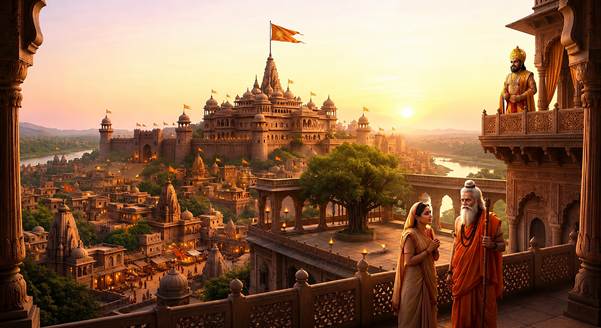
Dashrath, son of Aj, grandson of Raghu, and great-grandson of Dilip, was the scion of the glorious Suryavansh. He now reigned upon the throne of Ayodhya, and the flag of the Raghukul fluttered high above the royal palace. Prosperity bloomed across the kingdom, and its people counted themselves fortunate to live under such a noble sovereign.
King Dashrath had three queens—Kaushalya, Kaikeyi, and Sumitra. Yet he remained childless. However, this caused him little concern, for he felt no pressing urge to have a child. The Guru of the Raghukul was Sage Vasisht. One day, his wife, Arundhati, approached him with a question that had long lingered in her mind. "Have you thought about who will inherit the throne after Dashrath?" she asked. "He has no child…"
Prelude to an Avatar
“I have pondered over this myself,” Vashishth murmured, gazing into the distance.
“Can you not perform Vedic sacrifices for King Dashrath to beget a child?” Arundhati asked.
“I can,” he replied with a sigh. “But the king himself holds no desire to have children.”
Arundhati’s eyes gleamed with resolve. “Then I shall kindle that longing within him.”
Vashishth smiled. “So be it.”
A few days later, Arundhati stepped into the palace chambers, her infant grandchild nestled in her arms. The queens welcomed Guru Ma with reverence and eagerly gathered around her. Just then, King Dashrath returned from the court. At the sight of Arundhati, he at once bowed down to offer his deepest respects.
Seizing the moment, Arundhati subtly pinched her grandchild, causing the baby to burst into tears. Startled, Dashrath looked up. “Why is the Guru-putra crying?” Arundhati replied deftly, “He weeps because he wonders: Vashishth is the Guru of Dashrath, but whom shall I be the Guru of? Dashrath has no children to carry on the lineage.” Her words struck a hidden chord within Dashrath. For the first time, amid the splendor of his kingdom, he became acutely aware of what was missing.
Soon afterward, Dashrath approached Sage Vashishth with humility. “Gurudev, is there any way by which I may be blessed with children?” Vashishth looked at him thoughtfully. "There is a way. Long ago, Bhagavan Himself gave me His word that He would one day descend in Raghukul, and I would have the privilege of serving as the Kulguru. The moment foretold by Him has now arrived. A Putrakameshti yagya must be performed."
In those days, only one Brahmin in the entire Bhumandal was qualified to conduct such a sacred undertaking—Shringi Rishi. Vashishth summoned him to Ayodhya, and the yagya commenced.
सृंगी रिषिहि बसिष्ठ बोलावा। पुत्रकाम सुभ जग्य करावा॥ ~ Ramcharitmanas
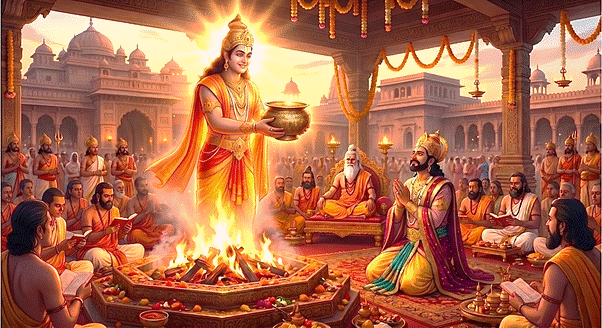
As the final oblations were offered, a celestial chime reverberated through the skies, signalling the successful completion of the sacrifice. From the kund itself emerged Agnidev (the god of fire), radiant and resplendent. In his hands, he carried a divine vessel with the yagya-prasad. Presenting it to Dashrath, he declared, “Distribute this among your queens as you wish.”
Dashrath poured half of the sacred offering into the hands of his eldest queen, Kaushalya, and half of the remainder into Kaikeyi's hands. Aware of Kaikeyi’s volatile temperament and wishing to preserve harmony in the household, he divided the last portion equally between them and said, “Please offer these to Sumitra.” The two queens gladly complied. Sumitra accepted the portions with tears of gratitude and made a solemn vow: “My children shall live only to serve yours.”
Arrival of Lord Ram
Time seemed to fly by.
The residents of Ayodhya waited with bated breath, their hearts brimming with anticipation for the children soon to be born to King Dasharath. At last, the blessed month of Chaitra arrived. The great sages, realizing that the Supreme was about to descend upon Earth, left their hermitages and gathered along the serene banks of the River Sarayu. Soon, the region overflowed with Mahatmas. Even the Sarayu could not contain herself; her waters swelled with unusual fullness.
When an astonished onlooker asked, “O holy river, why do you flood in the dry month of Chaitra?” Sarayu answered, “I am not flooding. I am ahlaadit—overwhelmed with bliss. It is my joy that expands my waters.”
At last, the auspicious Navami Tithi dawned.
That morning, Surya Devata rose in delight, thinking: In my own dynasty, the Supreme Lord is about to descend! He climbed proudly toward the zenith. The celestial beings, too, gathered to witness the spectacle. Brahma ji, however, intervened. Since God reveals Himself only to the spiritually qualified (adhikaris), he cautioned them against announcing the Lord’s arrival and bade them depart.
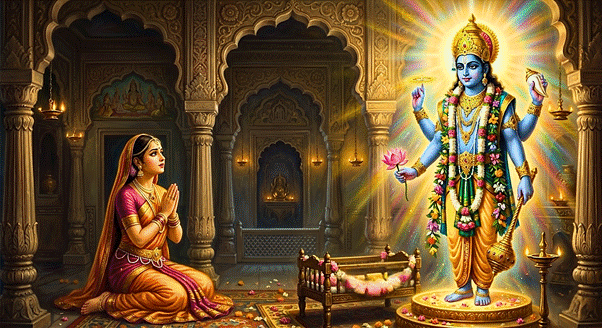
As the clock ticked toward Madhyan, a cool, fragrant breeze swept the land. The sacrificial fire pits (Agni kunds) spontaneously ignited, blazing with pure flames. Brahmins, immersed waist-deep in the shimmering waters for their midday prayers, began chanting the Gayatri Mantra. At that auspicious hour, Kaushalya’s womb became empty, and Bhagavan manifested.
Yet He did not appear as an ordinary infant.
भए प्रगट कृपाला परम दयाला कौसल्या हितकारी।
हरषित महतारी मुनि मनहारी अदभुत रूप बिचारी॥
लोचन अभिरामा तनु घनस्यामा निज आयुध भुज चारी।
भूषन बनमाला नयन बिसाला सोभासिंधु खरारी॥ ~ Ramcharitmanas
Dark as a rain laden cloud, with vast lotus-like eyes and adorned with celestial ornaments and a forest-flower garland, He bore His divine weapons in four hands.
The Lord appeared in His magnificent (four-armed Vishnu Form) Chaturbhuj Swaroop. Beholding this wondrous vision, Kaushalya was spellbound. “What is this, Maharaj?” she exclaimed, her voice quivering with awe. Bhagavan replied, “In your previous life, I gave my word that I would appear as your child. Today, I fulfill that vow.”
Overwhelmed, Kaushalya said, “O Lord, You promised to come as my child, yet before me You stand as the Supreme Father of all worlds. How can I think of You as my son in such a majestic Form?” With a serene, omniscient smile, the Lord responded, “I only wished to reveal My identity to you, so that no illusion or confusion could ever cloud your mind regarding who I am.”
She then implored, “O Dear Lord, please hide this cosmic Form. Please perform instead the innocent, endearing pastimes of a newborn.” Hearing her heartfelt plea, the all-powerful Lord set aside His divine weapons and withdrew His grandeur. The four-armed Form vanished, and in its place lay a helpless infant. His first cry filled the chamber with indescribable sweetness. Thus, appeared Ram, ushering in the Nar-Leela that would grace the Earth.
One of the most astonishing aspects of bhakti is that the Infinite allows Himself to be bound by love. The same Supreme Being worshipped by the gods accepts the role of a vulnerable child to reciprocate the affection of His devotees.
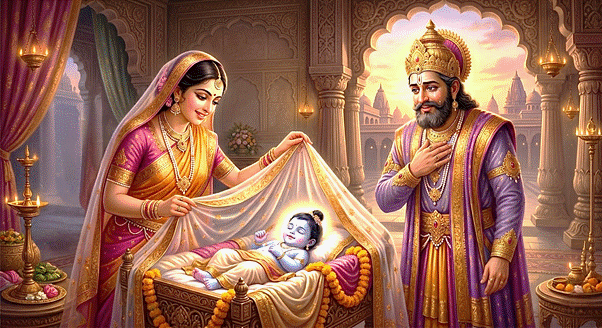
The news reached King Dasharath: a son had been born to Queen Kaushalya. Beaming with ecstasy, he rushed through the palace corridors to her chambers. “Please,” he gasped, “let me have darshan of the child!” Kaushalya gently pulled back the veil, and there lay the all-beautiful baby Ram. Beholding his son, Dashrath felt his heart soar. As the tidings spread, Ayodhya blossomed into celebration. The streets filled with music, laughter, and devotion as the citizens rejoiced at the birth of their beloved Ram.
Names Etched in Eternity
Having reached his highest meridian, Surya Devata refused to budge, transfixed by the beauty of the newborn Lord. Chandrama, growing frantic, pleaded, "Move along! If you block the sky, how will I ever catch a glimpse of Him?"
Surya struck a bargain. "Be patient. In the next age, the Lord will descend into your Chandravansh lineage."
"But that will not be until the Dvapara Yug," Chandrama protested. "We are still in the Treta Yug."
"Very well," Surya conceded. "In this very incarnation, He shall append your name to His, and the world will call Him Ramchandra."
Meanwhile, the festivities in Ayodhya reached a fever pitch. News soon arrived that Queen Kaikeyi had also given birth to a son, multiplying the joy of the people. Moments later, word spread that Queen Sumitra had been blessed with two children. The rejoicing knew no bounds.
In due course, King Dashrath requested Guru Vasisht to perform the sacred naming ceremony for the four princes. Taking the eldest child into his lap, Vasisht pronounced:
जो आनन्द सिंधु सुखरासी। सीकर तें त्रैलोक सुपासी॥
सो सुखधाम राम अस नामा। अखिल लोक दायक विश्रामा॥ ~ Ramcharitmanas
"This child is an ocean of divine bliss. He will bring peace and rest to all who remember Him. Therefore, I name Him Ram."
Turning to the second prince, Vasisht declared: "This child will nourish and sustain the people through his bharan-poshan. Therefore, I name him Bharat."
Looking at the third, he proclaimed, "He will be a treasure-house of noble qualities—lakshanon ki khaan." Thus, he named him Lakshman.
Finally, Vasisht gazed upon the youngest. "This child will be the destroyer of enemies. I name him Shatrughna." Interestingly, scriptural history rarely depicts Shatrughna slaying any demons on the battlefield. His warfare was of a different kind. He turned his battles inward and conquered the enemies within, such as ego, anger, desire—the foes that bind the soul.
Thus, the four sons of Dashrath were named. Though the epic of Lord Ram spans volumes, the Ram Katha in the Bhagavatam is encapsulated in just thirty-two verses across one and a half chapters.
Step into the enchanting world of His divine pastimes—in the next episode.
Frequently Asked Questions
Question: What makes Lord Ram’s birth different from an ordinary one?
Answer: Unlike ordinary souls, who take birth under the influence of karma and material nature, Bhagavan appears by His own free will. He is never forced into a body nor bound by it. The All-Blissful Lord need not hang upside down in a mother’s womb. However, by His Yogmaya power, He created in Kaushalya the feeling that He was present in her womb, and continually expanded it. In the end, He manifested from the outside, revealing that He had never actually been inside her. Thus, God’s appearance is not a birth in the ordinary sense, it is a divine descent. The Bhagavad Gita Verse 4.9 states, जन्म कर्म च मे दिव्यमेवं, His birth is divine. You may explore this subject in greater depth in the video: Did God Ever Enter a WOMB? | By Swami Mukundananda
Question: In Indian spiritual history, there have been other prominent figures who had the same name: Ram and Bharat. Can you please clarify?
Answer: Among those named Ram, three stand out prominently: Bhargav Ram (Parashuram), the warrior-sage and sixth incarnation of Vishnu; Yadav Ram (Balaram), the elder brother of Shree Krishna; and Raghav Ram (Lord Ram), the prince of Ayodhya, the embodiment of virtue, compassion, and divine bliss. The name Bharat has also adorned great personalities throughout history. Among them are Bharat, son of Shakuntala, famed for his extraordinary courage; Bharat Maharaj, the son of Rishabhdev; and Dashrath Nandan Bharat, (the younger brother of Lord Ram), celebrated for his selfless devotion.
Video Resource
When Lord Vishnu became Shree Ram - The Secret of Ram Avatar in Ramayana | Swami Mukundananda