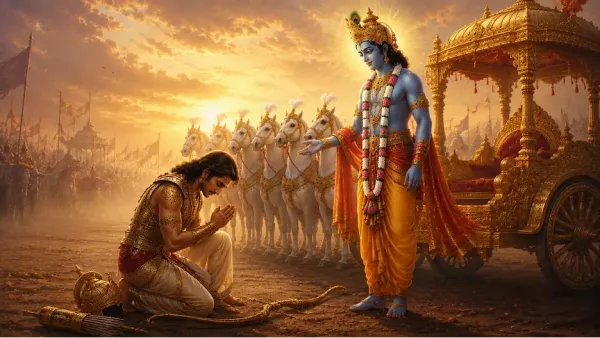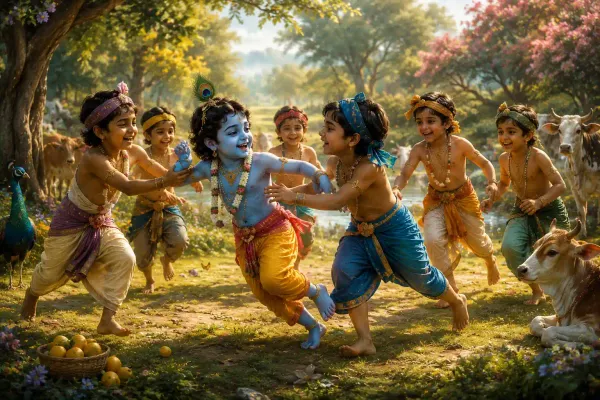
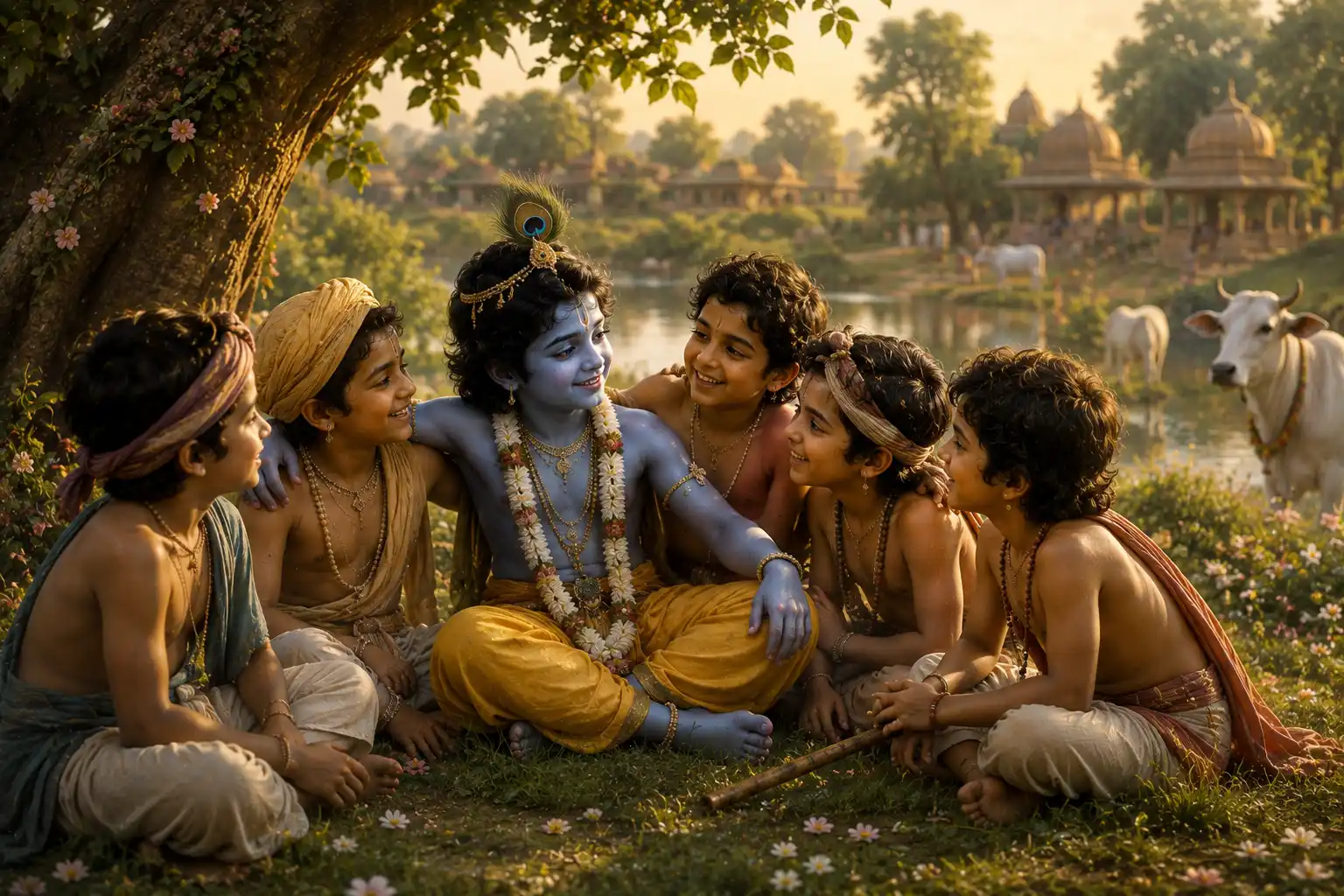
"The Lord of countless universes chose not only to be worshipped, but also to be loved as a friend. In the forests of Braj, beneath the shade of blossoming trees and the melodies of birds, the Supreme Being revealed that the sweetest relationship with God is one in which love leaves no room for fear."
The God Who Wants to Be Your Friend
When people think of God, they often imagine an all-powerful Being seated upon a magnificent throne, surrounded by celestial splendour and worshipped with awe by saints, sages, and angels. Such reverence is natural, for the scriptures proclaim that Shree Krishna is the Supreme Divine Personality, the source of all creation, the sustainer of countless universes, and the indwelling Lord residing within every heart. It was this same Krishna who effortlessly lifted Govardhan Hill upon His little finger, subdued the thousand-hooded serpent Kaliya, and destroyed mighty tyrants such as Kans with divine ease.
Yet, among all His extraordinary pastimes, it is not these displays of omnipotence that most deeply capture the hearts of devotees. Instead, it is the sight of the Supreme Lord running barefoot through the forests of Vrindavan, laughing with a group of village boys, sharing their lunches, accepting defeat in their games, and delighting in their affection. In these enchanting childhood pastimes, Krishna reveals a profound spiritual truth: although He is infinitely great, He is even more eager to share loving relationships with His devotees.
Swami Mukundananda explains that this is one of the unique glories of Sanatan Vedic Dharma. While many traditions emphasise approaching God with reverence and fear, the Vedic scriptures reveal that divine love blossoms in many beautiful relationships. A devotee may love God as a parent cherishes a child, as a servant serves a beloved master, as a soul longs for its eternal Beloved, or as a friend delights in the company of another friend. Each relationship is complete in itself because Krishna reciprocates perfectly with the love offered to Him.
Among these, Sakhya Bhav, the mood of friendship, possesses a sweetness unlike any other. Friendship knows no hierarchy. It flourishes where hearts are open, where affection is spontaneous, and where love flows without calculation. It is therefore remarkable that the Supreme Lord, before whom even the gods bow in reverence, chooses to experience this intimate relationship with the simple cowherd boys of Braj.
As we celebrate Janmashtami 2026, these divine pastimes invite us to look beyond Krishna's miracles and discover the tenderness of His heart. They remind us that God is not only the Almighty whom we worship from afar, but also the eternal Friend who delights in walking beside those who love Him.


The Forests of Braj: Where Friendship Blossomed
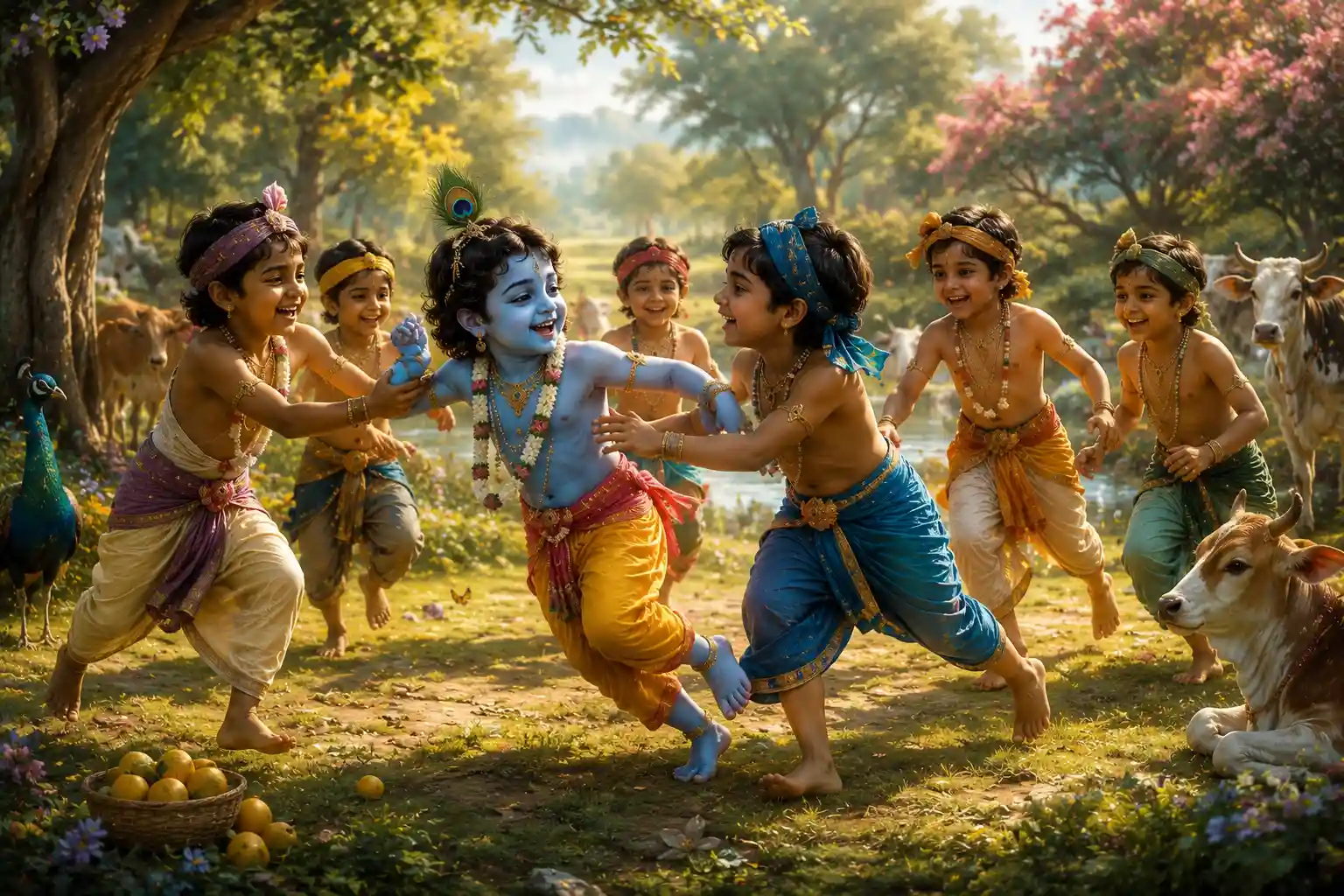
The sacred land of Braj is adorned with innumerable pastimes of Shree Krishna, each revealing a different flavour of divine love. In the courtyard of Nand Baba's home, Krishna became the darling son of Mother Yashoda, allowing Himself to be bathed, fed, scolded, and embraced in the sweetness of Vatsalya Bhav. To the gopis, He became the enchanting flute player who captivated their hearts with the highest expression of Madhurya Bhav. Yet as the sun rose over the lush forests of Vrindavan each morning, another beautiful chapter of divine love unfolded—the carefree friendship between Krishna and His beloved companions.
At about four years of age, Krishna was still too young to take the cows for grazing, so He accompanied the calves into the forests along with His childhood friends. These simple excursions became the setting for some of the most endearing Leelas described in the Srimad Bhagavatam. Together they wandered through flowering groves, crossed gentle streams, climbed fruit-laden trees, chased colourful birds, and rested beneath the cooling shade of ancient banyan trees. The melodies of Krishna's flute mingled with the laughter of the boys, while the fragrant breeze carried the scent of blooming kadamba flowers throughout the forests of Braj.
What made these pastimes so extraordinary was that Krishna's companions never saw Him as the Supreme Lord. Through the loving influence of Yogmaya, God's divine internal potency, they knew Him only as their closest friend. They did not pause to marvel at His omniscience or meditate upon His infinite power. They raced Him through the fields, wrestled with Him, teased Him, and laughed with Him exactly as children do with one another.
Even more astonishing was Krishna's own response. The all-knowing Lord willingly immersed Himself in these relationships, delighting completely in the innocence of childhood friendship. Swami Mukundananda explains that Krishna's divine sweetness, or madhurya, often conceals His majestic opulence, or aishwarya. By veiling His supreme position through Yogmaya, He allows His devotees to love Him naturally, without the distance that overwhelming reverence can create. It is this sweetness that makes the pastimes of Braj unique among all the manifestations of God.
A Lunch Shared with Love
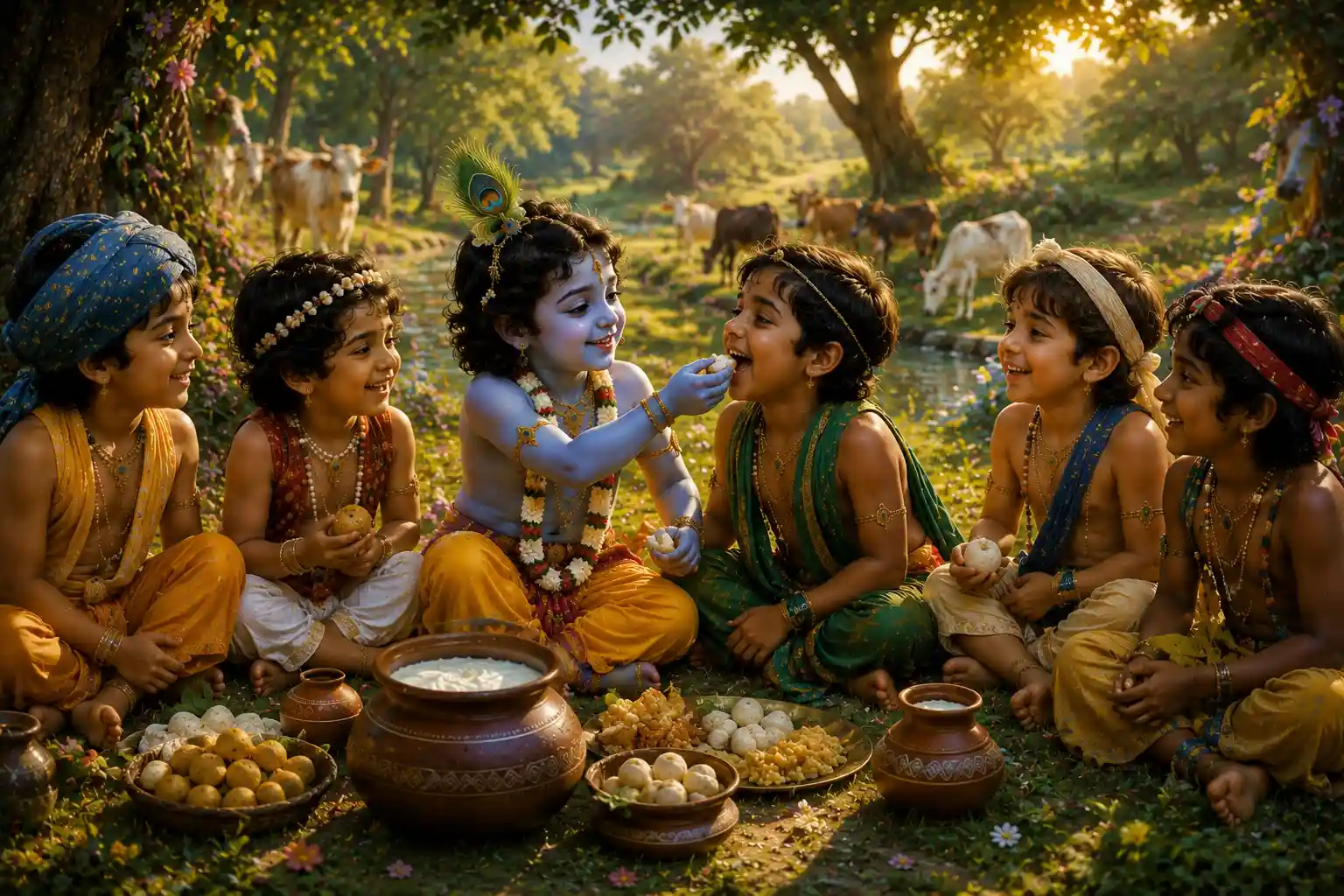
Among the countless childhood pastimes in Braj, the daily lunch shared by Krishna and His friends beautifully captures the essence of Sakhya Bhav.
Every morning before Krishna left home, Mother Yashoda lovingly prepared a meal for her beloved Kanha. The other boys also carried small tiffins packed with affection by their mothers. When the calves settled peacefully to graze, the boys gathered beneath the trees, spread out their meals upon the soft grass, and formed a cheerful circle around Krishna.
What followed was far more than an ordinary lunch. It became a celebration of love, simplicity, and companionship.
Krishna would glance playfully into another boy's meal and ask with innocent curiosity, "What has your Maiya prepared today? Let Me taste a little."
The friend would immediately pull his food closer, pretending to be annoyed. "You are always trying to steal everyone else's lunch! Go and eat what your own mother packed."
Rather than feeling offended, Krishna laughed with delight. If His request was refused, He would mischievously stretch out His hand and snatch a morsel anyway, sometimes directly from His friend's fingers. Tasting it with great satisfaction, He would smile broadly and exclaim, "Your mother cooks much better than Mine! I shall tell Maiya Yashoda to learn from her."
The entire forest would erupt in laughter.
Jagadguru Shree Kripaluji Maharaj beautifully captures this charming pastime in one of His devotional kirtans:
Dekho dekho re, Gwalan mukh chori chori Hari, khat kaur kahī bali hārī...
"Look! Hari secretly steals morsels from the mouths of His cowherd friends and joyfully relishes every bite."
Why does this seemingly simple pastime hold such profound significance? After all, Krishna is the Lord to whom the entire universe offers worship. The celestial beings present Him with heavenly delicacies, yet He finds greater joy in stealing a humble morsel from the lunch of a village boy.
The answer lies in the nature of divine love. Krishna was never attracted by the food itself; He was attracted by the affection with which it was offered. Love transforms the simplest gift into something infinitely precious. Just as He later accepted Sudama's humble handful of flattened rice with overwhelming joy, here too He relished every stolen morsel because it carried the sweetness of friendship.
These playful exchanges reveal a timeless truth. God does not measure the material value of what we offer Him. He looks only at the love that accompanies it. A simple offering given with devotion becomes dearer to Him than the grandest display made without affection.
The Lord Who Happily Accepted Defeat
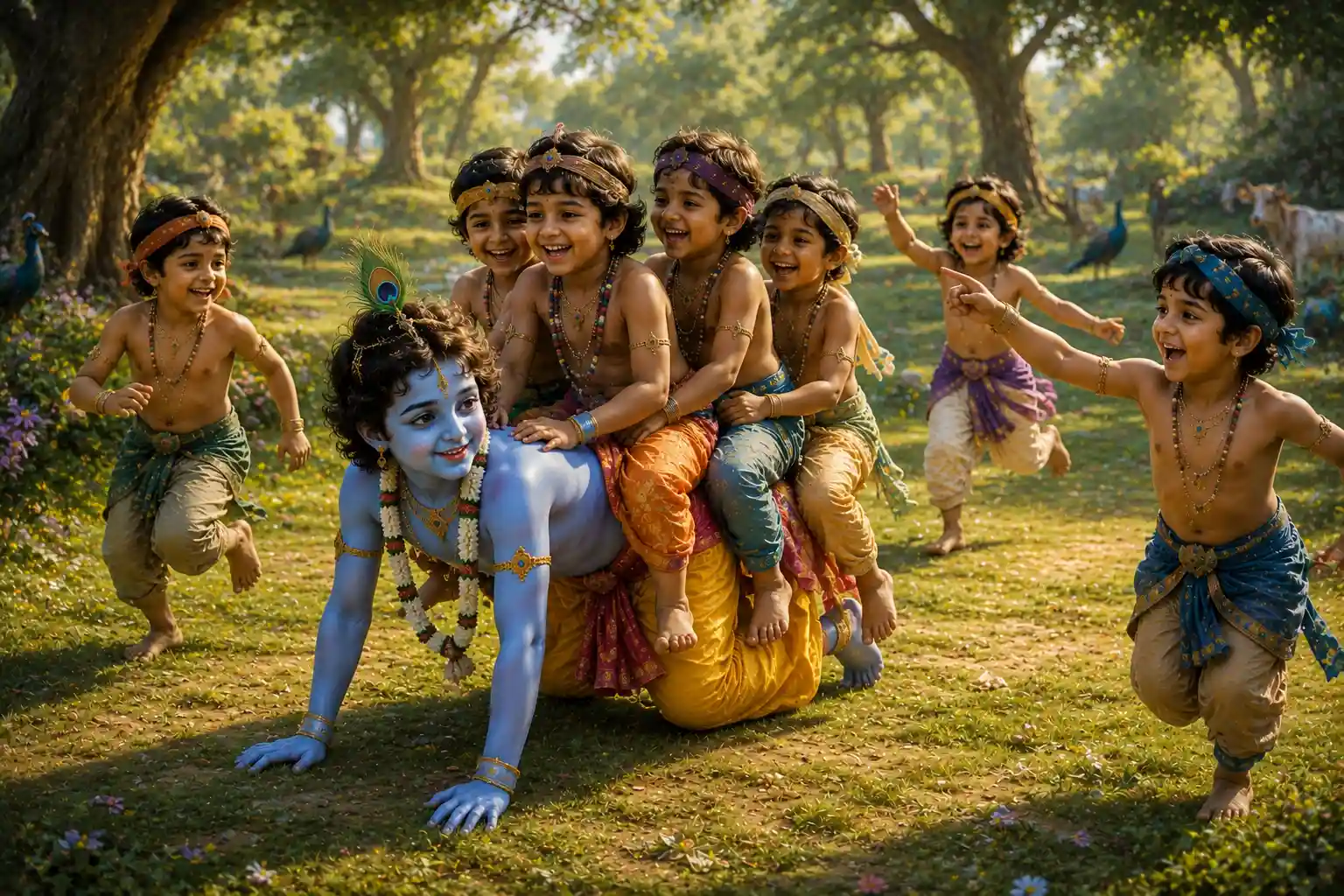
The forests of Braj echoed each day with the joyful sounds of children's games. Krishna and His companions invented endless competitions such as running races, wrestling matches, climbing contests, and playful challenges that filled their afternoons with laughter. There was no thought of victory or defeat lasting beyond the moment, for every game was simply another opportunity to enjoy one another's company.
On one memorable occasion, the boys agreed that whoever lost the game would become a horse while the winners would ride upon his back. When the contest ended, Krishna Himself was declared the loser.
Without the slightest hesitation, the Supreme Lord dropped onto His hands and knees, smiling as His friends climbed onto His back. Laughing with delight, they urged Him forward like an ordinary horse, calling out, "Come on! Run faster!"
One mischievous friend even gave Him a playful kick to make Him move more quickly.
From the perspective of the world, such a scene is unimaginable. The Lord worshipped by Brahma, Shiva, and countless celestial beings willingly allowed Himself to be treated like a village playmate. Yet Krishna experienced no loss of dignity. On the contrary, He delighted in every moment because these gestures arose not from disrespect, but from unalloyed love.
Swami Mukundananda often explains that Krishna is conquered not by power, scholarship, or austerity, but by pure devotion. In Braj, His friends never sought liberation, mystical powers, or heavenly pleasures. They desired only to spend every possible moment with their beloved companion. Their hearts were free from calculation, and it was precisely this simplicity that bound the Infinite Lord with the ropes of friendship.
Tradition lovingly recounts that after the game ended, Krishna smiled at the boy who had kicked Him and said with complete sincerity, "The kick you gave Me was filled with so much affection. Could you give Me another?"
To an ordinary mind, such words seem impossible. Yet they perfectly reveal the mystery of Krishna's personality. The Supreme Lord delights not in being honoured, but in being loved. His omnipotence remains untouched, yet His heart willingly becomes conquered by the affection of His devotees.
The forests of Braj were therefore far more than the setting for childhood games. They became the sacred stage upon which Krishna demonstrated that divine friendship transcends every worldly concept of greatness. Every shared meal, every burst of laughter, every playful race, and every innocent joke became an act of devotion, even though the boys themselves never realised it. Without performing severe austerities or mastering profound philosophy, these simple cowherd boys attained what countless sages aspire to achieve—they became the intimate friends of God.
A Friendship That Time Could Never Diminish
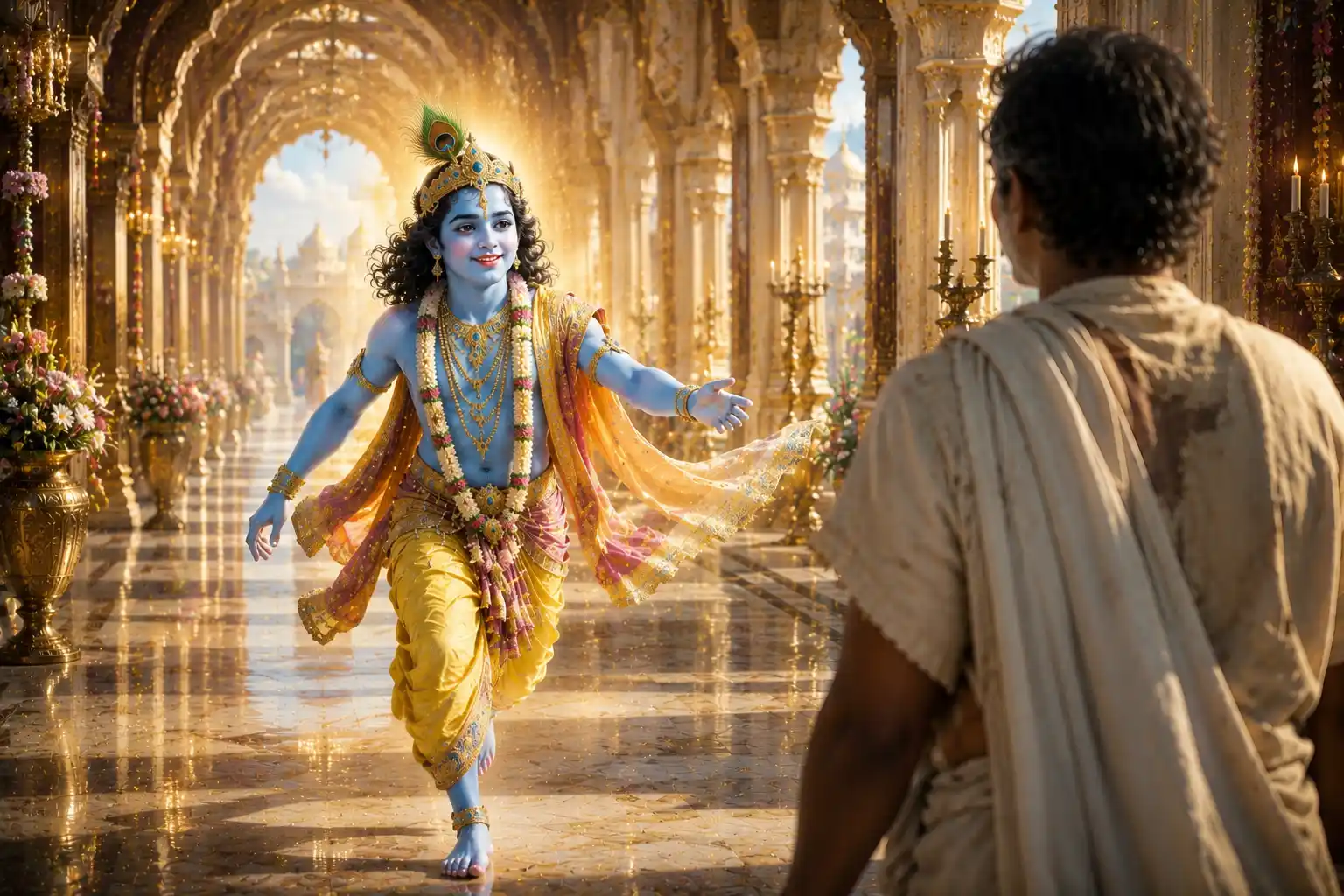
The enchanting days of Krishna's childhood in Braj did not last forever. As the years unfolded, the divine drama of His earthly pastimes led Him away from the forests of Vrindavan towards the responsibilities of fulfilling His mission upon earth. He liberated Mathura from the tyranny of Kans, established the magnificent city of Dwarka, guided kings and sages, and became the revered protector of Dharma. To those who observed Him from afar, it appeared that the mischievous cowherd boy had become a majestic monarch whose every moment was occupied with affairs of state. Surrounded by splendid palaces, noble warriors, devoted queens, and wise ministers, Krishna now seemed infinitely removed from the carefree child who had once wandered barefoot through the groves of Vrindavan.
Yet the outer circumstances of His life had changed far more than His heart.
The love that had bound Him to the simple residents of Braj had not diminished with the passing of time. Neither royal grandeur nor the responsibilities of ruling an empire could erase the memories of those who had loved Him without the slightest awareness of His divinity. The same Krishna who accepted defeat in children's games, stole morsels from His friends' lunches, and laughed beneath the shade of kadamba trees remained unchanged within. His kingdom had grown, His influence had expanded across Bharat, but His affection for His devotees was as spontaneous and intimate as ever.
Among all those who had shared His childhood, one friend occupied a particularly cherished place in His heart.
Sudama had studied with Krishna in the gurukul of Sage Sandipani Muni, where the two boys lived the simple life expected of every student. Together they gathered firewood from the forest, served their guru and his wife with humility, and accepted the discipline of the ashram with cheerful hearts. In those days there was no distinction between prince and pauper, for Krishna Himself delighted in living as an ordinary disciple, sharing every task with His companions. The bonds formed during those years were not built upon wealth or position but upon simplicity, mutual affection, and a shared life of service.
After completing their education, their paths diverged. Krishna gradually fulfilled His divine mission, while Sudama embraced the life of a humble Brahmin devoted to scriptural learning and spiritual practice. He possessed little interest in acquiring material comforts and accepted whatever came by providence with quiet contentment. Such was his spirit of renunciation that he would rather endure hardship than seek assistance from another. His wife, Sushila, shared his faith with remarkable patience, yet there were times when their poverty became almost unbearable. The roof of their little hut offered scant protection from the weather, their clothes had become threadbare through years of use, and many days passed with scarcely enough food to satisfy the hunger of their children.
Watching her family struggle, Sushila finally spoke to her husband with gentle hesitation. She reminded him that the Lord of Dwarka was not merely a famous king but the very friend with whom he had spent his youth. She did not urge him to ask for riches, for she knew such a request would never arise naturally from his heart. Instead, she lovingly suggested that he should simply visit Krishna. Surely there could be no impropriety in renewing the bond of friendship after so many years.
Sudama remained reluctant. Friendship, he felt, should never become a means of obtaining worldly gain. Yet seeing the sincerity in his wife's request and recognising the suffering she silently endured for the sake of their family, he agreed to undertake the journey. Before he departed, Sushila searched every corner of their humble dwelling for something worthy of offering to Krishna. There was almost nothing to be found. At last, after borrowing a small quantity of flattened rice from a neighbour, she carefully wrapped it in a worn piece of cloth and placed the little bundle into her husband's hands.
The offering was modest beyond measure, but it represented everything they possessed. More importantly, it carried the love of two hearts that cherished Krishna above all worldly possessions.
Holding that tiny bundle close to his chest, Sudama began the long walk to Dwarka. As he travelled along dusty roads and through quiet villages, memories of his childhood surfaced again and again. He recalled the simple joys of life in the gurukul, the conversations they had shared, the services they had performed together, and the gentle smile that had always adorned Krishna's face. The thought that his childhood companion had become the celebrated ruler of Dwarka filled him with both joy and hesitation. More than once he wondered whether he should turn back. How could a poor Brahmin clothed in patched garments present himself before a sovereign whose fame had spread throughout the land? Yet each time uncertainty arose, another thought followed immediately. He was not travelling to meet a king. He was going to see his friend.
While Sudama walked towards Dwarka, Krishna required no messenger to announce His arrival. The Lord who resides within every heart was fully aware of each step His devotee had taken, every thought that crossed his mind, and every emotion that stirred within him during the journey. Swami Mukundananda often explains that when a devotee sincerely turns towards God, the Lord's grace is already flowing towards that devotee. Long before Sudama reached the gates of Dwarka, Krishna had already prepared to welcome him with the affection reserved for one who had never ceased to dwell in His heart.
When Sudama finally arrived, the splendour of the royal city seemed almost overwhelming. Towering gateways, magnificent palaces, bustling streets, and richly adorned courtyards stood in striking contrast to the humble village from which he had come. Clutching his little bundle of flattened rice, he approached the palace entrance and quietly requested that the guards inform Krishna that His childhood friend Sudama had come to see Him.
The message had scarcely reached Krishna before He rose from His throne.
Without concern for royal protocol or courtly etiquette, He hurried towards the palace entrance with an eagerness that astonished everyone around Him. Ministers paused in bewilderment, attendants looked at one another in surprise, and even the queens wondered who could possibly command such affection from the Lord of Dwarka. But Krishna saw none of the distinctions that occupied the minds of others. He did not see a poor Brahmin wearing worn-out clothes or a weary traveller who had walked for days beneath the scorching sun. He saw only the dear friend with whom He had once shared the innocent joys of childhood.
As soon as they stood before one another, the years of separation vanished completely. Krishna embraced Sudama with overwhelming affection, holding him as though He had recovered a precious part of His own life. Tears flowed freely from His eyes, for divine love is never diminished by time, distance, or worldly circumstance. Those who witnessed the scene struggled to comprehend what they were seeing. The sovereign before whom mighty kings bowed in reverence now welcomed an impoverished Brahmin with greater honour than He would have shown the ruler of any kingdom.
Leading Sudama by the hand into the palace, Krishna seated him upon His own royal seat and personally began to wash his feet. The scriptures lovingly describe how His eyes overflowed with such deep affection that His tears mingled with the water bathing the feet of His childhood companion. In that unforgettable moment, the Supreme Lord demonstrated a truth that lies at the very heart of Bhakti: He is conquered not by wealth, learning, or social position, but by the pure love of His devotees.
The Eternal Meaning of Sakhya Bhav
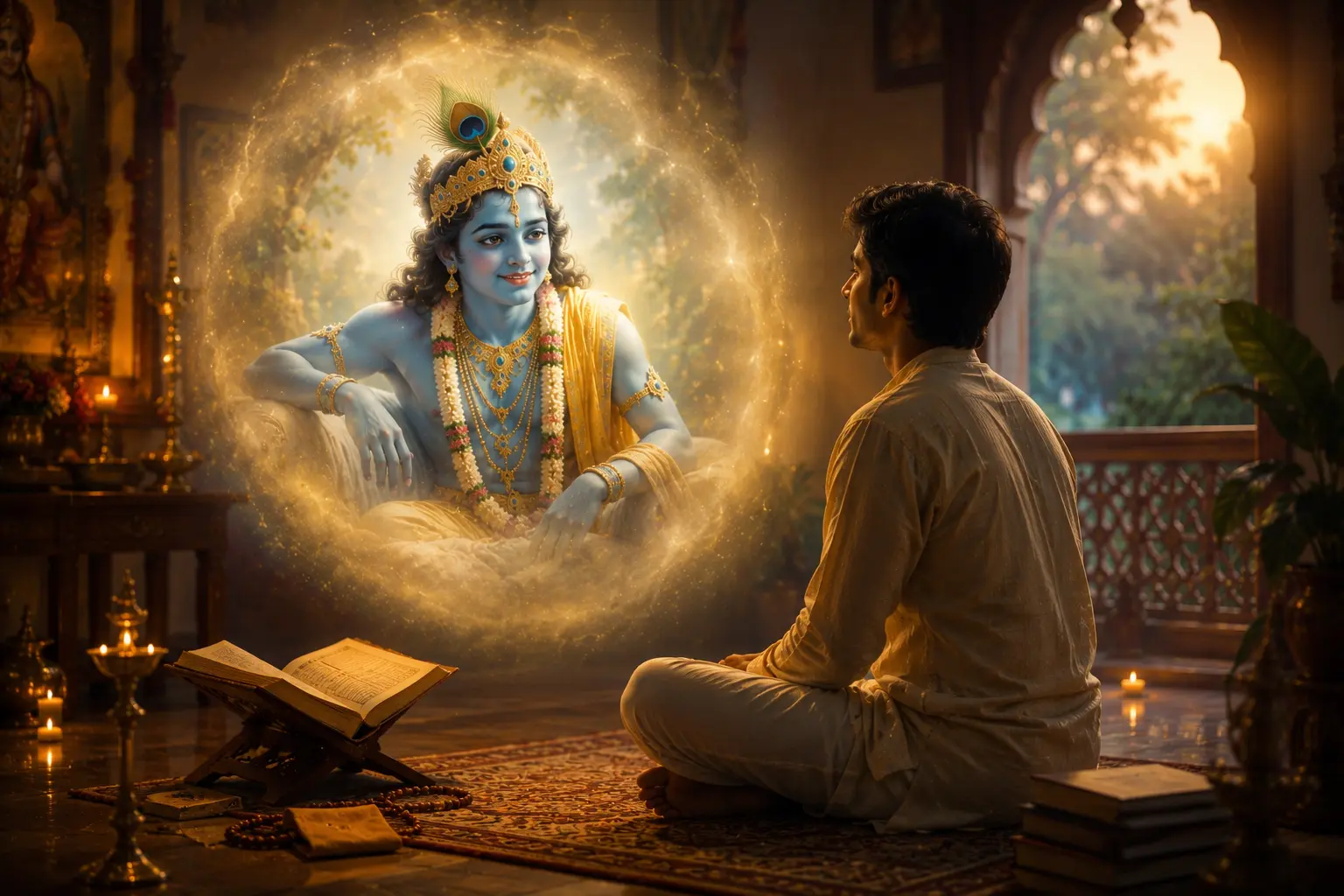
The reunion of Krishna and Sudama is far more than an account of divine generosity. It reveals one of the sweetest dimensions of Bhakti: the relationship known as Sakhya Bhav, the mood of friendship with God. While reverence naturally arises upon recognising Krishna as the Supreme Lord, the scriptures also reveal that His highest delight lies in loving exchanges with His devotees. The same Lord who is worshipped by Brahma, Shiva, and the celestial beings eagerly accepts the role of a friend when approached with a heart free from pride, fear, and selfish expectation.
This truth shines throughout Krishna's life. In Vrindavan, His cowherd companions never paused to reflect upon His divine majesty. They raced Him through the forests, shared their lunches with Him, climbed trees together, and laughed without restraint. Their affection was so natural that they never considered themselves to be serving the Supreme Personality of Godhead. Yet it was precisely this simplicity that made their love so precious. Yogmaya concealed Krishna's divine opulence so that these intimate relationships could flourish without the distance created by awe and reverence. Krishna, in turn, delighted in becoming one among them, allowing Himself to be defeated in games, teased by His companions, and even lovingly ordered about, because every interaction arose from pure affection.
Years later, nothing had changed. Although Krishna now ruled the prosperous kingdom of Dwarka, He did not greet Sudama as a king receiving a humble subject. He welcomed him as the friend of His youth, proving that divine friendship is untouched by time, status, or circumstance. Sudama's poverty never lessened Krishna's affection, just as Krishna's royal splendour never created distance in His own heart. Their meeting demonstrates that the Lord looks not at the external condition of a devotee but at the love residing within.
Swami Mukundananda often explains that one of the defining characteristics of Krishna is His willingness to reciprocate perfectly with the love offered by His devotees. In the Bhagavad Gita, Krishna Himself declares:
ये यथा मां प्रपद्यन्ते तांस्तथैव भजाम्यहम् ।
मम वर्त्मानुवर्तन्ते मनुष्या: पार्थ सर्वश: ॥ 11॥
ye yathā māṁ prapadyante tāns tathaiva bhajāmyaham
mama vartmānuvartante manuṣhyāḥ pārtha sarvaśhaḥ
BG 4.11: In whatever way people surrender unto Me, I reciprocate accordingly. Everyone follows My path, knowingly or unknowingly, O son of Pritha.
This profound declaration assures every seeker that God does not impose a relationship upon the soul. Instead, He lovingly responds to the mood in which He is approached. Those who worship Him with reverence experience Him as the all-powerful Lord. Those who serve Him with humility experience Him as the perfect Master. Those whose hearts overflow with parental affection behold Him as little Kanha. And those who seek His friendship discover a companion whose loyalty, compassion, and love surpass every worldly relationship.
The Srimad Bhagavatam takes this revelation even further. Speaking to Sage Durvasa, the Lord proclaims that although He is completely independent, He becomes as though dependent upon His devotees.
This verse is among the most astonishing declarations in all of scripture. The Supreme Lord, who governs the movement of galaxies and sustains countless universes, freely chooses to become bound by the love of His devotees. Swami Mukundananda beautifully explains that Krishna is not only Bhakta-vatsala, the affectionate protector of His devotees, but also Bhakta-vashya: the Lord who willingly allows Himself to be conquered by pure devotion. His apparent dependence is not a limitation of His divinity; it is the highest expression of His infinite love.
The stories of the cowherd boys and Sudama illustrate this truth with remarkable clarity. Neither possessed extraordinary scholarship, immense wealth, or mystical powers. They did not perform severe austerities to compel God to appear before them. They simply loved Krishna with unaffected sincerity. That love was sufficient to make the Infinite Lord share their meals, carry them upon His back during games, and later wash the feet of a poor Brahmin with tears of affection. The greatest miracle in these Leelas is not Krishna's display of supernatural power but His extraordinary willingness to place love above majesty.
For spiritual aspirants today, these pastimes offer both inspiration and guidance. It is natural to think of prayer as a formal ritual performed at a fixed time each day. Yet Sakhya Bhav gently expands our understanding of devotion. A true friend is present not only during moments of worship but throughout every aspect of life. Friends share their joys, confide their struggles, celebrate their victories, and seek comfort during times of uncertainty. Krishna invites us into that same relationship.
Swami Mukundananda encourages devotees to cultivate such intimacy through loving remembrance of the Lord's names, forms, qualities, and divine pastimes. His practice of Roop Dhyan Meditation enables seekers to visualise Krishna's enchanting form and gradually develop a living relationship with Him. As the mind repeatedly contemplates His childhood Leelas in Vrindavan, His compassion in Dwarka, and His divine guidance in the Bhagavad Gita, devotion slowly matures from distant admiration into heartfelt companionship. Prayer becomes conversation, remembrance becomes association, and the Lord who once seemed far away begins to feel wonderfully close.
This transformation does not happen overnight. Like every meaningful friendship, our relationship with Krishna deepens through time, trust, and constant remembrance. Each moment spent chanting His holy names, studying His teachings, serving selflessly, or reflecting upon His Leelas strengthens the bond between the soul and its eternal Friend. Gradually, the devotee realises that Krishna has never been distant. He has patiently accompanied every step of life's journey, waiting only for the heart to turn towards Him with love.
Conclusion
As we celebrate Janmashtami 2026, the stories of Krishna's childhood companions and His reunion with Sudama invite us to see the Lord through a new lens. The same Krishna who lifted Govardhan Hill, revealed the Universal Form, and delivered the timeless wisdom of the Bhagavad Gita also delighted in sharing lunches beneath the trees of Vrindavan and embracing a poor Brahmin with tears of overwhelming affection. His supreme majesty commands our reverence, but His boundless love captures our hearts.
Perhaps this is the deepest secret of Krishna's friendship. He does not ask us to become extraordinary before approaching Him. He asks only for sincerity. The cowherd boys offered laughter. Sudama offered a handful of flattened rice. Both offered love, and Krishna accepted their gifts as treasures beyond compare.
May this Janmashtami inspire us not merely to admire these beautiful Leelas but to live them. Let us speak to Krishna with openness, remember Him throughout the day, chant His divine names with affection, and invite Him into every joy and every challenge. For when we take even a small step towards Him with love, we discover that our eternal Friend has been waiting for us all along.
Call To Action: Continue Your Spiritual Journey with JKYog
If this exploration of Shree Krishna's divine avatar has inspired you to deepen your relationship with God, continue your journey through the authentic teachings of Swami Mukundananda and JKYog.
Study the Bhagavad Gita verse by verse through Swamiji's practical commentaries:

Immerse yourself in his illuminating discourses on the Srimad Bhagavatam, and experience guided Roop Dhyan meditations, bhajans, daily inspiration, and spiritual challenges through the Bhagavad Gita & Krishna Bhakti App:

 JKYog
JKYog
Frequently Asked Questions
What is Sakhya Bhav?
Sakhya Bhav is the devotional mood of relating to God as one's closest friend. It is one of the five primary devotional relationships described in the Bhakti tradition and is beautifully exemplified by Krishna's friendships with the cowherd boys of Vrindavan and Sudama.
Why is Krishna's friendship with Sudama so important?
Sudama's story demonstrates that Krishna values love above wealth, status, or external appearance. Although Sudama brought only a humble offering of flattened rice, Krishna received him with overwhelming affection and showered him with divine grace.
What does Bhagavad Gita 4.11 teach about friendship with God?
The verse teaches that Krishna reciprocates according to the love and surrender of each devotee. Those who approach Him as a friend experience His friendship in return.
How can I develop a personal relationship with Krishna?
Regular chanting, prayer, meditation on Krishna's divine form, studying the Bhagavad Gita and Srimad Bhagavatam, and practising the teachings of realised saints such as Swami Mukundananda gradually deepen one's relationship with the Lord.
What is Roop Dhyan Meditation?
Roop Dhyan Meditation is a devotional meditation practice taught by Swami Mukundananda in which practitioners lovingly visualise the divine form and pastimes of Shree Krishna to deepen concentration, devotion, and personal connection with God.
Resources
Watch these YouTube videos by Swami Mukundananda to dive deeper into bhakti: