

Introduction: When Heaven Spoke and a Kingdom Trembled
Every year, Janmashtami fills temples and homes with joyous celebrations as devotees commemorate the divine appearance of Shree Krishna. The sound of devotional songs fills the air, lamps illuminate sanctuaries, and hearts overflow with gratitude for the Lord whose life continues to inspire millions across the world. Yet behind the joy of Krishna's birth lies one of the most dramatic and profound episodes in the Srimad Bhagavatam, a prophecy so powerful that it transformed an affectionate brother into a ruthless tyrant and set in motion one of the greatest divine dramas in history.
The story of Krishna's advent does not begin in a prison cell in Mathura. Nor does it begin with the midnight appearance of the Supreme Lord in the home of Vasudev and Devaki. It begins much earlier, with the gradual rise of adharma, the abuse of power, and the silent prayers of countless devotees longing for divine intervention.
Janmashtami is therefore far more than a celebration of a sacred birth. It is the celebration of God's eternal promise that whenever righteousness declines and darkness seems to prevail, He never abandons His devotees. In ways often hidden from human understanding, He prepares the world for His descent long before anyone recognises His divine plan.
The Srimad Bhagavatam unfolds this extraordinary narrative with remarkable beauty. It reveals that every event leading to Krishna's birth, even the rise of the tyrant Kansa, formed part of a divine orchestration designed to restore dharma and awaken humanity to the path of devotion.
Why the Tenth Canto Is the Heart of the Srimad Bhagavatam
Among all the sacred scriptures of Sanatan Dharma, few occupy a place as exalted as the Srimad Bhagavatam. Across its twelve cantos, it guides the sincere seeker from philosophical inquiry to complete surrender, revealing the nature of the soul, the glory of devotion, and the limitless compassion of God.
Yet, the Tenth Canto shines with a unique brilliance.
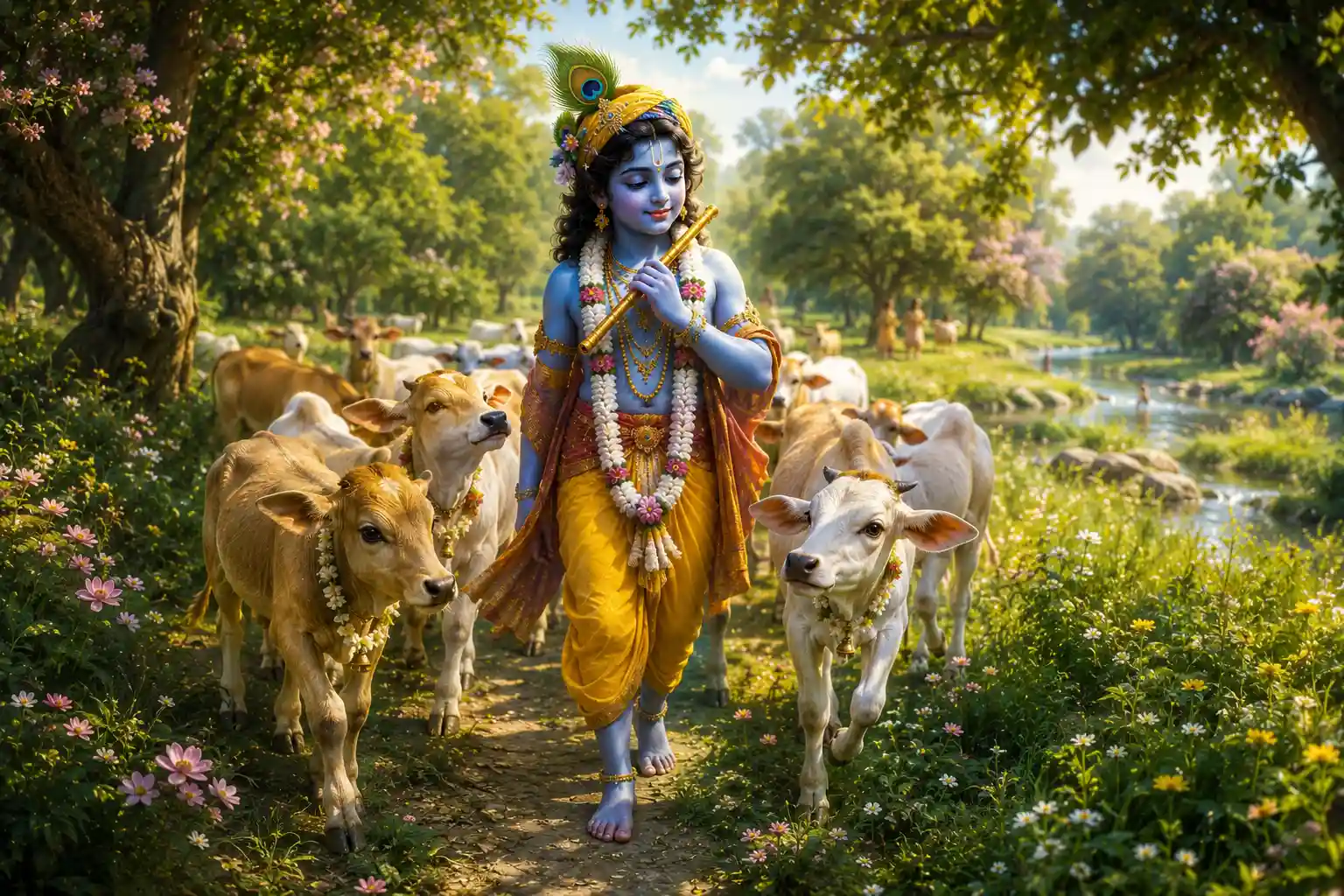
The great sage Shukadev Goswami, who narrated the Bhagavatam to King Parikshit during the final seven days of the king's life, devoted ninety chapters to describing the life and pastimes of Shree Krishna. No other section of the scripture receives such loving attention.
Swami Mukundananda beautifully explains that this is no coincidence. The earlier cantos prepare the heart through philosophy, history, and spiritual wisdom, but the Tenth Canto reveals the ultimate object of all spiritual practice: the all-attractive Supreme Divine Personality, Shree Krishna Himself. It is here that divine philosophy blossoms into divine love.
The Bhagavatam itself gives a charming glimpse into why Krishna's pastimes are narrated in such detail. While describing the incarnation of Lord Ram, Shukadev Goswami spoke briefly before moving on. King Parikshit listened respectfully, recognising that every word spoken by the realised sage carried immeasurable value.
But when Shukadev began narrating Krishna's childhood pastimes, the king's heart responded differently, for he longed to hear more.
Thus unfolds the longest canto of the Srimad Bhagavatam; not because Krishna performed more miracles than other incarnations, but because His intimate pastimes reveal the sweetest dimensions of God's personality. Here, the Supreme Lord laughs, plays, protects His devotees, accepts the love of His parents and friends, and demonstrates that divine love is greater even than divine majesty.
Before these enchanting childhood pastimes begin, however, the Bhagavatam carefully paints the backdrop against which the Lord would descend. It introduces a kingdom overshadowed by fear, a ruler consumed by insecurity, and a prophecy that would shake the foundations of an empire.
The Rise of Kansa: When Ambition Overpowered Righteousness
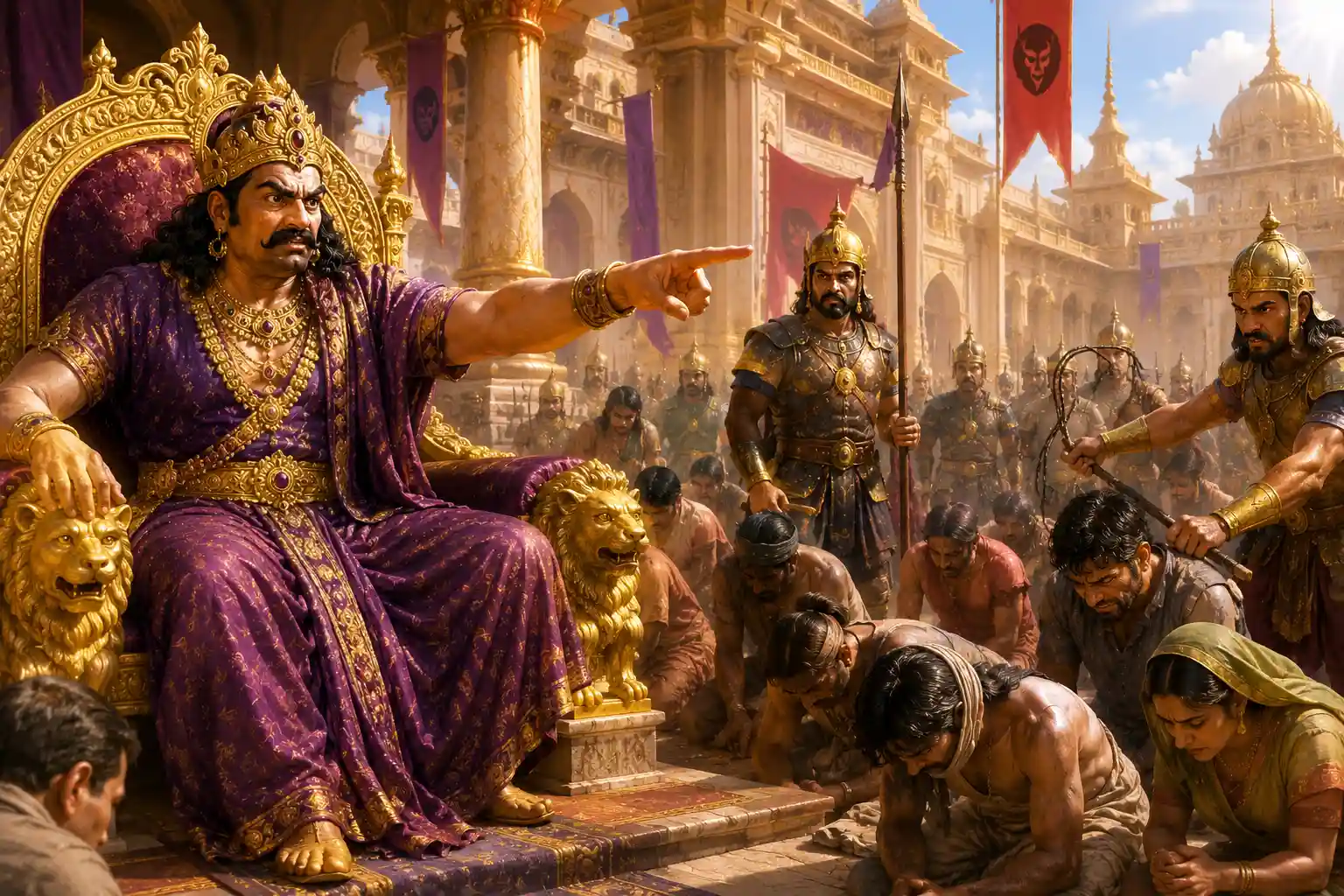
Long before Krishna's birth, the ancient city of Mathura flourished under the righteous rule of King Ugrasena. Descended from the illustrious Yadu dynasty, Ugrasena governed with fairness and upheld the principles of dharma that sustained peace throughout his kingdom. To his subjects, Mathura was a place of prosperity and stability.
Yet beneath this outward harmony, destiny was quietly preparing an extraordinary sequence of events.Kansa allowed anger to consume his heart. Determined to seize power, he rebelled against his own family, overthrew King Ugrasena, imprisoned both his father and other members of the royal household, and proclaimed himself ruler of Mathura.
With that single act, a kingdom governed by righteousness fell under the control of fear.
The transformation was swift and devastating.
The ruler who should have protected his people instead became their greatest source of suffering. Justice gave way to oppression. Compassion yielded to cruelty. The throne, once a symbol of responsibility, became an instrument of domination.
Kansa's tragedy was not simply that he became a cruel king. His greater tragedy was that he allowed fear to eclipse wisdom. Although he possessed immense power, he could no longer distinguish genuine threats from imagined ones. The more authority he accumulated, the less secure he became.
His story therefore remains strikingly relevant today.
While few aspire to rule kingdoms, many struggle with the same inner enemies. Pride convinces us that happiness depends upon controlling every circumstance. Fear whispers that losing status, wealth, relationships, or success will diminish our worth. Gradually, anxiety begins to govern our decisions instead of wisdom.
The Bhagavad Gita teaches that such fear arises whenever we identify ourselves solely with the temporary world. Lasting peace cannot be found by controlling external events but by anchoring the mind in God.
The Wedding That Changed the Course of History
As Kansa tightened his grip over Mathura, life within the kingdom continued outwardly as before. Royal ceremonies were celebrated, families carried on with their daily lives, and the rhythms of the city appeared unchanged. Yet beneath this fragile appearance of normalcy, destiny was quietly moving towards one of the most extraordinary moments in sacred history. That moment arrived with the marriage of Princess Devaki, the noble daughter of Devak, to the virtuous prince Vasudev, one of the most respected members of the Yadu dynasty. Their union was celebrated throughout Mathura with great joy, for both were admired for their character, wisdom, and unwavering commitment to dharma.
Among all those present, no one appeared happier than Kansa himself. Before fear consumed his heart, he genuinely loved his younger sister. The Bhagavatam presents this striking contrast to remind us that even those who later become instruments of adharma are not always devoid of affection.
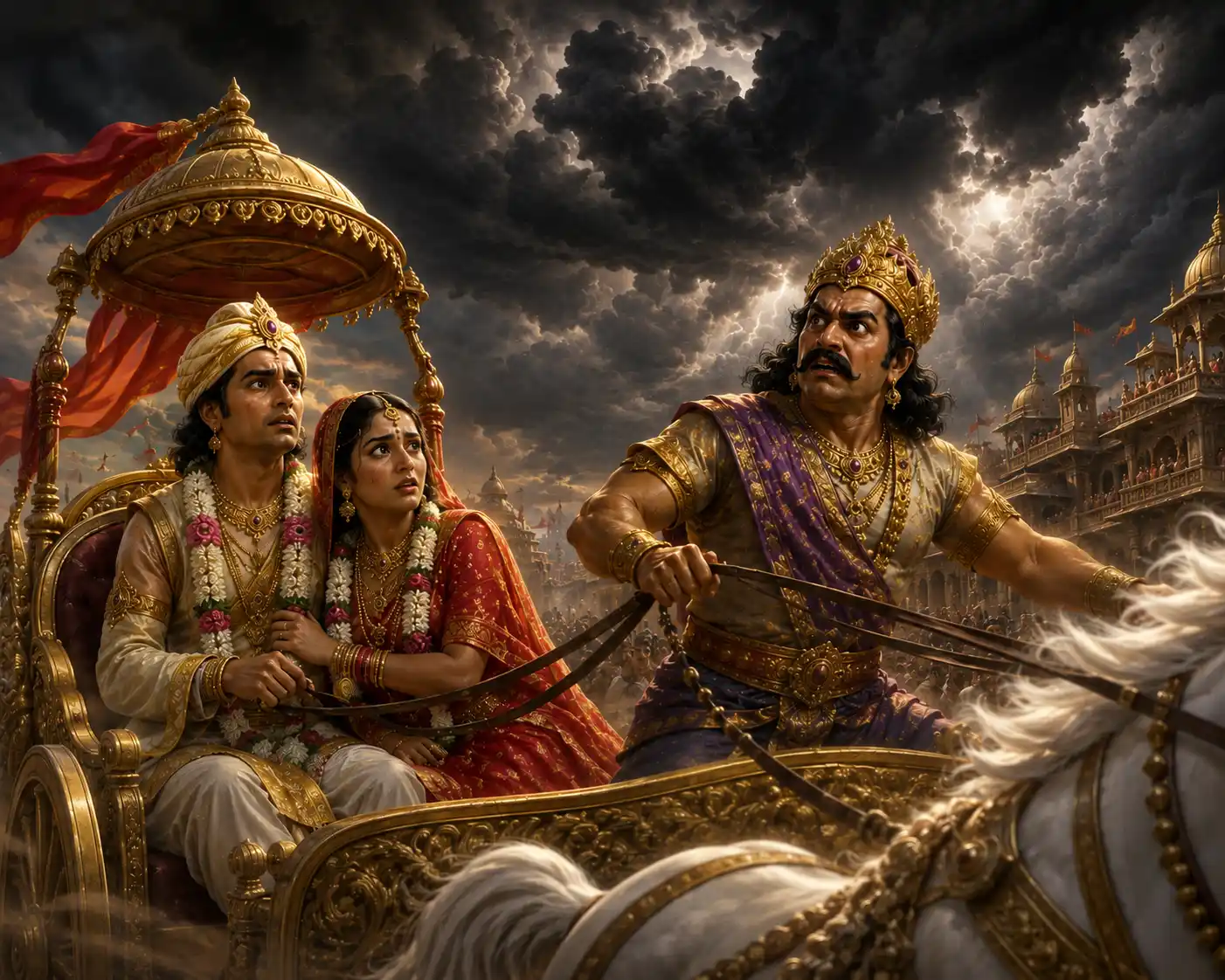
Overcome with brotherly pride and affection, Kansa performed an act that astonished everyone assembled for the royal procession. Although he was the ruler of Mathura, he personally took hold of the reins of Devaki's wedding chariot to escort his beloved sister and her husband to their new home. It was a gesture of honour and tenderness that reflected the bond they once shared. No one lining the streets of Mathura could have imagined that this joyful procession would become the setting for a divine announcement that would alter the destiny of kingdoms.
As the chariot rolled forward amidst music, blessings, and celebration, the heavens suddenly intervened. A celestial voice, an Akashvani, resounded through the sky:
"O Kansa! The eighth child born to Devaki shall be the cause of your death."
In a single instant, the atmosphere changed. The festive sounds that had filled the streets gave way to stunned silence. The words of the heavenly proclamation pierced Kansa's heart with terrifying force. Only moments earlier, he had been lovingly escorting his sister; now his mind became consumed by a single thought: his own survival. The prophecy did not threaten his kingdom, his wealth, or his reputation. It threatened his ego, and when the ego feels endangered, it often reacts without reason.
The transformation was immediate and horrifying. Drawing his sword, Kansa seized Devaki by her hair and prepared to kill her on the spot. The affection of a lifetime disappeared beneath an overwhelming wave of fear. The same hands that had lovingly guided her chariot now held a weapon against her. Fear has the power to distort even our purest relationships when self-preservation becomes our highest priority. A heart governed by selfishness cannot sustain love for long because every relationship eventually becomes measured by personal gain or personal loss.
At this critical moment, Vasudev displayed the qualities that distinguish true spiritual wisdom from ordinary intelligence. Faced with an armed tyrant, he neither responded with violence nor surrendered to panic. Instead, he remained calm, respectful, and deeply thoughtful. Knowing that Kansa's fear, not hatred, was driving his actions, Vasudev appealed to his reason.
He reminded Kansa that every living being who takes birth must one day leave the world. Death is not something that can be avoided through violence or prevented by destroying others. It is an inevitable law of material existence. Why then should a mighty king stain his honour by killing his own innocent sister on the happiest day of her life? Devaki herself posed no danger. The prophecy concerned a future child, not the bride standing before him. Vasudev then made an extraordinary promise. Every child born to Devaki would be brought personally to Kansa. There would be no deception, no attempt to conceal the births, and no betrayal of his word.
This promise reveals the remarkable integrity of Vasudev's character. He understood that preserving Devaki's life was of immediate importance. At the same time, he placed complete faith in the unseen workings of the Divine. He did not know how God's plan would unfold, yet he trusted that dharma demanded truthfulness even under impossible circumstances. The Srimad Bhagavatam repeatedly shows that genuine devotion does not remove life's difficult choices. Rather, it gives the devotee the courage to act righteously while leaving the outcome in God's hands.
Swami Mukundananda often explains that one of the greatest tests of faith arises when circumstances appear completely beyond our control.
The ordinary mind immediately seeks certainty, attempting to calculate every possible outcome before taking action. A devotee, however, performs the right action first and entrusts the results to God. Vasudev embodies this principle perfectly. He neither abandoned his duty as a husband nor compromised his commitment to truth. He fulfilled both, believing that the Lord's wisdom exceeded his own understanding.
For a brief moment, Kansa's heart softened. Recognising Vasudev's reputation for honesty, he accepted the promise and lowered his sword. Devaki's life was spared, and the wedding procession continued. To an outside observer, it may have seemed that peace had been restored. Yet the peace was only temporary. Fear that has not been conquered never truly disappears; it merely waits for another opportunity to arise. The prophecy continued to echo within Kansa's mind, growing stronger with every passing day until it overshadowed every other thought.
The events of this wedding procession contain a timeless lesson for every spiritual seeker. The greatest danger facing Kansa was not an unborn child but an uncontrolled mind.
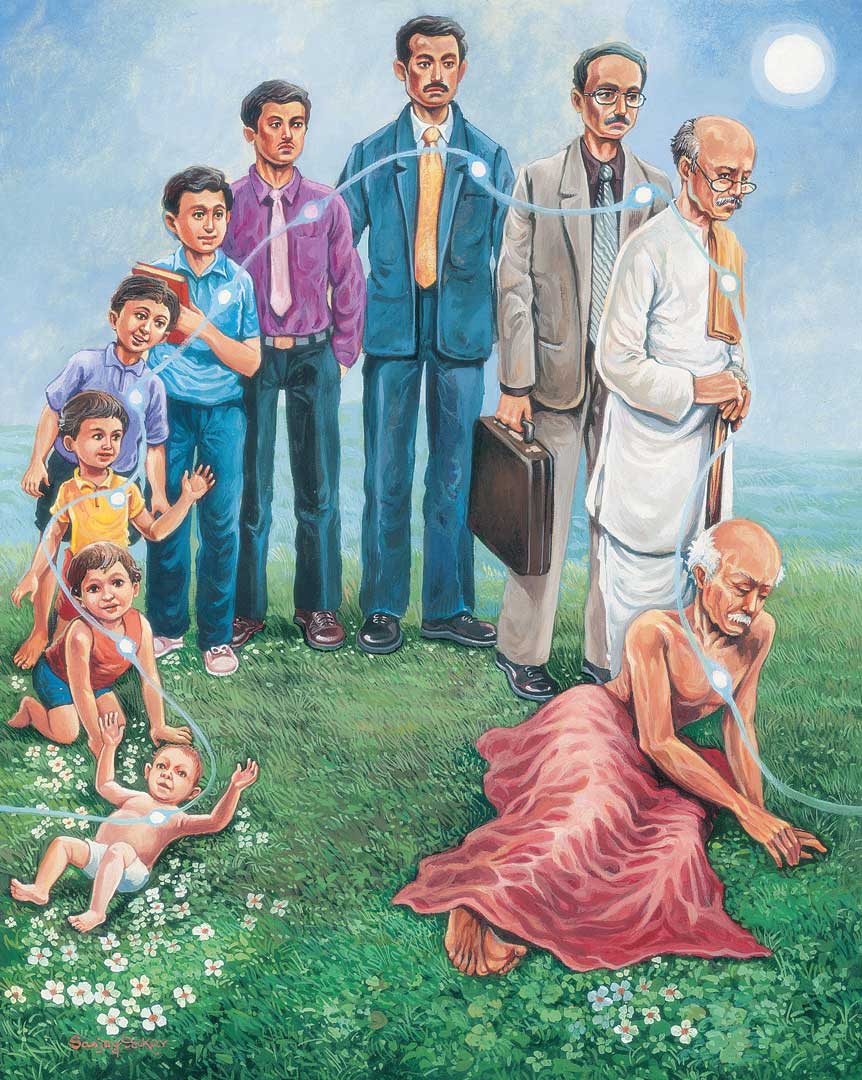
Shree Krishna, in the Bhagavad Gita explains that attachment gives rise to desire, desire gives rise to fear of loss, and fear clouds discrimination:
ध्यायतो विषयान्पुंस: सङ्गस्तेषूपजायते ।
सङ्गात्सञ्जायते काम: कामात्क्रोधोऽभिजायते ॥ 62॥
dhyāyato viṣhayān puṁsaḥ saṅgas teṣhūpajāyate
saṅgāt sañjāyate kāmaḥ kāmāt krodho ’bhijāyate
BG 2.62: While contemplating on the objects of the senses, one develops attachment to them. Attachment leads to desire, and from desire arises anger.
Once discrimination is lost, even intelligent people begin making destructive decisions. Kansa's downfall therefore began long before Krishna was born. It began the moment he allowed fear to become stronger than faith. Rather than seeing the prophecy as part of a divine plan, he saw it only as a threat to his own existence. In attempting to escape destiny, he unknowingly became an instrument through which that very destiny would unfold.
The wedding of Devaki and Vasudev thus marks far more than the beginning of Krishna's birth narrative. It reveals the eternal conflict between two ways of living. One path is governed by ego, control, and fear, represented by Kansa. The other is guided by faith, integrity, and surrender, represented by Vasudev and Devaki. Throughout the Srimad Bhagavatam, these two paths continue to unfold until they ultimately meet on the sacred night of Janmashtami, when the Supreme Lord appears to demonstrate that fear can never triumph over the will of God.
When Fear Becomes a Prison
Although Kansa had accepted Vasudev's promise and allowed the wedding procession to continue, the prophecy refused to leave his mind. It lingered like a shadow over every decision he made, gradually consuming his peace. The more he reflected upon the celestial announcement, the more his imagination magnified the danger. Instead of trusting in the natural course of events, he began trying to outwit destiny itself. Yet the history of the Srimad Bhagavatam repeatedly teaches that no one can frustrate the will of God. When human beings attempt to oppose the Divine through fear and force, they merely become instruments in fulfilling the very destiny they seek to escape.
Kansa's anxiety eventually overwhelmed whatever compassion remained in his heart. He ordered that Vasudev and Devaki be confined within the heavily guarded prison of Mathura. Iron doors, thick stone walls, and vigilant soldiers surrounded the royal couple day and night. To Kansa, the prison represented security. He believed that by controlling every external circumstance, he could control the future itself. Yet in reality, the prison revealed his own inner condition far more than it restrained his captives. Devaki and Vasudev were physically imprisoned, but their hearts remained anchored in faith. Kansa, on the other hand, wandered freely through his palace while remaining imprisoned by suspicion, anxiety, and the constant fear of death.
This contrast offers one of the profound spiritual lessons hidden within Krishna's birth narrative. External freedom alone does not make a person happy, nor do external hardships necessarily destroy inner peace.
A mind absorbed in God remains free even amidst suffering, while a mind dominated by fear remains restless even amidst luxury.
The walls that confined Vasudev and Devaki could not imprison their devotion, just as Kansa's magnificent palace could not free him from the torment of his own thoughts.
Swami Mukundananda often explains that the greatest bondage is not created by circumstances but by the uncontrolled mind. Human beings naturally believe that changing external situations will bring lasting happiness. We imagine that acquiring more wealth, greater recognition, or increased security will finally remove anxiety from our lives. Yet as soon as one concern disappears, another takes its place. Lasting peace is found not by controlling the world around us but by transforming the world within us. The lives of Vasudev and Devaki beautifully demonstrate this truth. Though deprived of comfort and separated from ordinary family life, they remained steadfast because their faith rested in God rather than in circumstances.
As the years passed, Devaki gave birth to her first son. True to his word, Vasudev carried the newborn child to Kansa. The scene is deeply moving. Every instinct of a father would urge him to protect his infant, yet Vasudev chose truth over self-interest, trusting that the Lord's plan would unfold in its own perfect time. Even Kansa was momentarily moved by this extraordinary integrity. Reflecting upon the prophecy, he reasoned that the celestial voice had spoken only of the eighth child. Why should he kill the first? Surprised by his own moment of mercy, he returned the infant to his parents.
For a brief period, it appeared that compassion had prevailed over fear. Yet divine history was not meant to unfold according to human calculations.
Narada's Timely Intervention
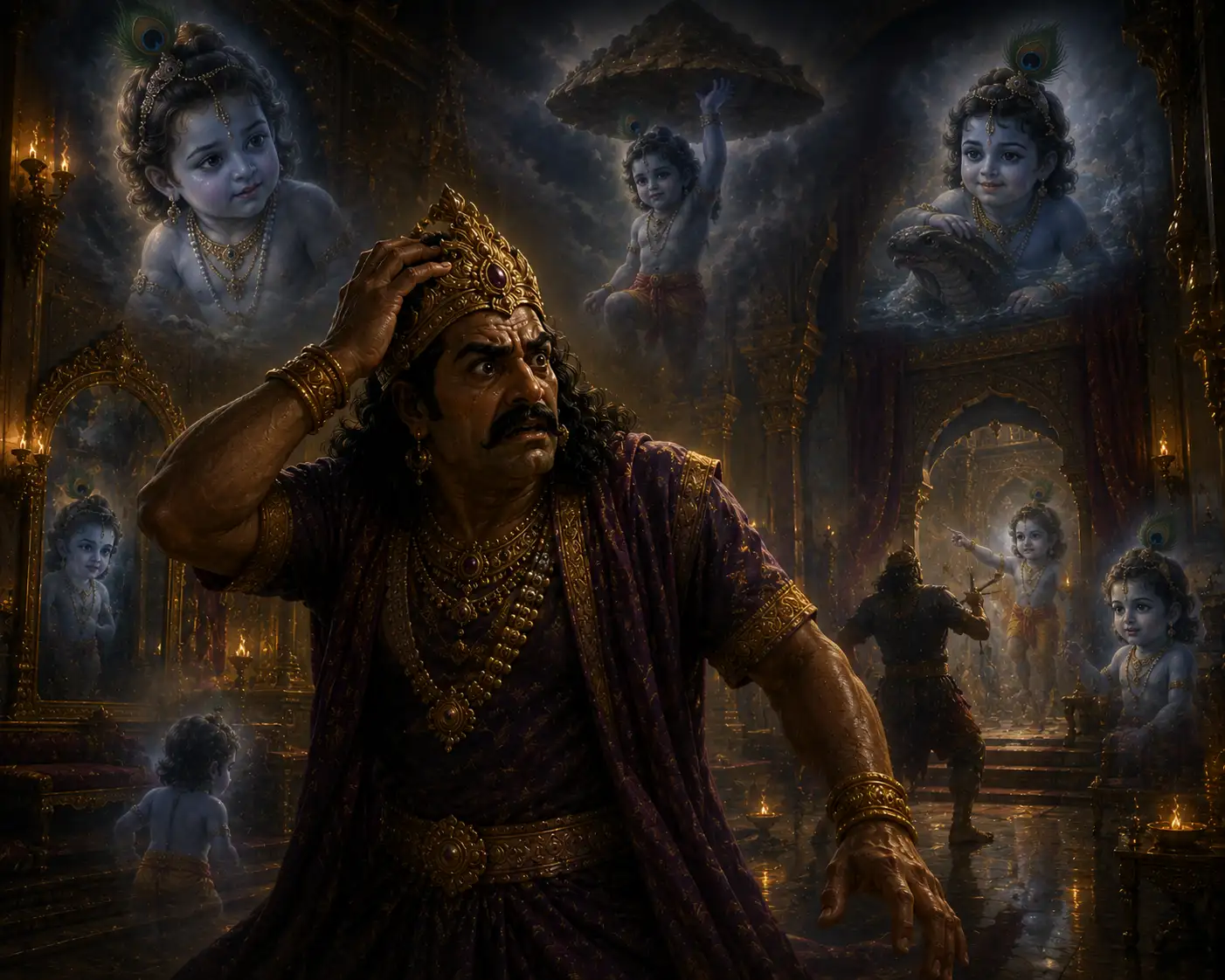
Among all the sages described in the Vedic scriptures, Devarshi Narad occupies a unique place. He moves freely through the three worlds, carrying the Lord's message wherever he goes. At first glance, some of his actions seem puzzling. He often appears at moments of great tension, says only a few carefully chosen words, and departs, leaving behind events that dramatically alter the course of history. To the casual observer, it may seem as though Narad creates conflict. In reality, he never acts independently. His every action serves the divine purpose, ensuring that God's eternal plan unfolds exactly when it should.
When Narad learned that Kansa had spared Devaki's first child, he immediately recognised the consequences. If Kansa's fear subsided, the sequence of events leading to Krishna's appearance might be delayed. The Lord had already resolved to descend for the protection of His devotees and the restoration of dharma. The time had come for that promise to be fulfilled.
Narad therefore visited Kansa, not to increase his cruelty for its own sake, but to awaken the insecurity that still lingered beneath the surface. During their conversation, the sage performed a simple yet unforgettable demonstration.
Holding a flower in his hand, Narad asked Kansa to count its petals.
"There are eight," replied the king.
Narad then smiled and asked, "Show me the eighth petal."
Kansa pointed to one of them without hesitation.
The sage gently rotated the flower.
"Now begin counting from this petal."
Once again Kansa counted carefully.
To his surprise, a different petal had become the eighth.
Narad rotated the flower again.
The result changed once more.
After repeating this simple exercise several times, Narad looked at the bewildered king and quietly asked, "If the eighth petal changes according to where you begin counting, how can you be certain which child will be the eighth?"
The lesson struck Kansa like a thunderbolt.
Until that moment, he had believed himself safe until Devaki's eighth child was born. Now a terrifying possibility entered his mind. What if the prophecy referred not to chronological order but to divine perspective? What if any child could be the one destined to end his life?
Fear, once again, overwhelmed reason.
The compassion that had briefly softened his heart vanished completely. Convinced that every child represented a possible threat, Kansa hardened himself beyond all mercy. One after another, as each child was born, he seized the innocent infant and ended its life.
The Srimad Bhagavatam presents these painful events not to glorify violence but to reveal the tragic consequences of a mind completely governed by fear. Every attempt Kansa made to preserve his life only drew him closer to the destiny he sought to avoid. His obsession blinded him to the reality that death cannot be prevented through cruelty, nor can destiny be altered by opposing the will of God.
For the devotee, Narad's intervention carries an equally profound lesson. God's plan often unfolds in ways that appear mysterious when viewed through ordinary human logic. Events that initially seem harsh or difficult may ultimately serve a far greater purpose than we can immediately perceive. The Lord's compassion is not measured by our temporary comfort but by His eternal concern for the soul's welfare. Through Narad's seemingly simple conversation with Kansa, the stage was being prepared for one of the most glorious nights in all of spiritual history: the divine appearance of Shree Krishna.
As darkness deepened within the prison of Mathura, another kind of preparation was taking place beyond the vision of ordinary eyes. The gods themselves had begun to pray. Mother Earth, burdened by oppression, cried out for relief. And in the eternal realm beyond material creation, the Supreme Lord had already resolved that the hour of His descent was drawing near.
The World Waits for the Lord
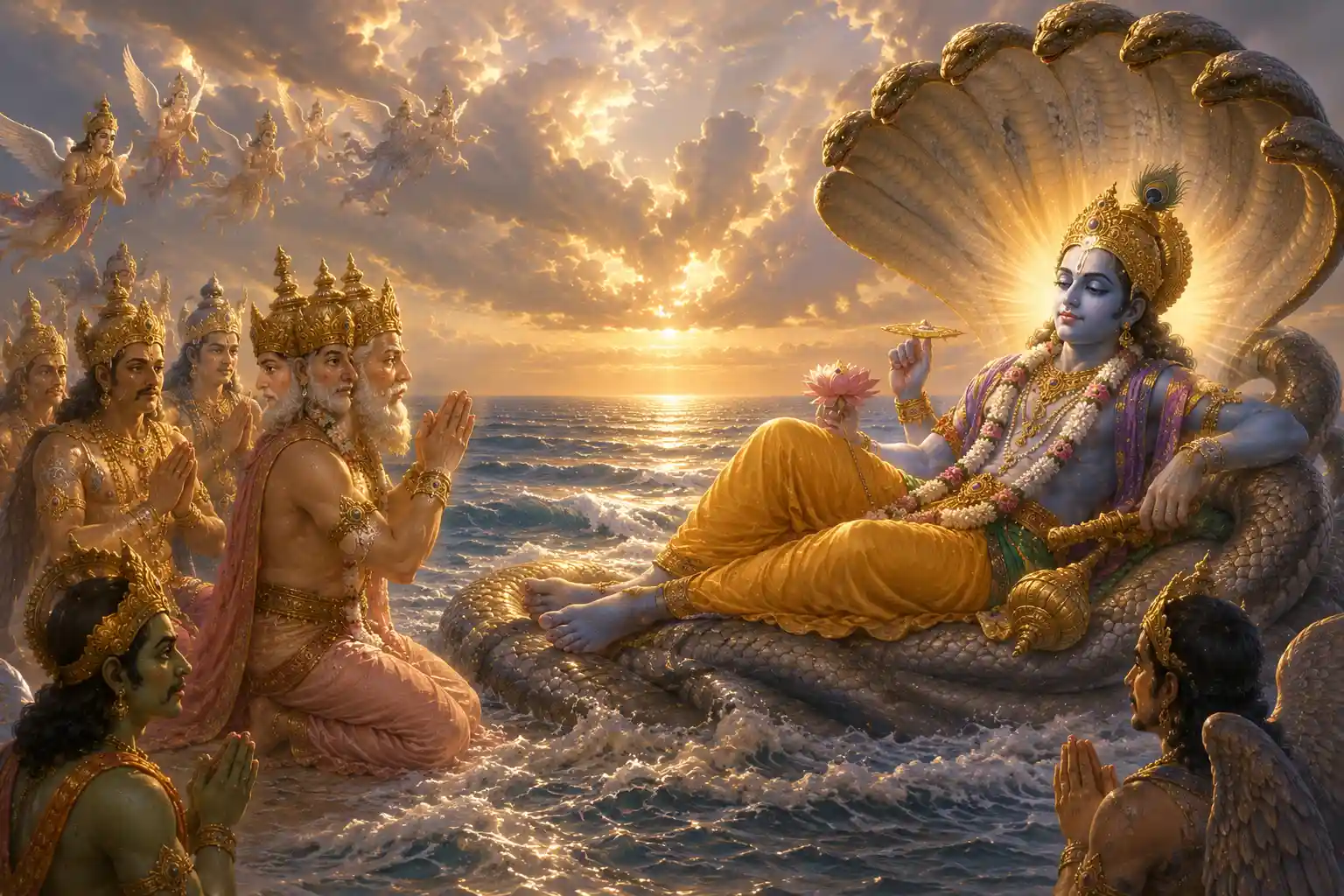
As Kansa's cruelty intensified, the burden of adharma upon the Earth became unbearable. The Srimad Bhagavatam describes how Mother Earth, unable to endure the oppression of demonic rulers any longer, approached the celestial gods in the form of a sorrowful cow. Led by Lord Brahma, the devas journeyed to the shores of the Kshira Sagara, the Ocean of Milk, where they offered heartfelt prayers to Lord Vishnu. Rather than demanding immediate action, they surrendered themselves to the Lord's wisdom, trusting that His intervention would come at the perfect moment.
Swami Mukundananda explains that this episode teaches an enduring spiritual principle. When the forces of darkness appear overwhelming, devotees do not abandon faith. They intensify their remembrance of God. The devas understood that while human effort is essential, ultimate victory over adharma comes only through divine grace. Their prayers remind us that the Lord is never indifferent to the suffering of His devotees. He may not always intervene according to our timetable, but He always acts according to His perfect wisdom.
The divine response soon came. Lord Vishnu assured the assembled devas that He would descend upon Earth as the son of Vasudev and Devaki. He instructed the celestial beings to take birth in the Yadu dynasty and in the villages of Braj so they could participate in His earthly pastimes. At the same time, Yogamaya, the Lord's divine internal energy, was entrusted with a crucial role in preparing the circumstances for His appearance.
Before Krishna's birth, another miraculous event took place. Devaki's seventh child, who was none other than Ananta Shesha, was mystically transferred by Yogamaya from Devaki's womb to that of Rohini, another wife of Vasudev who was living safely in Gokul under the care of Nanda Baba. Because He was "drawn away" from one womb to another, He became known as Sankarshana, and He later appeared as Lord Balaram, Krishna's elder brother and eternal companion.
To Kansa, it appeared that Devaki had suffered a miscarriage. His suspicions remained, but he could not comprehend the divine arrangement unfolding beyond his perception. The Lord's plans operate on a plane that no worldly power can obstruct. Kings may command armies and imprison saints, but they cannot restrain the will of the Supreme.
At last, the sacred night of Janmashtami arrived.
The prison that symbolised despair became the setting for one of the most glorious moments in spiritual history. At midnight, when the world lay enveloped in silence, the Supreme Personality of Godhead manifested before Vasudev and Devaki in His resplendent four-armed form, adorned with the conch, discus, mace, and lotus. Seeing the Lord before them, His divine parents offered heartfelt prayers, overwhelmed by reverence and devotion. They recognised that the child appearing before them was none other than the eternal Lord worshipped by sages and saints across countless ages.
Yet Krishna's purpose was not to inspire awe alone. At the request of His parents, He soon assumed the charming form of an ordinary infant. The Infinite became seemingly helpless. The Lord who sustains innumerable universes chose to rest peacefully in the arms of His devotee. This beautiful transformation reveals one of the central messages of the Bhagavatam: God's supreme majesty is matched only by His infinite sweetness.
Through Yogamaya's divine arrangement, the prison doors opened of their own accord, the guards fell into deep sleep, and the chains binding Vasudev miraculously loosened. Carrying the newborn Krishna in a basket upon his head, Vasudev stepped into the stormy night and began the journey towards Gokul. Even the river Yamuna, swollen by heavy rains, respectfully parted to allow the Lord's passage, while Ananta Shesha spread His mighty hoods above the infant Krishna, shielding Him from the rain.
These events are not merely miraculous episodes from sacred history. They symbolise the transformation that occurs when God enters the heart. The prison doors of ignorance begin to open, the chains of attachment gradually loosen, and obstacles that once appeared insurmountable become opportunities for divine grace. Janmashtami is therefore not only the remembrance of Krishna's appearance in Mathura thousands of years ago; it is an invitation to allow Him to appear within our own hearts through faith, devotion, and loving remembrance.
The Eternal Message of Janmashtami
The prophecy that terrified Kansa ultimately became the prophecy that filled the world with hope. Throughout the narrative, two contrasting responses to life's uncertainties unfold side by side. Kansa responded with fear, attempting to control destiny through violence. Vasudev and Devaki responded with faith, choosing truth and surrender even when every circumstance seemed unfavourable. Their lives remind us that while we cannot always control external events, we can always choose the spirit in which we face them.
This timeless lesson finds beautiful expression in Shree Krishna's own words in the Bhagavad Gita:
यदा यदा हि धर्मस्य ग्लानिर्भवति भारत ।
अभ्युत्थानमधर्मस्य तदात्मानं सृजाम्यहम् ॥ 7॥
yadā yadā hi dharmasya glānir bhavati bhārata
abhyutthānam adharmasya tadātmānaṁ sṛijāmyaham
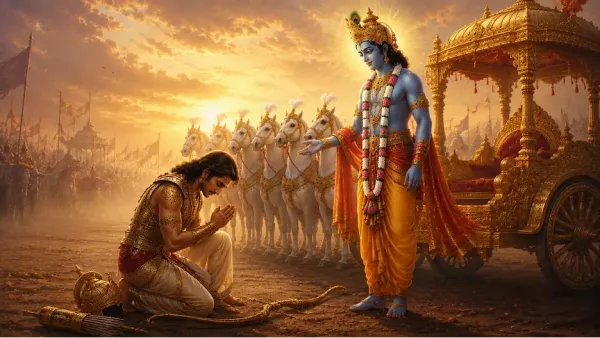
BG 4.7: Whenever there is a decline in righteousness and an increase in unrighteousness, O Arjun, at that time I manifest Myself on earth.
Krishna's appearance fulfilled this eternal promise, but His mission extended far beyond defeating a tyrant. He came to awaken devotion, restore hope, and remind every soul of its eternal relationship with God.
Krishna's birth is not merely a historical event; it becomes a living reality that renews hope, dispels inner darkness, and reminds us that divine grace is always working, even when we cannot yet see its unfolding.
As you celebrate Janmashtami 2026, remember that the prophecy which once struck fear into the heart of a mighty king became the fulfilment of humanity's greatest hope. Darkness may appear powerful for a time, but it can never extinguish the light of God's compassion. The Lord who descended in Mathura continues to descend into every heart that welcomes Him with faith, humility, and love.
Call To Action: Continue Your Spiritual Journey with JKYog
If this exploration of Shree Krishna's divine avatar has inspired you to deepen your relationship with God, continue your journey through the authentic teachings of Swami Mukundananda and JKYog.
Study the Bhagavad Gita verse by verse through Swamiji's practical commentaries:

Immerse yourself in his illuminating discourses on the Srimad Bhagavatam, and experience guided Roop Dhyan meditations, bhajans, daily inspiration, and spiritual challenges through the Bhagavad Gita & Krishna Bhakti App:

 JKYog
JKYog
Frequently Asked Questions
1. Why is the Tenth Canto called the heart of the Srimad Bhagavatam?
The Tenth Canto focuses on the divine life and pastimes of Shree Krishna, the Supreme Personality of Godhead. It is the longest canto because it reveals the sweetest and most intimate aspects of God's relationship with His devotees.
2. Why did Kansa become afraid of Devaki's child?
A divine proclamation (Akashvani) foretold that Devaki's eighth child would bring about Kansa's death. Consumed by fear and attachment to power, Kansa attempted to prevent the prophecy from being fulfilled.
3. Why did Vasudev promise to hand over his children to Kansa?
To save Devaki's life, Vasudev promised to bring each child to Kansa. His decision reflected extraordinary faith, integrity, and trust in God's divine plan.
4. What role did Sage Narad play in Krishna's birth story?
Narad acted as an instrument of the Lord's divine plan. By awakening Kansa's fears, he ensured that the events leading to Krishna's appearance unfolded according to God's will.
5.What can we learn from Janmashtami today?
Janmashtami teaches that no matter how powerful darkness appears, God's grace ultimately triumphs. It inspires us to trust divine timing, uphold righteousness, and cultivate loving devotion to Shree Krishna.
Further Resources