


Introduction: The Modern Quest for Inner Peace and Lasting Joy
In an era characterized by hyper-connectivity, technological speed, and unprecedented material abundance, human beings paradoxically find themselves grappling with profound emotional dissonance. Strained personal relationships, overwhelming decision fatigue, pervasive anxiety, and a persistent sense of emptiness frequently overshadow daily life. We often ask ourselves why, despite our best efforts, true happiness remains elusive. Is happiness an accidental stroke of luck, or is it a deliberate, cultivable skill governed by timeless spiritual laws?
Swami Mukundananda, a world-renowned spiritual leader, philosopher, Vedic scholar, and alumnus of both the Indian Institute of Technology (IIT Delhi) and the Indian Institute of Management (IIM Calcutta), offers a profound blueprint for inner transformation. Grounded in ancient Vedantic wisdom and presented with logical clarity, his teachings bridge the gap between ancient spiritual science and contemporary psychological needs. Through his acclaimed 21-Day Happiness Challenge, Swamiji systematically deconstructs the mechanisms of the human mind, offering practical tools to liberate individuals from self-created suffering.
Two central pillars of this transformational journey are Day 8, titled "Find Solution to Your Imbalanced Relationship," and Day 9, titled "Make Right Choices in Life." Together, these two discourses present a comprehensive roadmap for mastering interpersonal dynamics and shaping human destiny. Day 8 addresses the friction, disappointment, and imbalance that plague our connection with others by introducing the revolutionary framework of the Relationship Bank Account. Day 9 dives into the core engine of human progress: the power of conscious choice, illustrated vividly through the dramatic, life-transforming story of Saint Goswami Tulsidas.
This comprehensive exploration examines every facet of Swami Mukundananda's teachings across these two pivotal discourses. By understanding how to transform conditional expectations into selfless service, and how to elevate our decision-making capacity through intellectual clarity and spiritual resolve, we can unlock the door to harmonious relationships and an exalted destiny.
Part I: Deconstructing Imbalanced Relationships
The Root Cause of Relationship Discord
Human beings are inherently social creatures, driven by a deep-seated longing for affection, belonging, and connection. Yet, relationships remain one of the most significant sources of stress, heartache, and conflict in modern society. Marriages dissolve, friendships fracture, and family dynamics become burdened by bitterness and silent resentment. Swami Mukundananda begins his discourse on Day 8 of the Happiness Challenge by asking a fundamental question:
Why do relationships become imbalanced, fragile, and painful?
Swamiji explains that the root cause of relational turmoil lies in a fundamental misdirection of human focus. Most people enter relationships with a consumer mindset. They view the other person as a source of gratification, validation, comfort, and emotional fulfillment. We constantly evaluate our partners, family members, colleagues, and friends based on what they are doing for us. We ask: Are they treating me with respect? Are they fulfilling my emotional needs? Are they conforming to my expectations?
When our primary orientation is centered on receiving, we inevitably set ourselves up for disappointment. Human beings are imperfect, conditioned by their own past experiences, mental habits, and emotional limitations. No single individual can consistently fulfill all the expectations placed upon them by another. When expectations are unmet, frustration takes root. Frustration evolves into criticism, criticism breeds resentment, and resentment eventually destroys the fragile fabric of trust and love.
The Relationship Bank Account Analogy
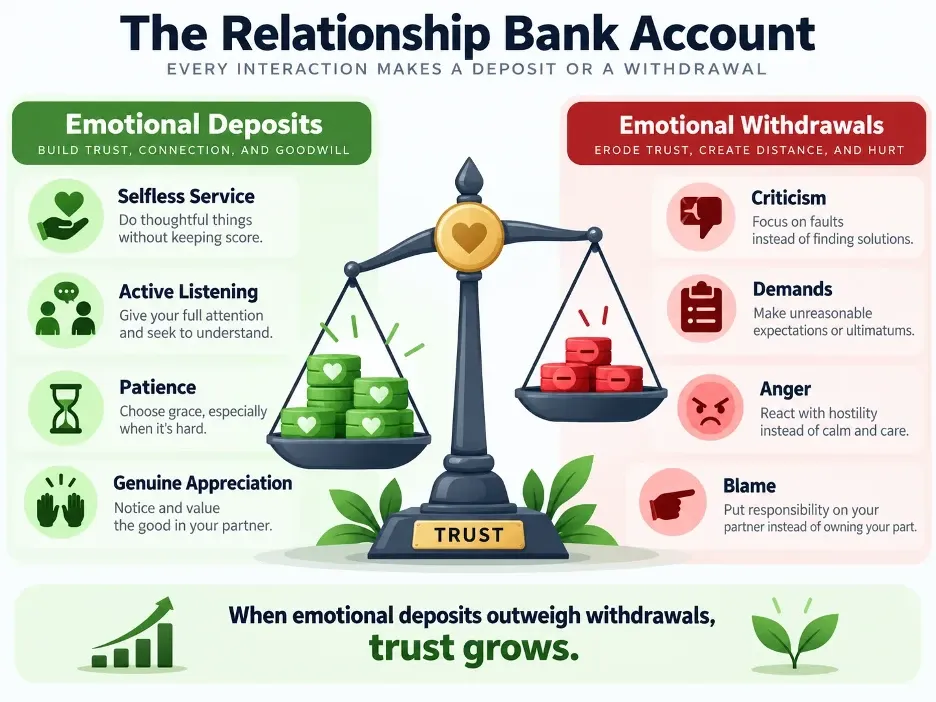
To illuminate the mechanics of interpersonal harmony, Swami Mukundananda introduces a brilliant and memorable metaphor: the Relationship Bank Account. Just as a financial bank account operates on the strict principles of credits and debits, every human relationship possesses a psychological reserve governed by emotional deposits and emotional withdrawals.
In a financial account, if you attempt to write a check for ten thousand dollars when your balance is only one hundred dollars, the check will inevitably bounce, incurring penalty fees and causing financial distress. You cannot make substantial withdrawals without first accumulating sufficient deposits. Surprisingly, in our personal relationships, we routinely violate this basic law of accounting.
We expect expensive withdrawals from our loved ones while failing to maintain an adequate balance of emotional deposits. What constitutes an emotional withdrawal in a relationship? Swamiji outlines several common forms of withdrawals:
- Demands and Expectations: Insisting that the other person behave according to our personal desires, standards, or timelines.
- Criticism and Judgement: Pointing out flaws, nitpicking mistakes, or making the other person feel inadequate.
- Emotional Reactivity and Anger: Outbursts of temper, harsh speech, moody silence, or passive-aggressive behavior.
- Self-Centeredness: Prioritizing one's own comfort, preferences, and desires above the needs of the other person.
- Blame and Accusation: Holding the other person responsible for our own negative emotional state or unhappiness.
When a relationship is subjected to continuous withdrawals without compensating deposits, the emotional account enters a severe deficit. In a bankrupt relationship, even a minor misunderstanding or casual comment triggers explosive arguments. The participants lack the psychological buffer required to forgive, tolerate, or understand each other.
Anatomy of Relationship Deposits
If withdrawals bankrupt a relationship, what constitutes an emotional deposit? Swami Mukundananda teaches that deposits are intentional, selfless actions and attitudes that build trust, emotional security, and genuine goodwill. Deposits represent investments of the heart that accumulate over time. Swamiji highlights key forms of emotional deposits:
- Selfless Service and Sacrifice: Joyfully putting the needs, comfort, and happiness of the other person above one's own without demanding anything in return.
- Genuine Appreciation and Compliments: Actively recognizing and expressing gratitude for the positive qualities, efforts, and virtues of the other person.
- Understanding and Active Listening: Seeking deeply to understand the other person's perspective, feelings, and struggles before demanding to be understood.
- Patience and Tolerance: Overlooking minor flaws, forgiving mistakes, and exercising restraint when provoked or disappointed.
- Affection and Kindness: Small, consistent gestures of love, care, encouragement, and emotional warmth.
When two individuals consistently prioritize making emotional deposits, their Relationship Bank Account develops a massive surplus. In a relationship blessed with a rich emotional balance, miscommunications and errors are easily absorbed. Mistakes are forgiven with ease because the overwhelming reservoir of goodwill prevents temporary grievances from damaging the bond.
Reversing the Formula: Lowering Expectations for Others, Raising Standards for Yourself
The crucial breakthrough taught by Swami Mukundananda on Day 8 lies in changing our internal orientation. Swamiji presents a revolutionary formula for restoring balance to any relationship, no matter how strained or broken it may currently appear:
Lower your expectations of others while raising your standards for yourself.
In standard human interactions, people operate in the exact reverse manner. They hold extremely low standards for their own behavior, excusing their own outbursts, laziness, and flaws as natural human imperfections, while maintaining ridiculously high expectations for others, demanding perfection, flawless devotion, and total compliance. This asymmetrical posture guarantees continuous conflict.
By consciously reversing this dynamic, we take complete ownership of our relationships. Swamiji advises us to ask ourselves: What standard am I setting for my own patience, kindness, humility, and willingness to serve? Am I making continuous deposits of selfless love, or am I constantly attempting to withdraw emotional capital through expectations and demands?
When you lower your expectations of others, you liberate them from the heavy burden of your demands. You accept them as they are, recognizing that their flaws are a product of their own mental conditioning. Concurrently, by raising your personal standards of tolerance, understanding, and service, you transform into a continuous source of positive emotional energy. You cease being a needy beggar seeking emotional validation and become a generous giver capable of enriching every life you touch.
Part II: Cultivating Harmony Through Mind Management
Mind Management in Interpersonal Dynamics
Swami Mukundananda emphasizes that external relationship management is fundamentally an extension of internal mind management. The human mind is either our best friend or our worst enemy. When the mind is infested with pride, selfishness, greed, and possessiveness, every relationship it engages in becomes toxic and unstable. Conversely, when the mind is disciplined, tranquil, and anchored in higher spiritual principles, it naturally radiates harmony.
Many people fall into the trap of believing that their happiness depends entirely on changing the behavior of their spouse, child, parent, or friend. They reason: "If only my partner were more affectionate, if only my boss were more reasonable, if only my children were more obedient, I would finally be happy." Swamiji firmly dismantles this delusion. Attempting to control or change external individuals is an exercise in futility. The only mind over which you possess direct authority is your own.
Day 4 of Swamiji's Happiness Challenge highlights the necessity of taking full responsibility for one's own emotions. When someone speaks harshly to us, their words are merely external acoustic vibrations. The emotional pain, anger, or offense we experience is created entirely within our own mind by our internal interpretation and attachment. By cultivating intellectual clarity, we can choose not to absorb negative energy. We can disengage our emotional reactivity from external circumstances and respond with wisdom, dignity, and compassion.
Moving from Transactional Love to Unconditional Devotional Contribution
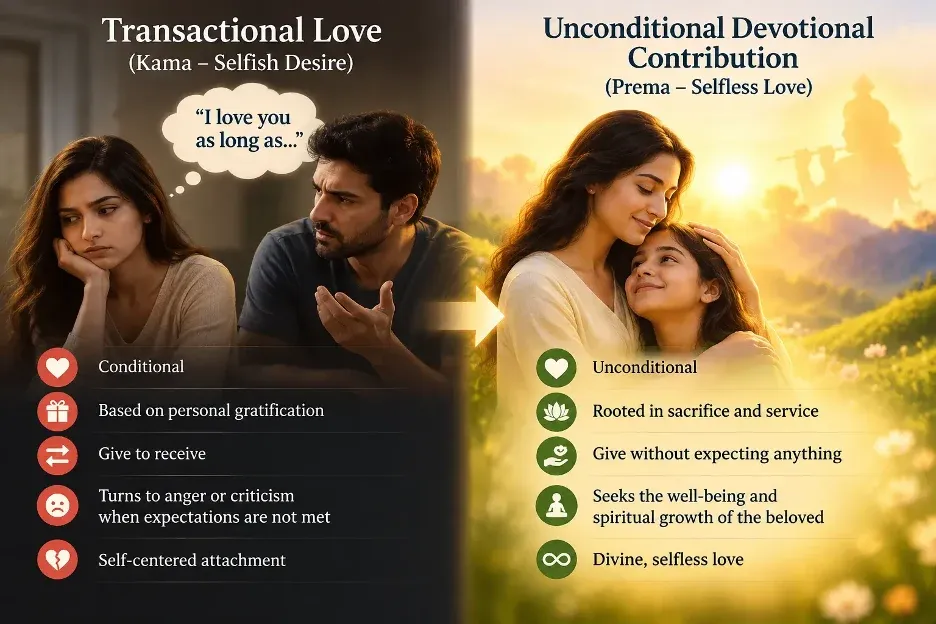
In modern vernacular, the word "love" is frequently used, yet rarely understood. What passes for love in the material world is usually transactional attachment, known in Vedic philosophy as Kama or selfish desire. Transactional love is conditional: "I will love you as long as you make me feel good, agree with me, and meet my needs." The moment the other person fails to deliver the expected gratification, the so-called love instantly transforms into anger, criticism, or indifference.
Swami Mukundananda contrasts this transactional mindset with divine, selfless love, known as Prema. True love is rooted in the spirit of sacrifice and service. It does not bargain, trade, or keep score. It seeks only the well-being and spiritual elevation of the beloved.
Swamiji explains that when we practice Karma Yog, the art of performing duties while keeping the mind attached to the Supreme, our entire approach to human relationships undergoes a sacred alchemy. We begin to see the Divine residing within the hearts of all living beings. Serving our family, friends, and community is no longer viewed as a burdensome duty or a transactional exchange. Instead, it becomes an act of devotional offering, a means of purifying the mind and expressing love for God.
When your relationships are elevated to this spiritual plane, disappointment becomes impossible. Since you no longer demand personal gratification, no one can deprive you of your peace. You become an inexhaustible fountain of goodwill, pouring emotional deposits into the lives of everyone around you without expecting anything in return.
Part III: The Science of Wise Choices

The Architecture of Human Destiny
On Day 9 of the Happiness Challenge, Swami Mukundananda shifts the focus from interpersonal dynamics to the fundamental engine that drives individual destiny: the power of human choice. Day 9 is titled "Make Right Choices in Life," carrying the profound message:
Choose and commit to excellence!
Swami Mukundanandai asserts that human life is not a random sequence of arbitrary events, nor is it strictly dictated by blind fate. While external circumstances and past karmic impressions influence our starting point, our ultimate path, character, and destiny are shaped by the choices we make every single day, every single hour, and every single moment.
Consider two individuals born in the exact same environment, raised by the same parents, and exposed to the same external challenges. One chooses the path of discipline, integrity, continuous self-improvement, and spiritual devotion, eventually attaining greatness, inner peace, and social reverence. The other chooses the path of indolence, self-indulgence, resentment, and vice, descending into misery and self-destruction. What accounted for their divergent paths? It was not their initial circumstance, but the trajectory of their personal choices.
We are constantly standing at crossroads. Conscientious choices build character, elevate consciousness, and forge an exalted life. Unconscious, impulsive choices erode virtue, degrade intellect, and lead to regret. Therefore, mastering the science of making right choices is the most vital skill a human being can cultivate.
The Foundation of Wise Choices: A Contented Mind
An essential revelation presented by Swami Mukundananda on Day 9 is the intimate relationship between our emotional state and our decision-making ability. Swamiji points out a critical psychological truth:
A happy and contented mind makes far superior, wiser choices than an agitated, discontented mind.
When the mind is agitated by stress, fear, anger, jealousy, or despair, the intellect becomes clouded and impaired. Under the influence of turbulent emotions, human beings make impulsive, destructive choices that they later regret for years or decades. A person driven by acute loneliness may choose a toxic partner; a person consumed by frustration may make a reckless financial gamble; a person overcome by anger may utter words that sever a lifelong friendship.
Conversely, when the mind is anchored in internal peace, gratitude, and contentment, the intellect remains sharp, clear, and serene. A calm mind possesses the perspective required to evaluate long-term consequences, weigh ethical considerations, and choose wisdom over immediate gratification.
Swamiji emphasizes that happiness is not merely the byproduct of good choices; it is also the prerequisite for making good choices. By practicing the foundational tools of the Happiness Challenge disengaging reactivity, practicing gratitude, taking internal responsibility, and nurturing a quiet mind, we create the optimal internal environment for sound judgment and noble choices.
Short-Term Pleasure versus Long-Term Excellence: Preyas and Shreyas
To deepen our understanding of choice, Swami Mukundananda draws upon the ancient wisdom of the Katha Upanishad, which categorizes all human choices into two distinct paths: Preyas and Shreyas.
- Preyas (The Path of Immediate Pleasure): This path offers immediate gratification, comfort, and sensory delight. However, because it is rooted in short-term impulse and sensory attachment, it ultimately leads to long-term bondage, health degradation, financial ruin, and spiritual stagnation. In the words of the Bhagavad Gita, pleasure that feels like nectar in the beginning invariably turns into poison in the end.
- Shreyas (The Path of Ultimate Good): This path demands discipline, effort, self-restraint, and bitter austerity in the beginning. It requires sacrificing immediate sensory comfort for the sake of higher values, health, intellectual mastery, and divine realization. Though it feels like poison at first, it transforms into eternal nectar in the end, yielding abiding peace, joy, and liberation.
Modern society is overwhelmingly engineered to entice human beings down the path of Preyas. Fast food, instant entertainment, superficial social media validation, and addictive sensory distractions offer immediate spikes of dopamine while quietly bankrupting human potential.
Swami Mukundananda challenges us to break free from the slavery of the lower mind and senses. The lower mind (Manas) naturally gravitates toward comfort and immediate pleasure. It is the sacred duty of the higher intellect (Buddhi) to govern the mind, applying discernment to choose Shreyas over Preyas. True freedom is not the license to indulge every passing impulse, but the disciplined power to choose that which aligns with our highest purpose.
Part IV: The Transformative Tale of Goswami Tulsidas
The Infatuation of Young Tulsidas

To illustrate the extraordinary, life-altering power of a single conscious choice, Swami Mukundananda narrates one of the most compelling and famous stories from the history of Indian saintly literature: the transformation of Goswami Tulsidas.
Today, Saint Tulsidas is universally revered across the world as a towering spiritual genius, a supreme devotee of Lord Ram, and the immortal author of the Hindi Ramcharitmanas, a literary and devotional masterpiece that has nourished the souls of millions for over four centuries. However, in his early youth, Tulsidas was far from being a saint. In fact, he was completely gripped by intense worldly passion and infatuation.
Tulsidas was deeply, almost obsessively, attached to his beautiful young wife, Ratnavali. His mind revolved around her constantly. He could barely tolerate being separated from her for even a few hours. His intense physical and emotional attachment blinded him to all other duties, higher intellectual pursuits, and spiritual aspirations.
One day, while Tulsidas was away from home on business, Ratnavali's brother arrived to take her to her father's house for a brief family visit. Knowing her husband's obsessive nature, Ratnavali left quietly, hoping that he would understand and await her return.
When Tulsidas returned home that evening and discovered that his wife was absent, he was overcome with acute restlessness and distress. The thought of spending a single night without her was unbearable to his infatuated mind. Ignoring all social decorum, weather warnings, and common sense, he immediately set off after her in the dead of night.
The Stormy Night, the Swollen River, and the Snake
As Tulsidas journeyed toward his father-in-law's village, a fierce, torrential storm erupted. The skies poured relentless rain, thunder cracked overhead, and pitch darkness enveloped the countryside. Soon, Tulsidas arrived at the bank of a major river, which had swollen into a raging, turbulent torrent due to flash floods.
The local boatmen had long since tied up their boats and departed, refusing to navigate the treacherous waters in the middle of a night storm. Any ordinary person would have paused, recognized the extreme danger, and waited for dawn. But Tulsidas's mind was consumed by passionate obsession. Driven by intense desire, he spotted a bloated human corpse floating near the riverbank. Driven by desperation, he grabbed hold of the lifeless body, using it as a makeshift raft to paddle his way across the deadly, roaring river.
Having miraculously survived the crossing, Tulsidas reached Ratnavali's ancestral home in the late hours of the night. The large house was locked from the inside, and all the inhabitants were fast asleep. Unwilling to knock and risk embarrassing himself before his in-laws, Tulsidas circled the perimeter of the house, searching for a way to reach his wife's second-floor bedroom window.
In the dark, rain-swept night, he saw what appeared to be a thick, sturdy rope hanging down from the upper balcony. Without hesitation, he grabbed the rope and hauled himself up the wall, scrambling into Ratnavali's room.
When Ratnavali awoke and saw her husband standing before her, drenched, battered, and mud-stained, she was utterly astonished and alarmed. She asked how he had managed to cross the flooded river and climb up to her second-floor room in total darkness.
Tulsidas proudly recounted his harrowing exploits. He told her how he had braved the raging river and how he had used the heavy rope hanging from her balcony to climb up.
Curious and concerned, Ratnavali took a lamp and peered out of the window to inspect the rope. To her horror, she discovered that there was no rope. What Tulsidas had grabbed and pulled with all his weight was actually a deadly, venomous cobra that had been hanging from the roof eaves. In his intense, delusional state, Tulsidas had not even realized that he was gripping a deadly serpent.
The Life-Changing Admonition and the Choice of Awakening
Ratnavali was a woman of exceptional intelligence, moral courage, and spiritual depth. Rather than feeling flattered by her husband's extreme, life-threatening infatuation, she felt a profound sense of anguish and pity for his spiritual blindness. Looking directly into his eyes, she uttered a set of powerful, poetic words that reverberated through the depths of his soul:
"Aadhaa bhi jo prem aapko is chamde ke sharir se hai, utna prem yadi aap Shree Ram se karte, toh aap bhav-sagar se paar ho jaate."
She chided him, saying: "This body of mine is nothing more than a temporary structure made of skin, flesh, bone, blood, and filth. If even half of the intense love, passion, and desperate attachment you have shown for this perishable physical frame were directed toward Lord Ram, you would have already crossed the ocean of material existence and attained supreme God-realization!"
Ratnavali's words struck Tulsidas like a bolt of lightning. The sharp truth of her admonition shattered the thick veil of worldly illusion (Maya) that had clouded his intellect for years. In that precise instant, Tulsidas stood at the ultimate crossroads of his life.
He had two choices. He could have reacted with hurt pride, anger, and defensiveness, arguing with his wife, rationalizing his behavior, and remaining trapped in the mundane cycle of worldly attachment. Or, he could accept the truth, recognize his delusion, and choose to redirect his powerful emotional energy toward the Divine.
In that transformative moment, Tulsidas made the conscious, unwavering choice for spiritual awakening. He did not utter a single word of argument. He turned around, descended from the house, and walked away into the night, renouncing his worldly life forever.
The Emerging Saint and the Immortal Ramcharitmanas
From that fateful night onward, Tulsidas directed the full intensity of his passion, focus, and energy toward Lord Ram. The same fiery intensity that had previously driven him to grab a floating corpse and climb a poisonous snake was now channeled into intense spiritual sadhana, devotion, and scriptural contemplation.
He traveled to holy pilgrimage sites, engaged in deep meditation, and earned the divine grace of Hanuman Ji and Lord Ram. His heart became an ocean of pure, divine love. Under divine inspiration, he composed the Ramcharitmanas in Awadhi, making the sacred lore of Lord Ram accessible to the common human being in a lyrical, emotionally resonant, and philosophically profound format.
Swami Mukundananda points out the eternal lesson embedded within Tulsidas's life story:
The energy of the human mind is neutral, like electric current. When directed toward material sense objects, it manifests as binding obsession, jealousy, and distress. When redirected toward the Supreme, that exact same energy transforms into divine devotion, supreme wisdom, and eternal liberation.
Tulsidas's destiny was not sealed by his past mistakes or his youthful infatuations. It was defined by the single, courageous choice he made on that stormy night: the choice to align his life with Shreyas, to commit to divine excellence, and never to look back.
Part V: Integrating Wisdom into Modern Daily Life
Practical Tools for Relationship Harmony and Conscious Living

The teachings of Swami Mukundananda on Days 8 and 9 of the Happiness Challenge are not meant to remain theoretical concepts in books or lectures. They are practical tools designed for immediate application in the crucible of daily life. By synthesizing the principles of the Relationship Bank Account with the discipline of Conscious Choice, we can transform our personal life and spiritual journey.
Here is a practical action plan derived from Swamiji's discourses:
- Perform a Daily Relationship Audit: Every evening, reflect on your interactions with family members, friends, and colleagues. Ask yourself: Did I make emotional deposits today through kindness, listening, appreciation, and service? Or did I make heavy withdrawals through demands, impatience, criticism, and moodiness? Strive consciously to maintain a massive surplus of deposits in every key relationship.
- Practice the "High Standards for Self, Low Expectations for Others" Rule: Whenever you feel disappointed or angry with someone, immediately pause and shift your focus. Stop analyzing their shortcomings. Ask instead: Am I maintaining high standards of tolerance, patience, and understanding? Am I demanding a perfection from them that I myself do not possess?
- Pause Before Deciding (Disengaging Impulse): Before making significant choices, whether in career, relationships, lifestyle, or daily habits, take a step back. Ensure that your mind is calm and contented before committing to a decision. Never make major life decisions in a state of acute anger, despair, or chaotic desire.
- Evaluate Choices Through the Lens of Preyas versus Shreyas: When faced with options, ask: Is this choice merely offering short-term sensory pleasure that will lead to long-term regret (Preyas), or does it require discipline now to yield enduring peace, health, and spiritual growth (Shreyas)? Consciously select Shreyas.
- Redirect Mental Energy Toward Higher Goals: Recognize that your mind's capacity for passion and dedication is a divine gift. If you find yourself obsessing over worldly attachments, sports, politics, status, or material acquisition, follow the example of Saint Tulsidas. Redirect that enthusiasm toward noble service, personal development, mind management, and devotion to God.
Building Unwavering Commitment (Sankalpa)
Making a good choice is only the first step; committing to that choice with unwavering determination (Sankalpa) is what guarantees success. Swami Mukundananda reminds us that many people make noble resolutions on New Year's Day or after hearing an inspiring lecture, only to abandon them at the first encounter with difficulty.
True excellence requires perseverance. When you choose to improve your relationships, discipline your mind, or deepen your spiritual practice, expect resistance from your past habits and external environments. When obstacles arise, anchor your mind in the higher purpose. Remind yourself that lasting happiness is a discipline, not a momentary feeling.
Conclusion: Embracing the Path of Lasting Happiness
Swami Mukundananda’s insights on Days 8 and 9 of the Happiness Challenge provide an exquisite, holistic guide for human elevation. In Day 8, Swamiji solves the age-old puzzle of relational friction by inviting us to become generous givers rather than needy takers. By filling our Relationship Bank Accounts with selfless service, tolerance, and active appreciation, while lowering our demands on others, we create sanctuaries of love, harmony, and mutual respect in our homes and workplaces.
In Day 9, Swamiji empowers us to assume full ownership of our destiny through the power of right choices. We learn that a peaceful, contented mind is the bedrock of wise decision-making, and that choosing Shreyas over Preyas elevates us from sensory slavery to spiritual mastery. The glorious story of Saint Goswami Tulsidas serves as a timeless testament to the fact that no matter where we currently stand, a single conscious choice, backed by resolute commitment, can redirect our life from worldly delusion to divine realization.
Happiness is neither a distant dream nor a matter of chance. It is an internal art, a daily practice, and a conscious choice. By applying these profound Vedantic principles with sincerity and perseverance, we can heal our relationships, master our minds, and walk with confidence on the path of everlasting joy, fulfillment, and spiritual perfection.
Summary of Key Takeaways
- Relationship Harmony (Day 8): Relationships operate like bank accounts. Prioritize making continuous deposits of love, service, patience, and appreciation. Lower your expectations of others while raising your standards for yourself.
- Conscious Choices (Day 9): Destiny is shaped by choices, not circumstances. A calm, contented mind is essential for wise decision-making. Choose Shreyas (long-term good) over Preyas (short-term pleasure).
- The Lesson of Tulsidas: Channel mental energy away from worldly infatuation toward divine devotion. A single resolute choice can transform one's character and destiny entirely.
FAQs
- What is the Relationship Bank Account concept? It is a metaphor where relationships thrive on emotional deposits (such as selfless service, appreciation, and patience) and become bankrupt when emotional withdrawals (such as criticism, demands, and anger) exceed deposits.
- How can I resolve friction in an imbalanced relationship? Follow Swamiji's golden rule: lower your expectations of others while raising your standards for yourself. Shift your focus from demanding emotional fulfillment to actively making selfless emotional deposits.
- What is the difference between Preyas and Shreyas? Preyas is the path of immediate pleasure that feels like nectar initially but leads to long-term distress. Shreyas is the path of ultimate good that requires discipline upfront but yields lasting peace and spiritual growth.
- Why is a peaceful mind essential for making right choices? An agitated or discontented mind impairs judgment and leads to impulsive regrets. A calm, contented mind provides the clarity required to evaluate long-term consequences and choose wisdom over short-term impulses.
- What key lessons do Saint Tulsidas’s life story teach us? It proves that mental energy is neutral. When redirected from worldly infatuation toward divine devotion through a single conscious choice, that same passion can completely transform your character and destiny.
Further Resources
 JKYog Team