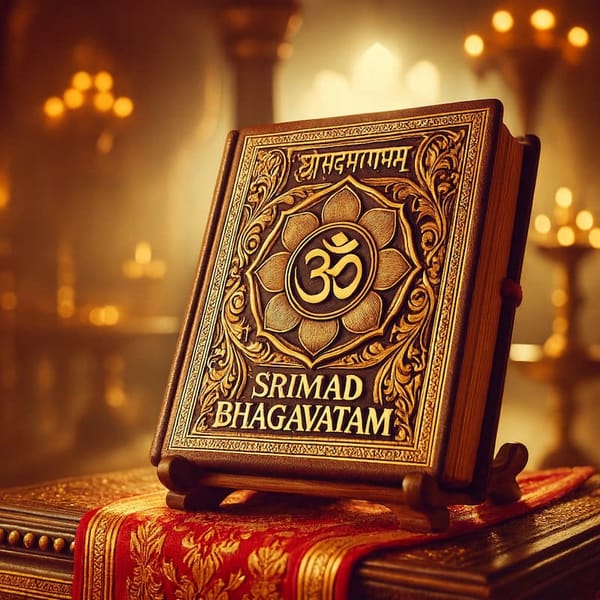

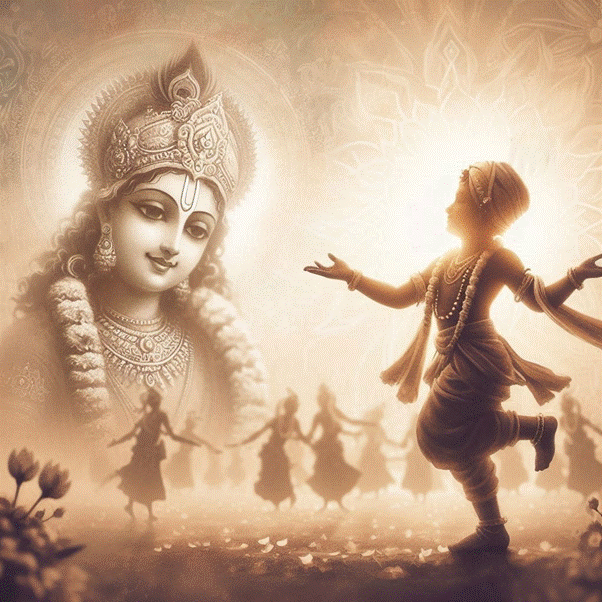
What is the Srimad Bhagavatam?
While every eternal principle rests on the authority of the Vedas, the Srimad Bhagavatam—penned by Sage Ved Vyas—shines as their distilled essence, the ripened fruit of Vedic wisdom. One who listens to this Katha with sincerity, focus, and devotion inevitably finds their spiritual knowledge expanding, worldly attachments fading, and love for the Divine blossoming within. But why so?
The Bhagavatam reveals something not found even in the Upanishads: Shyam prem. It pours forth a sweetness that quenches the soul’s deepest yearning. As Jagadguru Shree Kripaluji Maharaj says,
“वन्दनीय हैं उपनिषद, इनमें ज्ञान महान;
श्याम प्रेम बिनु ज्ञान सो प्राण-हीन तनु जान।” ~ Verse 88, Bhakti Shatak
The Upanishads are venerable and hold profound wisdom, as they are part of the Vedas. Yet, knowledge without love for the Supreme Lord is like a lifeless body. It is this love that turns knowledge into realization and learning into living devotion. So, let us embark on this pilgrimage and partake the nectar of divine love!
Mystery of the Amar Katha
The Srimad Bhagavat Katha, also known as the Amar Katha, is an ocean of wisdom and divine love. Its verses flow like streams of bliss, revealing the Lord’s pastimes that illumine the mind and nourish the heart.
Before entering this sacred narrative, tradition invites us to first understand its significance. This practice mirrors what happens at pilgrimage sites, where the priest explains the importance of the holy place you visit. By grasping its value, one’s heart becomes more receptive, allowing deeper devotional sentiments to awaken. Likewise, beginning this katha with its glory prepares the listener to receive its nectar. An enchanting tale from the Puranas now ushers us into this profound journey.
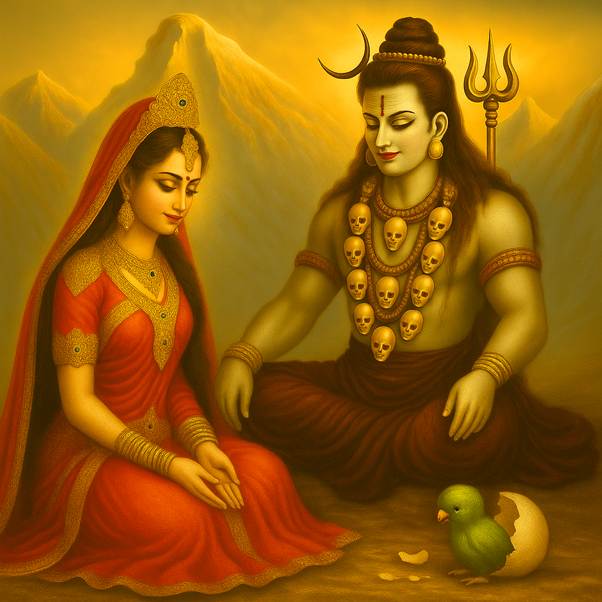
Once, Vamadev Maharaj, the Guru of Parvati, approached her and enquired, “Your husband, Bhagavan Shiv, wears a garland of skulls around his neck. Do you know whose heads they are?” Parvati replied calmly, “No, Gurudev. Why should I concern myself with it?” Astonished, Vamadev asked, “Is it of no concern to you? These are the skeletal heads of women—and your husband holds them so close to his heart. Shouldn’t you want to know who they belong to?” His words stirred the womanly ire in Parvati. Curious, she went straight to Shiv ji and asked, “My beloved, whose heads are these in your garland?”
Shiv ji attempted to brush aside her query, but Parvati's heart was restless. She could not ignore the fact that these heads were held so close to her husband's heart. Seeing that Parvati would not let the matter drop, Lord Shiv finally relented and revealed the truth, “These are the heads from your past lives.” Parvati stood frozen in wonder.
Bhagavan Shiv continued, “My love for you is so profound that even death cannot sever it. Whenever you leave your body, I preserve your head out of my deep attachment to you. And with each of those skulls I have woven this garland.” Parvati was touched by Shiv ji’s love for her, yet a question lingered in her mind, “Why is it that I repeatedly leave my body while you never do?” Lord Shiv responded, “Because I have the Amar Katha—the tale of immortality.” Parvati’s eyes lit up with eagerness. “If you possess it, why don’t you share it with me? After all, the katha bestows immortality!”
Lord Shiv then agreed to narrate the Amar Katha but imposed a condition: no one else must hear it. So, atop Mount Kailash, Shiv ji clapped his hands, and all beings immediately departed, sensing His wish for complete secrecy. Taking His seat on the Vyas asan, Shiv ji explained, “When I begin narrating the Amar Katha, I shall enter a divine trance. However, to retain awareness, I will need some sign from you that you are still listening. So, keep responding with some form of acknowledgement like ‘hmm,’ ‘okay,’ or ‘yes,’ so I may continue the narration.” Parvati agreed.
Narration with a Twist
Parvati listened to the katha with deep absorption, exclaiming enthusiastically—“Yes! Wow! So wonderful!”—keeping Shiv ji aware. Unknown to both, nearby lay a parrot’s egg, which hatched at that very moment. The newborn parrot, enchanted by the narration, also listened with rapt attention.
As the recitation progressed, Shiv ji entered the profound wisdom of the 11th canto, filled with subtle scriptural insights. Parvati, overwhelmed by its intricacies, drifted into sleep. Meanwhile, the parrot, mesmerized, continued listening. When Lord Shiv’s trance deepened and Parvati ceased her responses, the parrot, fearing the narration would stop, began filling in her place with encouraging sounds like “Very good! Excellent!” In this way, the recitation continued uninterrupted.
Towards the end, when Bhagavan Shiv began wrapping up the katha, Parvati's eyelids fluttered open as she asked, “Maharaj, what happened after Shree Krishna imparted the divine knowledge to Uddhav?” Shiv ji replied, “Ah, Parvati, I have already shared that part of the story with you.” Parvati's cheeks flushed slightly as she admitted, “I fell asleep and missed it.”
“Then who was responding with such fervor during the narration?” Shiv ji asked. They looked around and found the little parrot sitting nearby! As part of a divine leela, Shiv ji’s expression turned fierce. He grasped His trident and chased the parrot. Frightened, the bird fled and reached the ashram of Sage Ved Vyas. The baby parrot then entered through the mouth of Vyas’s wife and settled in her womb.
Lord Shiv followed the parrot and soon arrived at Sage Ved Vyas’s ashram. The sage noticing His arrival, inquired about the reason for His visit. Bhagavan Shiv explained that He was searching for a parrot He intended to punish, for the bird had heard the Amar Katha without permission. Ved Vyas smiled gently, “If the parrot has heard the tale of immortality, it is already immortal. How can you kill it now?” Lord Shiv acknowledged the truth and returned to Kailash. In time, that very parrot took birth as the great Shukadev Goswami, son of Ved Vyas, and the revered speaker of the Shrimad Bhagavat Mahapuran.
The splendor of this sacred text is vast in itself. Discover another captivating tale that reflects its radiance—the meeting of Bhakti Devi and Sage Narad—Click to watch.
Auspicious Invocation
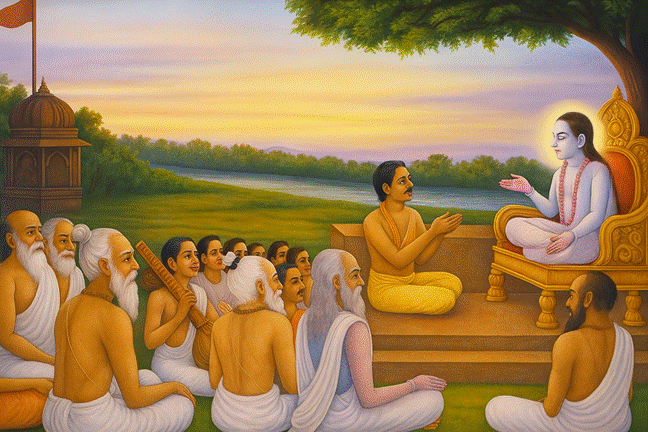
Having basked in its glory, we now turn the page and dive into the timeless katha itself. Ved Vyas opens with the Mangalacharan, the auspicious invocation beckoning the Divine.
ॐ नमो भगवते वासुदेवाय
जन्माद्यस्य यतोऽन्वयादितरतश्चार्थेष्वभिज्ञ: स्वराट्
तेने ब्रह्म हृदा य आदिकवये मुह्यन्ति यत्सूरय: ।
तेजोवारिमृदां यथा विनिमयो यत्र त्रिसर्गोऽमृषा
धाम्ना स्वेन सदा निरस्तकुहकं सत्यं परं धीमहि ॥ १ ॥
Ved Vyas begins the first verse of the Mahapuran by describing God in universal terms: “That Supreme Lord, from whom this entire creation emanates, within whom it exists, and into whom it shall merge one day.” He defines the Almighty by His role in the cosmos—as the source, support, and final destination of everything.
He goes on to say that the Lord’s material energy (Maya) creates an illusion where the temporary seems permanent and the eternal seems fleeting. For instance, people often chase wealth, status, or beauty, believing these will bring lasting happiness, even though they are constantly changing or fading. At the same time, they overlook inner peace, love, and connection with the Divine—aspects that endure beyond life’s uncertainties. In this way, our experience of reality is often clouded, pulling attention away from what truly matters.
The verse also refers to how the Lord imparted the wisdom of the Vedant in the heart of the first-born Brahma. “Satyam Param Dhimahi—I meditate upon that Supreme Truth.” Here again, the focus is on Param Satya, the Absolute Truth, rather than on any particular deity or Form of God like Krishna, Shiv, Ram, Durga. By referring simply to Satya, Ved Vyas embraced a universal perspective—ensuring that seekers of all traditions could approach this wisdom without bias or division. Just as sunlight shines equally on flowers of every color, the Supreme Truth is accessible to all. In this way, the author invites us to look beyond surface differences and turn inward toward the eternal, unchanging source of life.
Essence of Devotion
Following this, in the second verse, Sage Ved Vyas unfolds the purpose of the scripture and reveals the insights he is about to share.
धर्म: प्रोज्झितकैतवोऽत्र परमो निर्मत्सराणां सतां
वेद्यं वास्तवमत्र वस्तु शिवदं तापत्रयोन्मूलनम् ।
श्रीमद्भागवते महामुनिकृते किं वा परैरीश्वर:
सद्यो हृद्यवरुध्यतेऽत्र कृतिभि: शुश्रूषुभिस्तत्क्षणात् ॥ २ ॥
Ved Vyas declares that in this Katha, he will describe Kaitav Rahit Dharma: a path of dharma completely devoid of any propensity to cheat. But what does “cheating” mean in this context? It refers to engaging in devotion with the expectation of personal gain. If one practices bhakti merely to obtain something—whether wealth, status, or even heavenly rewards—this is not true devotion; it is, in essence, a subtle form of cheating.
The author points out that in many other Puranas, he has described devotion that is motivated by material desires. In contrast, in this scripture, he intends to go beyond such conditional devotion. Here, he presents pure, selfless, and unalloyed nishkam bhakti, devotion performed entirely for the pleasure of the Lord, free from any personal motives or expectations.
निगमकल्पतरोर्गलितं फलं
शुकमुखादमृतद्रवसंयुतम् ।
पिबत भागवतं रसमालयं
मुहुरहो रसिका भुवि भावुका: ॥ ३ ॥
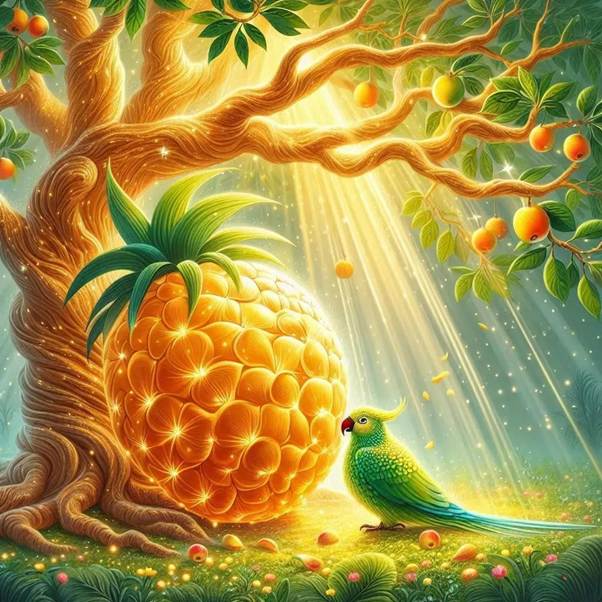
In the third verse, Sage Ved Vyas uses a vivid analogy to highlight the significance of the Srimad Bhagavat Mahapuran. He likens the Vedas to a Kalpavriksh, a wish-fulfilling tree, with the Srimad Bhagavatam being its ripened fruit. Just as a fruit ripened to perfection is the sweetest, the Bhagavatam is the essence of Vedic wisdom, matured and enriched by divine grace.
Ved Vyas describes the Bhagavatam as Rasamalay, a treasury overflowing with divine spiritual nectar. Just as a parrot’s genes are naturally attuned to pick the ripest and sweetest fruits, Shukadev, with his spiritual insight, has savored this scripture and recognized it as the most nourishing essence. Through Shukadev's experience, the Bhagavatam has been passed down to us.
With an invitation to the devotees, Ved Vyas says, "Peevat Bhagavatam!" —drink this fruit, dear seekers! Though fruits are typically eaten with the mouth, this is no ordinary fruit. It has no seed, no fibre, no skin—it is pure ras, the nectar of divine love and devotion. And it is not to be consumed with the tongue, but with the ears. So, listen to this Amar Katha deeply and let yourself be immersed in the ocean of bhakti!
Final Reflection
From its cosmic truths to the Lord’s sweetest pastimes, Srimad Bhagavatam, the crown jewel among scriptures, teaches us to:
🙏 Approach spiritual knowledge with sincerity, focus, and humility.
✨ Cultivate pure, selfless devotion that transcends personal desires.
💖 Attune our hearts and minds to the eternal nectar of divine love.
Like Shukadev Goswami, let us relish the essence of the Vedic Kalpavriksh, allowing its richness to elevate our souls. With open ears and receptive hearts, we embark on a journey that promises ever-deeper insight and the timeless bliss of bhakti.
FAQs
Question: Are the Srimad Bhagavatam and the Bhagavad Gita the same scripture?
Answer: No. Though both belong to the Vedic canon, the Bhagavad Gita presents a focused dialogue between Shree Krishna and Arjun on karma (action) and dharma (righteousness), whereas the Srimad Bhagavatam offers a comprehensive narrative encompassing Shree Krishna’s divine pastimes, cosmology, and principles of bhakti.
Question: How extensive is the Srimad Bhagavatam?
Answer: The Srimad Bhagavatam spans 12 cantos and around 18,000 verses, yet its true greatness lies in the depth of its spiritual wisdom, all brought to light through devotion. Like an ocean, it unveils deeper layers of wisdom each time it is read, remaining both timeless and eternally relevant.
Video Resource
Srimad Bhagavatam [Bhagwat Katha] - Part 1 by SwamiMukundananda