Imagine driving through an out-of-season snowstorm at midnight. Visibility reduced to fifteen percent. Every turn of the wheel a gamble. Every foot forward swallowed by swirling white chaos.
This is not merely a travel memory from Swami Mukundananda Ji’s journeys — it is the perfect portrait of most human lives. We navigate through a perpetual blizzard of half-processed worries, unmet desires, old regrets, tomorrow’s anxieties, and unresolved emotions. The path to peace is not obstructed by the world. It is obstructed by the noise inside us.
Meditation is not a relaxation technique to escape this storm. It is a strategic necessity of the soul — the laser that transforms scattered light into a beam capable of cutting through the hardest diamonds of worldly illusion.
Swami Mukundanada Ji offers something the modern world desperately needs not just the hardware of meditation – posture, timing, breathing, technique – but its software: the inner architecture of the self. The bhav-filled science of Roopdhyan that does not merely quite the mind but transforms the soul.
This blog draws on the essential teachings of Swami Mukundananda Ji. Whether you are beginning, deepening, or completely rebuilding your practice, this is what every sincere seeker deserves to understand before they close their eyes.
You Are Not Who You Think You Are
Every great science begins by correctly identifying its subject. A doctor must understand anatomy before performing surgery. A meditator must understand the nature of the self before attempting to train it.
The Vedic tradition, as illuminated by Swami Mukundananda Ji, begins with a truth that sounds simple and changes everything: you are not your body. Not your thoughts, your moods, your history, or your opinions. You are the eternal, divine soul — the Chaitanya spark — inhabiting the body the way a driver inhabits a vehicle. The vehicle ages and breaks down. The driver is eternal.
This single recognition relocates the entire challenge of meditation. If you are the soul, then the restless mind is not your identity — it is your instrument. And instruments, however unruly, can be tuned.
The Four Facets of the Inner Mind
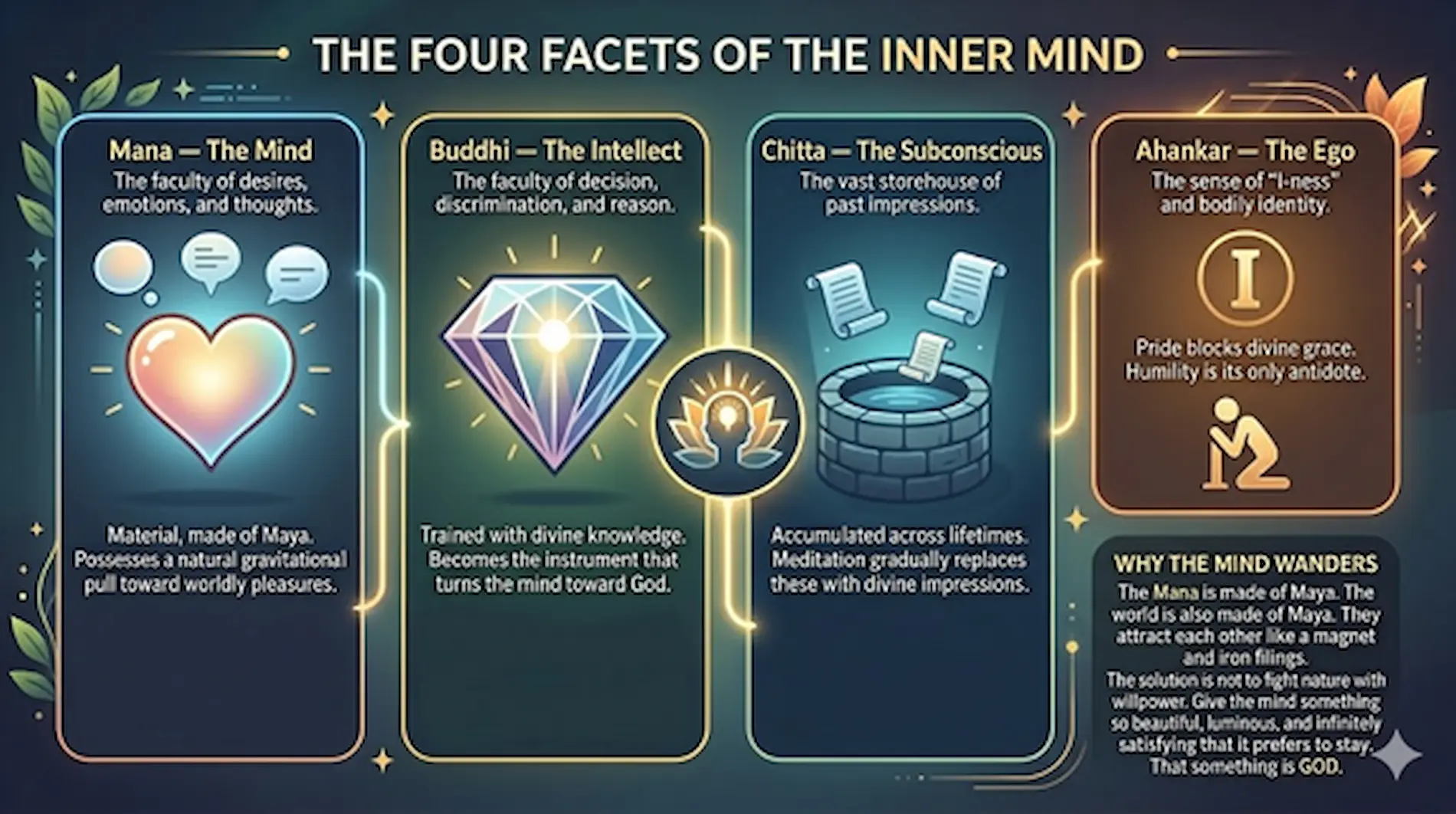
1. Mana — The Mind — The faculty of desires, emotions, and thoughts. It is material, made of Maya, and possesses a natural gravitational pull toward worldly pleasures.
2. Buddhi — The Intellect — The faculty of decision, discrimination, and reason. Trained with divine knowledge, Buddhi becomes the instrument that turns the mind toward God.
3. Chitta — The Subconscious — The vast storehouse of past impressions accumulated across lifetimes. Meditation gradually replaces these with divine impressions.
4. Ahankar — The Ego — The sense of “I-ness” and bodily identity. Pride blocks divine grace; humility is its only antidote.
Why the Mind Wanders and Why It’s Not Your Fault
The Mana is made of Maya. The world is also made of Maya. Of course, they attract each other like a magnet and iron filings, it requires no effort. The mind drifts toward worldly things not because you are weak, but because it is following its own nature. The solution is not to fight that nature with brute willpower. It is to give the mind something so beautiful, so luminous, so infinitely satisfying, that it genuinely prefers to stay. That something is God.
What Meditation Really Is
Here is something Swami Mukundananda Ji says that stops people mid-thought: you already know how to meditate. A newlywed wife meditates upon her husband even when he is away. The ambitious young professional meditates upon his career. The entrepreneur who wakes at 3 AM churning over a business problem — that is meditation. The grieving person who cannot stop replaying a loss is meditation. The term ‘pre-meditated’ in a courtroom literally means thought upon in advance. The mind is always meditating. The only question worth asking is: on what?
“The object of meditation makes all the difference. You can use a glass to drink whiskey or to drink kesar pista milk — what is in the glass determines the outcome.”
— Swami Mukundananda Ji
When the mind rests on the world, the world’s qualities flow into it — restlessness, craving, anxiety. When the mind rests on God — Who is all-pure, all-blissful, the very source of peace — His qualities begin flowing in instead.
Many modern techniques ask practitioners to focus on breath, sound, or simply emptiness. Swami Mukundananda Ji acknowledges their value while naming their limitation honestly: they work on the surface while leaving the depths untouched. The Chitta with its accumulated impressions remains largely undisturbed. You can concentrate a troubled mind and simply become a more focused version of the same troubled self.
Roopdhyan — meditation on the divine form of God — works at the root. Because God is all-pure, bringing the mind into sincere contact with His form, qualities, and pastimes begins purifying the chitta at its source. Not by force. By proximity. The way a room fills with fragrance when you bring flowers into it.
Four Sacred Benefits of Meditation
1. Laser-Like Focus — Sunrays scattered across a field warm nothing. Those same rays focused through a magnifying glass can start a fire. A focused mind becomes extraordinary in work, creativity, and spiritual practice.
2. Unshakeable Willpower — By subduing the mind’s craving for pleasure and aversion to discomfort, meditation cultivates self-discipline — the foundation of all lasting achievement.
3. Union with the Divine — The same Lord who resides in holy pilgrimages also sits in the lotus of your heart. Through meditation, you connect with that supreme power within — no journeys needed.
4. Purification of Mind — Bathed in divine, sublime thoughts, the mind sheds its material conditioning layer by layer. The bhav — the sacred sentiment — is itself the purifying fire.
Practical Mechanics
The Best Time — Brahma Muhurta
The brahma muhurta — the two sacred hours before sunrise — is the crown jewel of meditation time. Brahma means God; this is literally the hour set aside for communing with the Divine. The world sleeps, the atmosphere is pure, and your mind is like an empty slate before the day’s impressions fill it.
Begin each night with five minutes of bringing the Lord’s image to your mind before sleeping — this makes your sleep meditative. Then wake up and meditate, making your entire day meditative. Those who cannot meditate in the morning should choose another consistent time daily and honor it with commitment.
Posture — Sthira Sukham Asanam and Direction
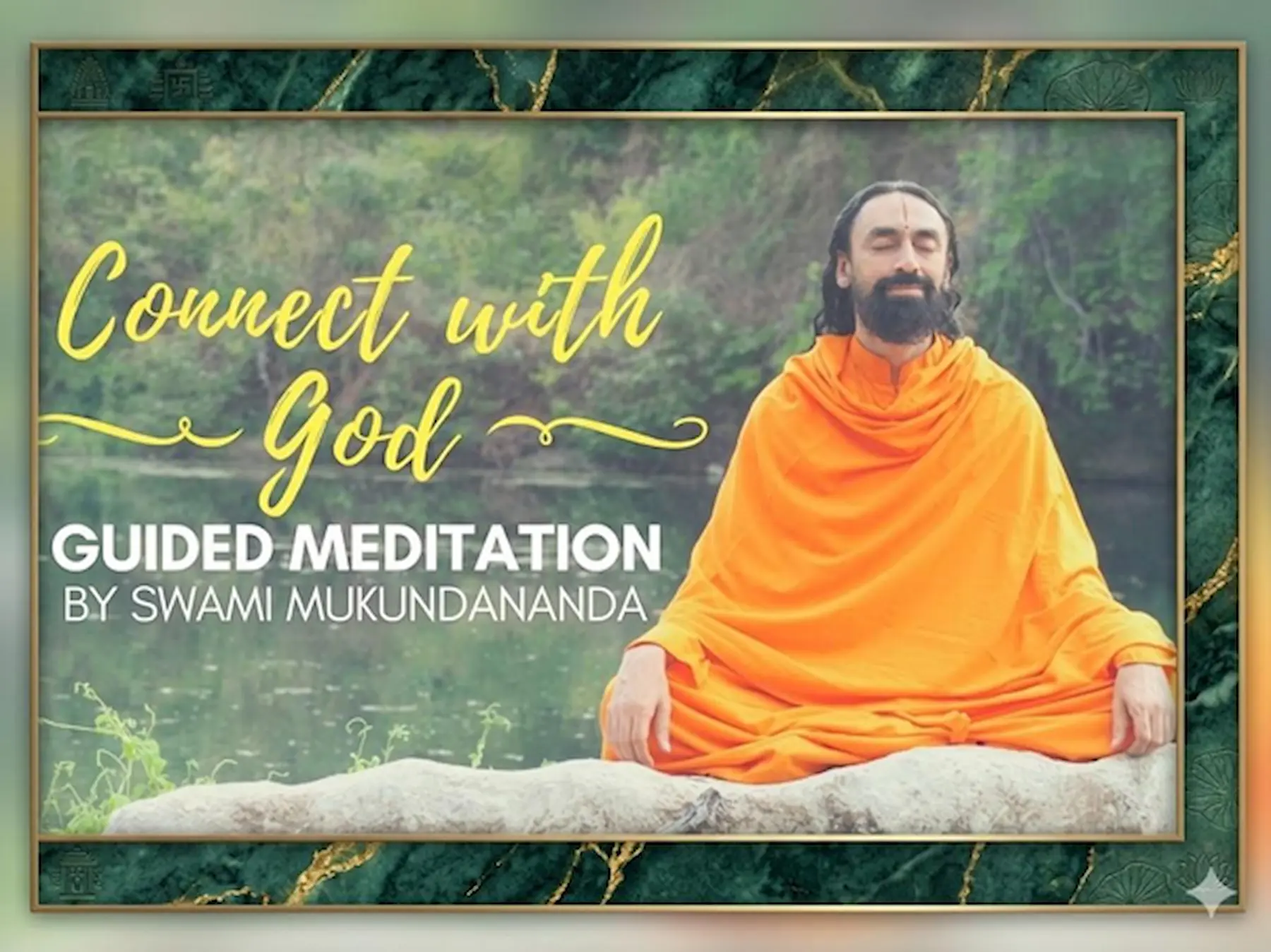
Follow Maharishi Patanjali’s timeless guidance: sthiram sukham asanam — sit alert yet comfortably. Spine straight, neck straight, hands resting on the knees or in the lap. Too rigid creates physical distraction; too relaxing invites sleep. In Bhakti meditation, the direction you face is immaterial for God is everywhere. The whole world is His temple.
Five Pillars of Daily Sadhana
Before formal meditation, Swami Mukundananda Ji teaches that a daily sadhana framework prepares the vessel of the heart to receive grace:
1. Self-Awareness — Taking honest stock of your shortcomings and seeing the big picture of your eternal journey — not as self-criticism, but as a navigator checking coordinates.
2. Vairagya — Dispassion — Repeatedly reminding the mind that true bliss resides in God, not in the temporary objects of the world. Vairagya loosens the world’s grip on the mind before you sit in meditation.
3. Sambandh — Relationship — Firmly establishing the sacred sentiment in the heart: “He is mine, and I am His.” This sense of belonging is the seed of all bhakti.
4. Internalizing Divine Knowledge — Deeply pondering one gem of wisdom from scripture or the Guru until it genuinely shifts your perspective — not merely understood intellectually, but absorbed into the chitta.
5. Humility — The Gateway to Grace — Pride is the cloud that blocks the sun of God’s grace. The heart that cries for the Lord like a child for its mother is the heart that receives His descent.
The Sacred Hour — Your Daily Framework
Swami Mukundananda Ji recommends the following one-hour daily sadhana. Each element strengthens each other, and together they produce what no single practice achieves alone:
• Spiritual discourse — nourish the Buddhi: 20 minutes
• Roopdhyan — transform the Chitta (the heart of the practice): 10 minutes• Sincere prayer — soften the Ahankar: 5 minutes
• Kirtan — purify the heart: 20 minutes
• Arati — close with reverence: 5 minutes
Roopdhyan — The King of All Meditation
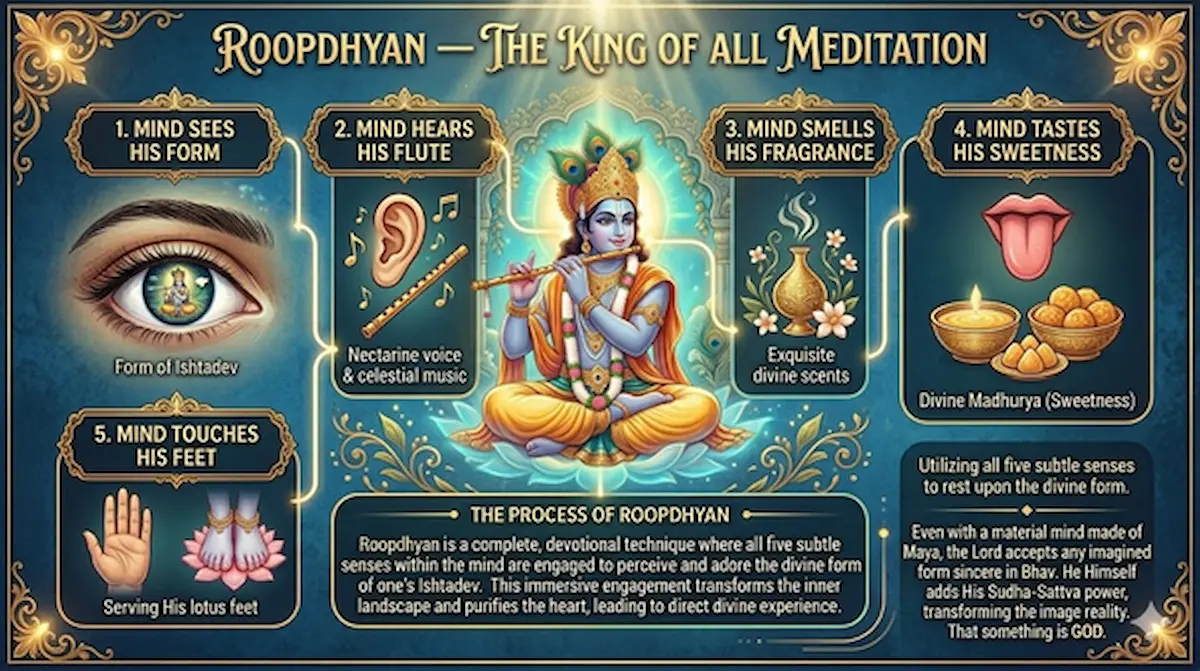
This is where bhakti becomes a living flame where the dry technique of sitting still transforms into a love-drenched encounter with the Divine.
In Roopdhyan, Swamiji teaches to utilize the five subtle senses present within the mind itself are brought to rest upon the divine form of your chosen Lord — your Ishtadev. The mind sees, hears, tastes, touches, and smells in its subtle dimension.
Do not worry if you have never seen God. Even the greatest yogis and munis cannot perceive His actual divine form with the material mind, for He is transcendental and the mind is made of maya. But the Lord, in His boundless compassion, extends an extraordinary invitation: create an image as your heart desires. Give Him any form, call Him any name, dress Him in any color your love reaches for. He accepts it all, based entirely on the sincerity of your bhav. As the heart is purified through sustained practice, He Himself adds His divine Sudha-Sattva power and the imagined image begins to transforms into the experienced divine reality over time.
Five Approaches to Roopdhyan
Roopdhyan is not one fixed method but a living family of practices, each suited to a different state of the heart. Swami Mukundananda Ji teaches five distinct approaches that together form a complete inner science.
1. Meditation on the Divine Form
Close your eyes. Bring before your mind the form of your chosen Lord — Shree Krishna, Radha Rani, Lord Ram — in whatever way arises most naturally. If a temple deity once stopped your breath, let that image be your beginning. If a painting has always drawn you, use that. The image need not be vivid. It need not be perfect. It simply needs to be offered with sincerity.
Visualize yourself on the soft green banks of the Yamuna in Vrindavan. The morning light is still golden at the edges. Birds are singing. The air carries the fragrance of Kadamba flowers. In a quiet forest grove, Shree Krishna sits upon a radiant throne — His complexion a deep, luminous blue, His large eyes full of tender compassion. A peacock feather rests in His crown. A smile waits at the corners of His lips, as though He has been expecting you.
Now engage with the subtle senses of your mind. Gently wipe His face with the softest cloth. Apply sandalwood to His forehead. Adorn Him with diamond necklaces – one at the throat, one at the chest, one reaching the navel. Fasten golden anklets at His feet and listen, in your mind’s ear, for their melodious tinkle as He stirs. You are not inventing this. You are discovering it, one sincere breath at a time.
2. Meditation on Divine Qualities
Bring the Lord’s image before you and contemplate His limitless attributes — His boundless compassion, His infinite wisdom, His beauty without end, His perfectly still presence that contains all worlds. Then visualize those qualities flowing from Him into you. You feel yourself becoming quieter, more patient, more loving. This is how the chitta is reprogrammed, one sincere session at a time.
3. Manasi Seva — Serving God in the Mind
Love, by its nature, cannot remain still. It reaches out and serves. Manasi Seva is the practice of mentally offering seva to the Lord — washing His feet, adorning Him with garlands, fanning Him, preparing food, and singing to Him. Every act of devotion that can be offered in a temple can be offered in the mind with equal sincerity and in some ways superior effect: in the inner sanctuary there are no limitations: no shortage of flowers, no distance to travel. God, Who sees the bhav rather than the material offering, responds to the fullness of the heart’s intention.
Crucially, Swamiji teaches do not let the Lord stand still in your mind. A static image, however beautiful, eventually loses the mind’s attention and wandering begins. Manasi Seva keeps the encounter living, breathing, and dynamically engaged.
4. Leela Dhyan — Entering the Divine Pastime

Among the greatest gifts Swami Mukundananda Ji offers the meditator is the Jhulan Leela – the divine swing pastime of Radha Krishna. Visualize a grand Kadamba tree in the sacred forests of Vrindavan. A swing hangs from its branches — its silken ropes wound with fresh flowers, its seat cushioned with petals. Radha and Krishna sit together, resplendent and playful, their divine love filling the very air with sweetness. You come forward. With a heart full of seva, you take the rope and begin gently, lovingly, to pull.
Now let all five subtle senses of the mind engage at once. See the radiance of Their forms as the swing rises. Hear the melodious tinkle of golden anklets and waist bells ringing through the sacred grove. Feel the silk rope in your hands and the soft Vrindavan breeze on your face as they pass. Smell the Kadamba blossoms, the sandalwood, the garlands. This is what Swami Mukundananda Ji calls dynamic meditation — every inner faculty fully occupied in divine joy, leaving no door through which the world can re-enter.
5. Viraha — The Meditation of Divine Longing
This is the most advanced, and the most powerful, of all meditation according to Swami Mukundananda Ji. Viraha means separation — the ache of the soul for God. It arises most naturally after the heart has first tasted the sweetness of Milan — the joy of the Lord’s presence in meditation — and then experienced the mind drifting away.
Most practitioners experience this drift as failure. Swami Mukundananda Ji reveals it as the doorway to the most purifying practice in all of sadhana. Instead of frustration, the practitioner consciously enters the feeling of separation: “My Lord, I slipped away from You again. My practice is still so weak. When will You truly reveal Yourself to me? When will You come?”
This is not self-pity. It is not despair. It is the most honest prayer a soul can offer — complete acknowledgment of its own limitations and total dependence on divine grace. This humble, burning yearning, Swami Mukundananda Ji teaches, is a fire. It burns away accumulated karma with a speed and depth that comfortable, undisturbed meditation cannot match.
“The tears of sincere longing are not a sign of weakness. They are the most powerful prayer the soul can offer — a sacred fire that purifies what years of comfortable practice cannot reach.”
— Inspired by Swami Mukundananda Ji’s teachings on Viraha
The mathematics of Viraha are beautiful: as the heart is purified by its fire, the capacity for longing grows deeper. The longing intensifies. The heart cries more genuinely. And a purer heart can hold more of God’s presence. This cascading effect continues until the entire world with all its noise and shimmer begins to feel genuinely empty without the Lord. That state of complete, helpless surrender is the final trigger for divine grace.
In practice, Milan and Viraha alternate like breath — inhaling the sweetness of union in the Lord’s presence, exhaling the honest ache of separation. Together they form the most dynamic, most alive, most transformative rhythm in all of Bhakti meditation.
When the Mind Wanders: Lord Krishna’s Own Answer
Arjun was not a beginner. His powers of concentration were so extraordinary that when his teacher asked all his students to describe the target before them, every other student saw the tree, the branches, the bird. Arjun saw only: the eye. The eye. The eye.
Yet even Arjun confessed to Lord Krishna: “This mind of mine feels more restless than the wind. I cannot control it.” If Arjun — the greatest focused mind of his age — struggled, then what to say about rest of us.
Lord Krishna’s answer is honest and hopeful. He does not say the mind is uncontrollable that would make the entire endeavor pointless. He says it is difficult, and it is possible. Through two things: Abhyas — consistent practice, and Vairagya — a genuine, growing detachment from the world’s pull.
The Three-Step Return
Swami Mukundananda Ji breaks this down into three practical movements that every meditator can apply the moment the mind wanders:
• Gently lift the mind from wherever it has gone. “Hey mind, come away from there.” This requires effort, because it goes against the mind’s nature. Do it anyway, without harshness.: Vairagya
• Place the mind back upon the Lord. “Sit here, beloved mind.” This also requires effort. Do it with love, not frustration.: Abhyas
• When the mind slips again — and it will — simply repeat. No self-criticism. No drama. The returning, done calmly and consistently, is itself the practice.: Return without disturbance
Do not measure your meditation by how many times the mind drifts. Measure it by how many times you lovingly bring it home. Every single return is an act of Abhyas. Every return is the practice.
Modern neuroscience, arriving millennia after the Yoga Sutras, confirms the same truth: consistent practice builds new neural pathways. What begins as a deliberate, exhausting act gradually becomes the mind’s natural default. The same mind that once sprinted toward distraction begins, session by session, to turn toward the Divine as instinctively as it once turned away.
Kirtan: When Outer Sound Guards the Inner Flame
Even the most sincere meditator faces a practical problem in the early stages: the mind has not yet built the stamina to hold the divine form for extended periods. It slips. It wanders. Guilt arrives, and with it, discouragement.
For exactly this stage, Swami Mukundananda Ji teaches the Tridha process: Kirtan (chanting), Shravan (hearing), and Smaran (Roopdhyan itself). Of these, he says clearly: Roopdhyan is the Prana the life-force of your sadhana. Without it, Kirtan becomes a beautiful body without breath. But Kirtan is the ultimate helper with the outer sound that protects the inner flame.
When the divine names surround your meditation — chanted aloud or listened to devotionally — they create a field of sacred energy. The moment the mind slips from the inner visualization, the sound catches it before it falls too far into worldly thought. It is like learning to walk beside a wall: the wall does not walk for you, but it is there when your balance wavers.
Begin. The Lord Has Been Waiting.
He has been sitting in the temple of your heart since before you were born — radiant, patient, entirely unhurried. The door between you has to be opened from your side. And it opens with something very small: one sincere step.
You do not need a purified mind to begin the purification. You do not need to have resolved your doubts, silenced your distractions, or become more spiritual than you currently are. Swami Mukundananda Ji teaches thousands of seekers across the world — engineers and grandmothers, skeptics and the devoted, beginners and those who have tried and stopped ten times before — and the instruction he gives each of them is the same: begin exactly where you are. Bring whatever love you have. The Lord, Who sees the sincere heart, meets it infinitely more than halfway.
Your First Steps
Tonight
Before sleeping, spend five quiet minutes bringing a gentle image of the Lord before your mind. Do not evaluate it. Do not judge it. Simply be with it. Let that be your beginning.
This Week
Establish the one-hour daily Sadhana. Not perfectly. Consistently. Let it become the most sacred appointment in your day — the one no worldly obligation is allowed to cancel.
Call to Action
Frequently Asked Questions
Why do I keep quitting meditation — and what’s different about Roopdhyan?
Most people quit because they try to force the mind into silence, which goes against its nature. The mind wants engagement. Roopdhyan gives it something deeply beautiful to focus on, so practice feels natural rather than forced — like holding a conversation with someone you love, rather than sitting still in an empty room.
My mind wanders constantly. Is that normal?
Not only normal — it is expected. The Mana is made of Maya, and the world is also made of Maya. A wandering mind is not failure. What matters is noticing it and returning. Each return is the practice. Even Arjun struggled.
How do I visualize God if I don’t have a clear image?
Start with any image that feels meaningful to you — a temple deity, a painting that has always drawn you. Look at it, then close your eyes and recall it. It does not need to be vivid or perfect. What matters is the sincerity of your bhav, not the clarity of the image.
What is Viraha, and why is it so powerful?
Viraha is the feeling of longing for God — the ache that arises when the mind has tasted His presence and then slipped away. Instead of frustration, that moment becomes a humble prayer. That sincere longing is a fire that burns away accumulated karma with a speed and depth that comfortable meditation cannot match.
How long before I notice real change?
Small shifts often appear within a few weeks — more patience, unexpected moments of calm, a quieter quality to your reactions. Deeper transformation takes months of consistent practice. Progress is gradual and often invisible from the inside, the way a river carves stone. Keep going.