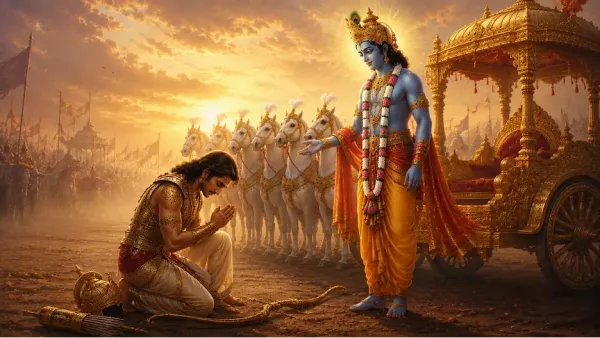

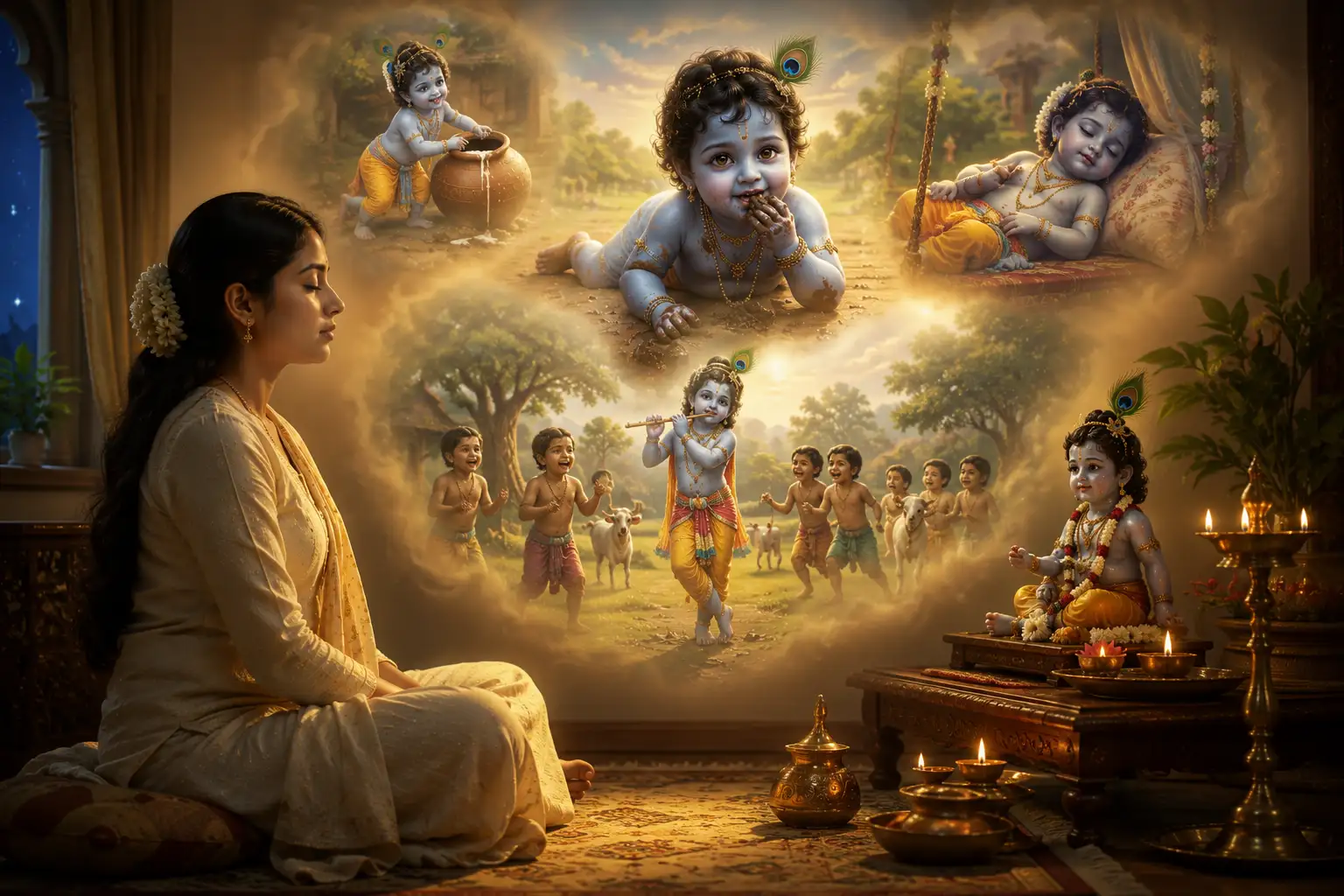
“Whenever there is a decline in righteousness and an increase in unrighteousness, O Arjun, at that time I manifest Myself on earth.”
— Bhagavad Gita 4.7
यदा यदा हि धर्मस्य ग्लानिर्भवति भारत ।
अभ्युत्थानमधर्मस्य तदात्मानं सृजाम्यहम् ॥ 7॥
yadā yadā hi dharmasya glānir bhavati bhārata
abhyutthānam adharmasya tadātmānaṁ sṛijāmyaham
Every year, millions of devotees eagerly await the sacred night of Janmashtami: the divine appearance day of Lord Krishna. Temples glow with lamps, devotional songs fill the air, and devotees gather in loving remembrance of the Supreme Lord. Yet beyond the festivities, decorations, fasting, and midnight celebrations lies a profound spiritual opportunity.
Janmashtami is not merely the commemoration of a historical event. It is an invitation to awaken the dormant divinity within our hearts. It reminds us that God is not distant or inaccessible. Out of His infinite compassion, He descends into this world to guide humanity, restore righteousness, and shower grace upon all souls.
The appearance of Lord Krishna thousands of years ago continues to illuminate the path for seekers today. In a world increasingly filled with anxiety, distraction, conflict, and uncertainty, Krishna's teachings offer timeless wisdom, inner peace, and a deeper understanding of life's true purpose.
As we celebrate Janmashtami 2026, let us look beyond the external festivities and discover the deeper spiritual meaning behind Krishna's divine avatar.
What Makes Janmashtami Spiritually Powerful?
Among all Hindu festivals, Janmashtami holds a unique place because it celebrates not merely the birth of a saint, king, or prophet, but the appearance of the Supreme Divine Personality Himself.
The scriptures explain that Lord Krishna's arrival was not governed by the laws of nature. Unlike ordinary souls who take birth due to karma, Krishna descends by His own divine will.
His appearance serves as a reminder that God is actively involved in the welfare of creation. He is not an indifferent observer but a loving caretaker who repeatedly reaches out to uplift humanity.
More importantly, Janmashtami reminds us that every soul has an eternal relationship with God. The purpose of life is not merely material success, social recognition, or sensory pleasure. The true purpose is to rediscover our forgotten connection with the Divine.
This is why devotees experience such deep joy during Janmashtami. It is a celebration of divine love, divine grace, and divine remembrance.
The Relevance of Krishna's Message in Modern Life
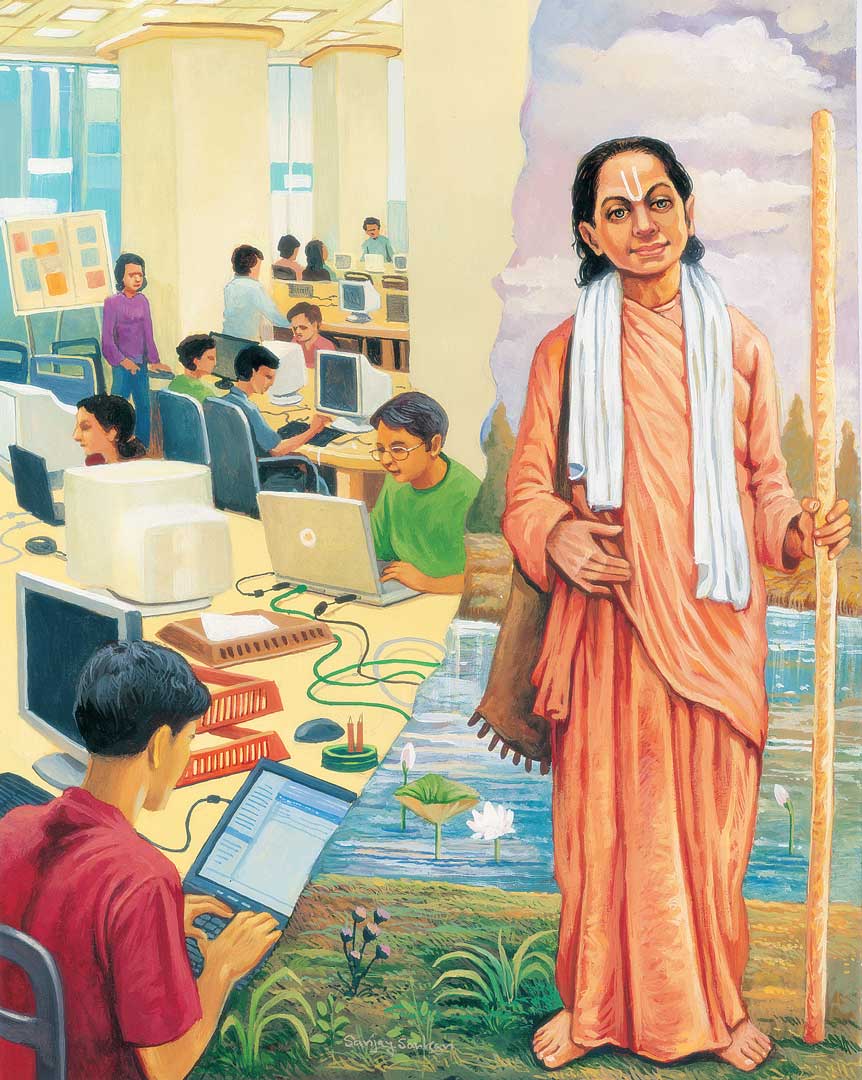
Today's world is technologically advanced yet emotionally exhausted. We have more convenience than ever before, but many struggle with stress, loneliness, confusion, and a lack of deeper meaning.
The Bhagavad Gita, spoken by Lord Krishna over 5,000 years ago, addresses these very challenges.
Swami Mukundananda beautifully explains:
“Our life becomes auspicious when we harbor sublime thoughts. These thoughts become noble when the mind is purified. And the mind is purified by loving devotion to the all-pure Supreme.”
The greatest battles we face today may not be fought on physical battlefields like Kurukshetra. They are fought within our minds:
- Between selfishness and selflessness
- Between fear and faith
- Between attachment and surrender
- Between ego and devotion
Krishna's teachings provide practical solutions to each of these inner struggles.
Janmashtami therefore becomes more than a festival. It becomes a spiritual reset, an opportunity to realign our hearts with divine wisdom.
Understanding the Divine Nature of Krishna's Avatar
One of the most important teachings of Janmashtami is understanding that Krishna's birth was entirely different from ordinary human birth.
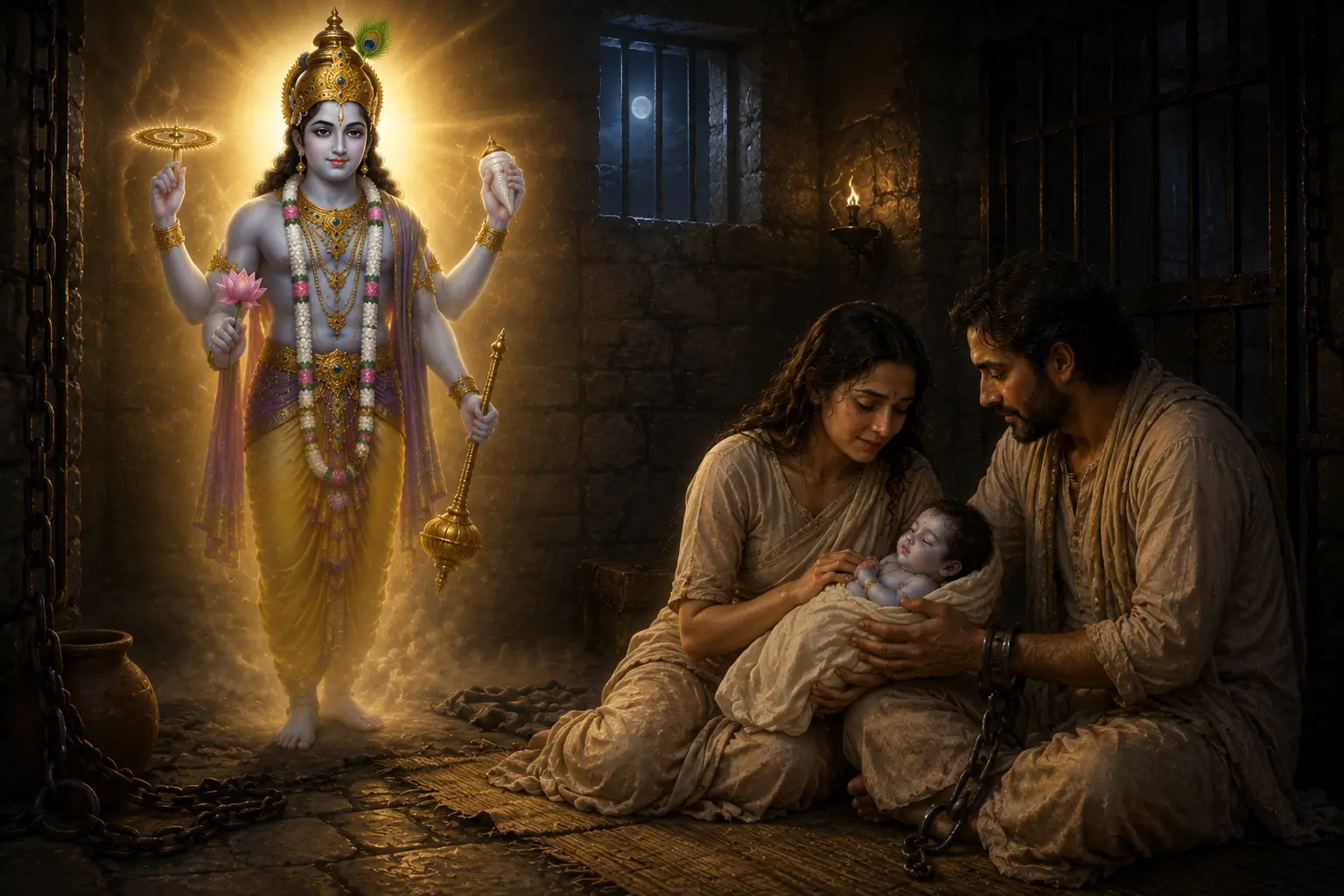
The scriptures describe how Lord Krishna appeared before Vasudev and Devaki in Kansa's prison in a magnificent divine form. He manifested with transcendental beauty and divine opulence before later assuming the form of an infant.
Several extraordinary truths distinguish Krishna's appearance:
He Appeared by His Own Will
Ordinary souls are forced into birth due to karmic reactions. Krishna is never bound by karma.
He descends solely out of compassion.
He Retains His Divine Nature
Even while appearing as a human child, Krishna remains the Supreme Lord with all His divine powers intact.
He Arrives Through Yoga Maya
His appearance is orchestrated by His internal divine energy, known as Yoga Maya, rather than material nature.
Those who understand the divine nature of My birth and activities, O Arjun, upon leaving the body, do not have to take birth again, but come to My eternal abode.
— Bhagavad Gita 4.9
जन्म कर्म च मे दिव्यमेवं यो वेत्ति तत्त्वत: ।
त्यक्त्वा देहं पुनर्जन्म नैति मामेति सोऽर्जुन ॥ 9॥
janma karma cha me divyam evaṁ yo vetti tattvataḥ
tyaktvā dehaṁ punar janma naiti mām eti so ’rjuna
This verse reveals that understanding Krishna's avatar is not simply intellectual knowledge: it is a doorway to spiritual freedom.
The Hidden Purpose Behind Krishna's Descent
Most people are familiar with Krishna's famous declaration:
“To protect the righteous, destroy the wicked, and establish dharma.”
These purposes are certainly true.
Yet Swami Mukundananda reveals a deeper perspective:
The Lord's ultimate purpose is not merely correction; it is connection.
God does not descend simply to punish evil. He descends because He longs to awaken divine love within the hearts of souls who have forgotten Him.
Like a loving parent searching for a lost child, Krishna repeatedly comes to guide us back toward our eternal spiritual home.
His avatar is therefore the greatest expression of divine compassion.
A Beautiful Example of Pure Devotion: The Story of Dhanna Jat
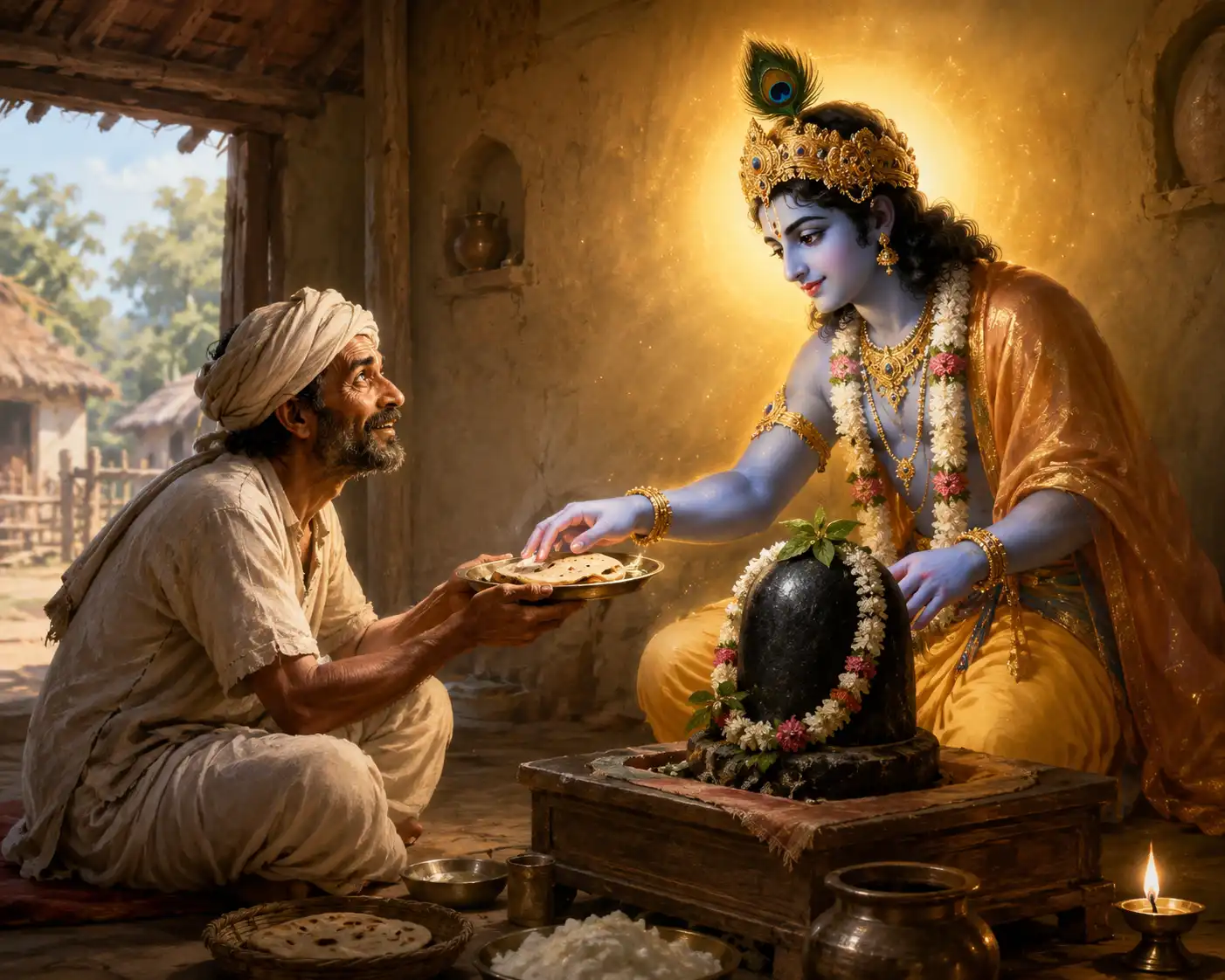
The life of Dhanna Jat illustrates one of the most heart-touching lessons of Janmashtami.
Dhanna was a simple villager with little scriptural knowledge. A priest once gave him a stone, presenting it as a sacred Shaligram.
Dhanna accepted it with complete faith.
Every day, he lovingly prepared food and offered it to the stone, believing Krishna Himself would come and eat.
When the Lord did not visibly accept the offering, Dhanna became deeply distressed. He refused to eat until Krishna accepted the meal.
One day passed.
Then another.
Days turned into a week.
His devotion remained unwavering.
Unable to resist such pure love, Lord Krishna finally manifested from the stone and accepted the offering with His own hands.
The story carries profound spiritual lessons:
- God responds to sincere love more than ritual perfection.
- Faith can accomplish what intellectual pride cannot.
- Divine grace flows naturally toward a pure heart.
As Swami Mukundananda explains:
“He created divine sentiments even towards a piece of stone, and that invoked Krishna's grace.”
This story beautifully demonstrates that Krishna is conquered not by scholarship, wealth, or status, but by genuine devotion.
Why Didn't Everyone Recognize Krishna?
An intriguing question arises.
If Krishna was God Himself, why did so many people fail to recognize Him?
The Mahabharata provides a striking example through Duryodhana.
Despite witnessing Krishna's extraordinary powers and even beholding His universal form, Duryodhana remained unconvinced.
Why?
Because spiritual vision requires more than physical sight.
The scriptures explain that impure consciousness acts like a veil, preventing us from perceiving divine reality.
Lord Krishna says:
“I am not manifest to everyone, being veiled by My divine Yogmaya energy. Hence, those without knowledge do not know that I am without birth and changeless.”
— Bhagavad Gita 7.25
नाहं प्रकाश: सर्वस्य योगमायासमावृत: ।
मूढोऽयं नाभिजानाति लोको मामजमव्ययम् ॥ 25॥
nāhaṁ prakāśhaḥ sarvasya yoga-māyā-samāvṛitaḥ
mūḍho ’yaṁ nābhijānāti loko mām ajam avyayam
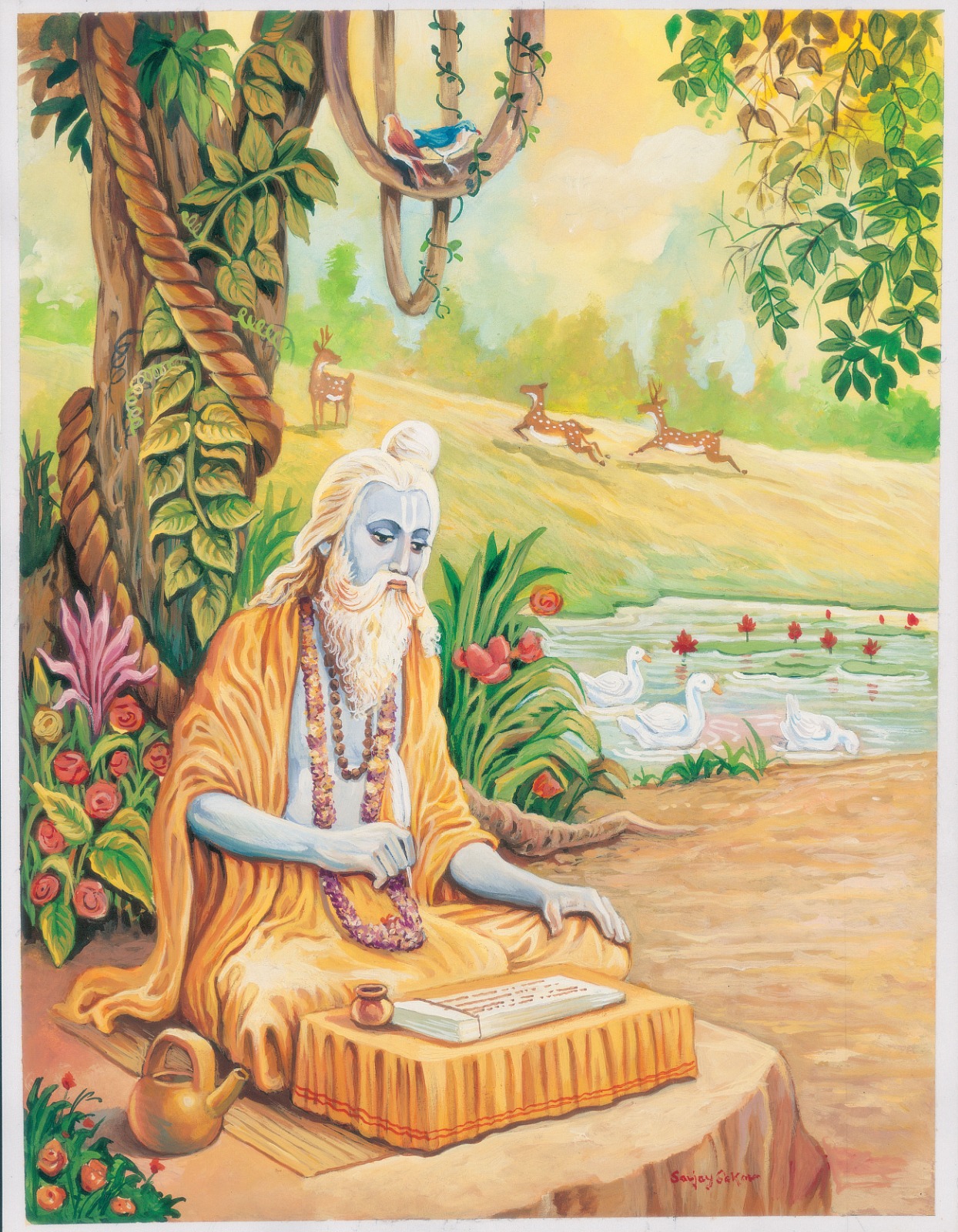
The lesson is profound: Seeing God is not the same as realizing God.
Only when the heart becomes purified through devotion can divine truth be fully experienced.
The Deep Symbolism of Lord Krishna's Form
Every aspect of Krishna's appearance carries spiritual significance.
Peacock Feather
The peacock feather represents beauty, grace, and humility.
Despite being the Supreme Lord, Krishna remains approachable and charming.
The Flute
Krishna's flute symbolizes surrender.
A flute produces divine music only because it is hollow inside.
Similarly, when we empty ourselves of ego, God can work through us.
Yellow Garments
His yellow dhoti represents purity, simplicity, and spiritual illumination.
Blue Complexion
Krishna's blue color reflects His infinite nature, vast like the sky and the ocean.
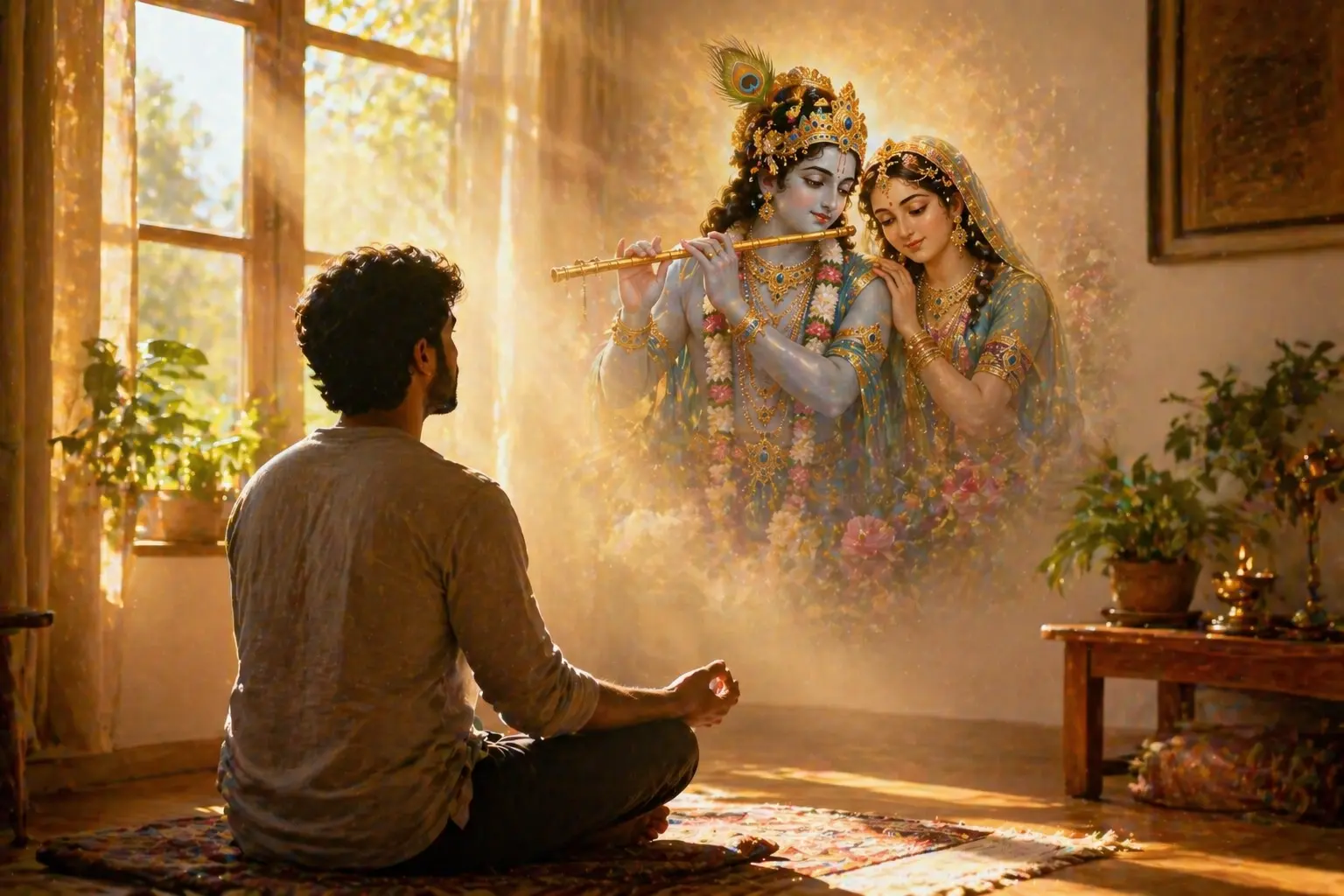
As devotees meditate on these symbols, they discover deeper layers of spiritual meaning hidden within Krishna's enchanting form.
How to Celebrate Janmashtami with True Bhakti
While rituals and festivities are beautiful expressions of devotion, Janmashtami becomes truly transformative when celebrated internally.
1. Develop a Personal Relationship with Krishna
Think of Krishna not only as the Supreme Lord but also as:
- Your Friend
- Your Guide
- Your Beloved
- Your Divine Child
- Your Eternal Companion
The more personal the relationship, the deeper the devotion.
2. Immerse Yourself in Daily Sadhana
Spend time each day:
- Chanting Krishna's names
- Reading the Bhagavad Gita
- Studying Krishna's divine pastimes
- Practicing meditation
Even a few sincere minutes daily can transform consciousness.
3. Offer Your Actions to Krishna
Bhakti extends beyond prayer.
Every action can become worship when performed with the intention of pleasing God.
Ask yourself:
- What would Krishna want me to do right now?
- Am I acting with integrity?
- Are my choices aligned with dharma?
This simple practice gradually turns daily life into a spiritual journey.
What Swami Mukundananda Teaches About Lord Krishna's Avatar
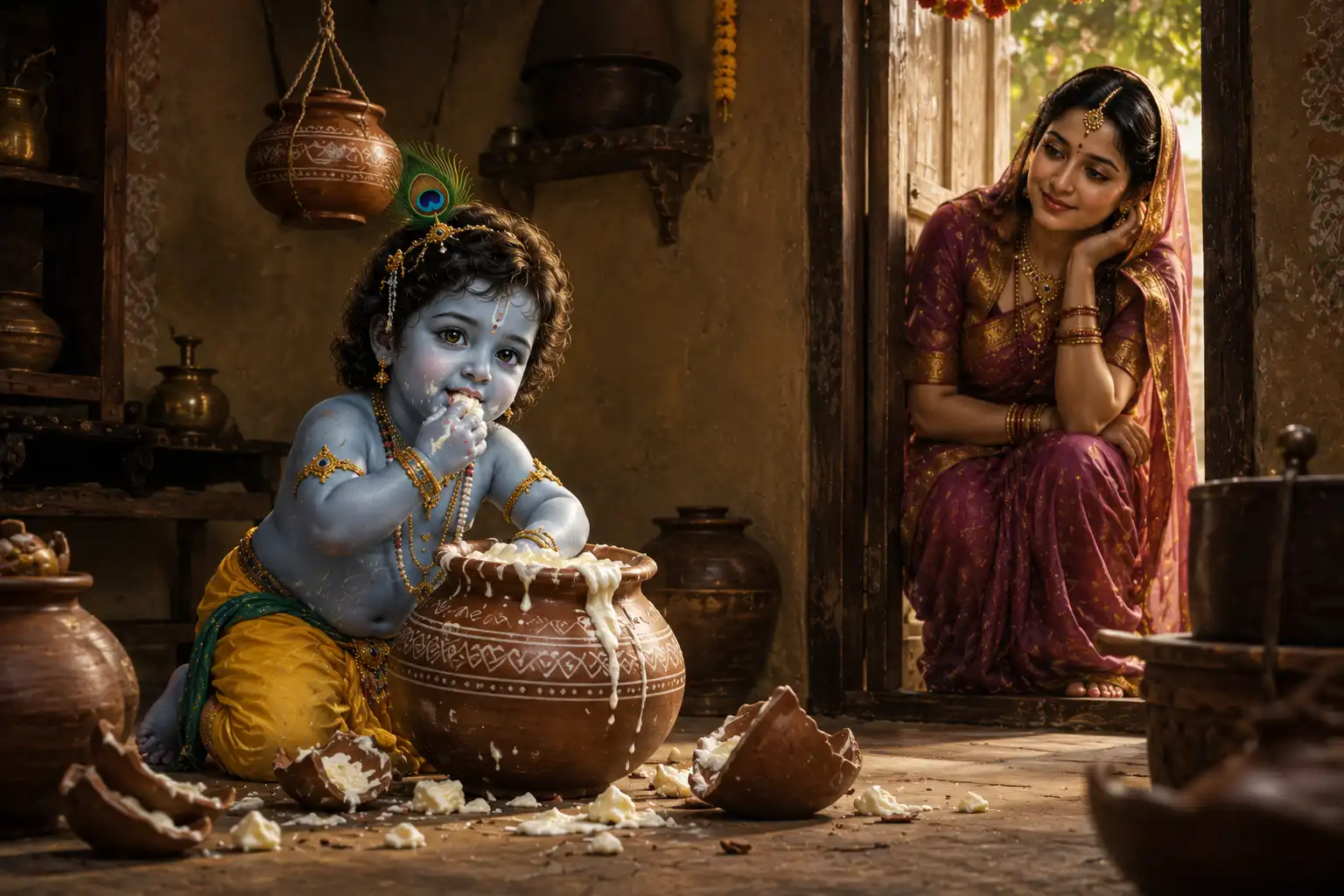
One of the most enlightening aspects of Swami Mukundananda's Janmashtami discourses is his explanation that Krishna's appearance is not merely a historical event, it is an expression of divine compassion.
Many people understand the Bhagavad Gita verses describing how God descends to protect the righteous and destroy evil. However, Swamiji emphasizes that these are not the deepest reasons for God's appearance.
The Supreme Lord descends because He wishes to reawaken divine love within the hearts of souls who have forgotten their eternal relationship with Him.
Through His divine pastimes, teachings, and interactions with devotees, Krishna demonstrates:
- How to love God selflessly
- How to remain detached amidst worldly responsibilities
- How to overcome ego and material illusion
- How to transform ordinary life into spiritual practice
Swamiji often explains that Krishna's avatar serves as a bridge between the infinite and the finite. By appearing in a human-like form, God becomes approachable, relatable, and accessible to everyone.
This is why Janmashtami is not simply about celebrating a birth that happened thousands of years ago. It is about responding to Krishna's invitation to deepen our own spiritual journey today.
Final Reflections: Let Janmashtami Be a New Beginning
This Janmashtami, do more than celebrate the birth of Lord Krishna.
Celebrate the possibility of your own spiritual awakening.
Allow Krishna's teachings to illuminate your decisions. Allow His compassion to soften your heart. Allow His wisdom to guide your journey.
When devotion deepens, the mind becomes peaceful. When the mind becomes peaceful, life becomes purposeful. And when life becomes centered on Krishna, every moment becomes sacred.
May this Janmashtami mark not just a festival on the calendar, but the beginning of a deeper relationship with the Divine.
May Lord Krishna's grace fill your heart with faith, wisdom, joy, and everlasting devotion.
Key Takeaways from Janmashtami
| Theme | Spiritual Insight |
|---|---|
| Divine Birth | Krishna's appearance is transcendental and beyond karma |
| Bhakti | Pure love attracts divine grace |
| Spiritual Vision | God is realized through purified consciousness |
| Avatar Purpose | Krishna descends to awaken divine love |
| Daily Practice | Consistent devotion transforms life |
| Krishna Consciousness | Every action can become an offering to God |
Begin Your Krishna Bhakti Journey Today
Janmashtami is not meant to inspire devotion for just one night.
It is an invitation to begin a lifelong relationship with the Divine.
If Lord Krishna's teachings resonate with your heart, take the next step:
- Listen to Swami Mukundananda's inspiring discourses on Krishna Bhakti


- Study the Bhagavad Gita regularly.

The journey toward God begins with a single sincere step.
And Krishna assures us that no effort on the spiritual path is ever lost.
Frequently Asked Questions
What is the spiritual significance of Janmashtami?
Janmashtami celebrates the divine appearance of Lord Krishna, the Supreme Personality of Godhead. Spiritually, it reminds us that God periodically descends to guide humanity, restore righteousness, and awaken divine love within the hearts of souls.
Why is Lord Krishna's birth considered divine?
Unlike ordinary beings who take birth due to karma, Krishna appears by His own divine will. His birth is transcendental, governed by Yoga Maya, and free from material limitations. Understanding this divine nature is said to lead toward liberation.
What is the main message of Janmashtami?
The central message of Janmashtami is that devotion to God purifies the mind, transforms the heart, and leads to lasting happiness. Krishna teaches us to live with faith, duty, compassion, and surrender.
How should devotees celebrate Janmashtami?
Devotees can celebrate through:
- Fasting
- Chanting Krishna's names
- Reading the Bhagavad Gita
- Singing bhajans and kirtans
- Participating in midnight worship
- Listening to spiritual discourses
- Performing acts of service
Most importantly, celebrations should be accompanied by heartfelt devotion.
Why do devotees fast on Janmashtami?
Fasting helps discipline the senses and focus the mind on spiritual remembrance. It symbolizes prioritizing the soul's nourishment over bodily desires and creates a devotional atmosphere throughout the day.
What does Krishna's flute symbolize?
The flute symbolizes complete surrender. Just as the flute is hollow and free from obstruction, devotees aspire to remove ego and allow God's will to flow through them.
What can modern people learn from Krishna?
Krishna teaches timeless principles such as:
- Managing stress through detachment
- Performing duties responsibly
- Maintaining balance in relationships
- Developing inner strength
- Living with purpose and integrity
- Cultivating devotion amid worldly life
Why didn't everyone recognize Krishna as God?
Recognition of divinity requires spiritual purity. Although many saw Krishna physically, only those with faith, devotion, and purified consciousness could fully perceive His divine nature.
How does Krishna help His devotees today?
Krishna guides devotees through spiritual wisdom, inner inspiration, divine protection, and grace. Through prayer, scripture, saints, and personal spiritual practice, devotees continue to experience His presence and guidance.
What is the best prayer for Janmashtami?
A simple heartfelt prayer is:
"O Lord Krishna, please purify my heart, guide my actions, strengthen my devotion, and help me remember You in every moment of my life."