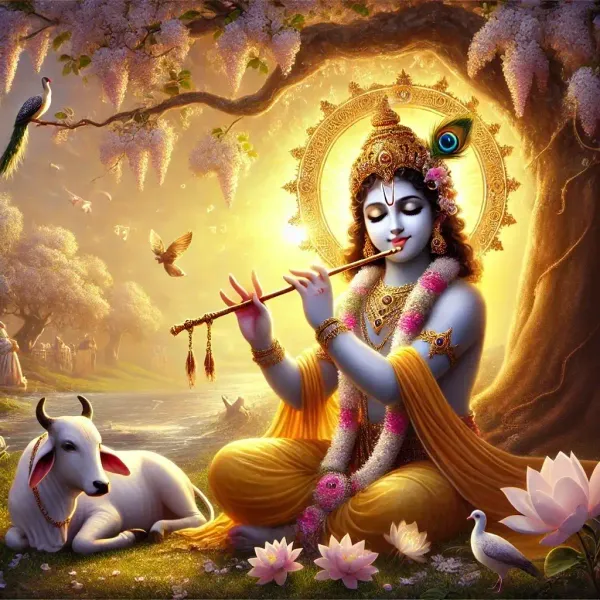
The Srimad Bhagavatam, one of the most revered Hindu scriptures, shares a mix of events that offer profound spiritual insights through the playful yet purposeful life of Shree Krishna. Among the most celebrated of these pastimes (leela) is the Damodar leela, which includes Shree Krishna’s mischief with butter, His interaction with Mother Yashoda, and His eventual binding with a rope around His waist. Far from being an incident of childhood pranks, this episode reveals profound truths and life lessons that explore divine love, devotion, discipline, and the nature of God in an accessible and endearing form.
At the center of this divine pastime is Shree Krishna, barely two years old, whose charm, innocence, and celestial intent blend seamlessly into everyday domestic moments. As Mother Yashoda churns yogurt, thinking fondly of her little Shree Krishna and planning to feed Him butter, a cascade of events unfolds that will leave the entire village of Gokul astonished. This pastime, rich with symbolism and devotional depth, marks a pivotal point in Shree Krishna’s childhood pastimes and introduces us to one of His beloved names: Damodar.
Mother Yashoda’s Maternal Dilemma
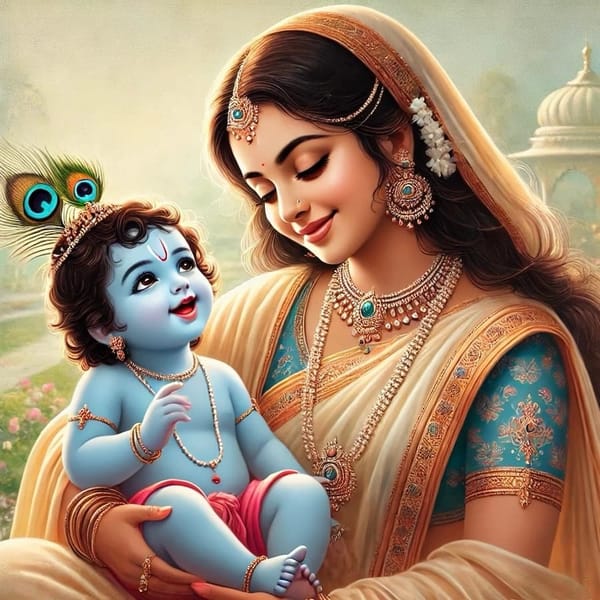
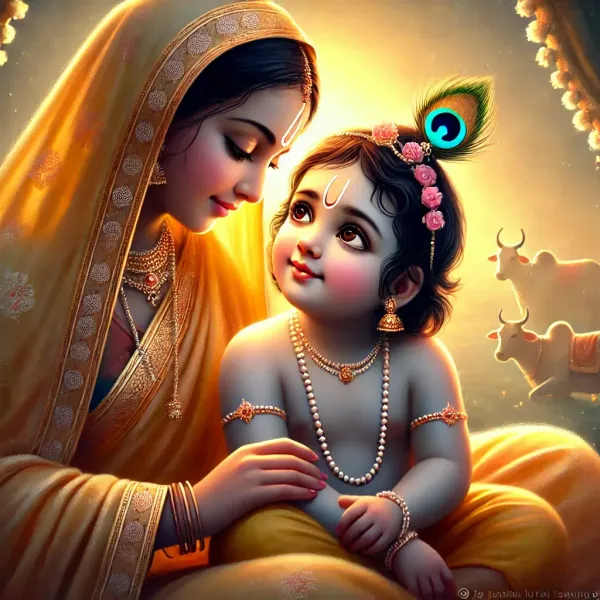
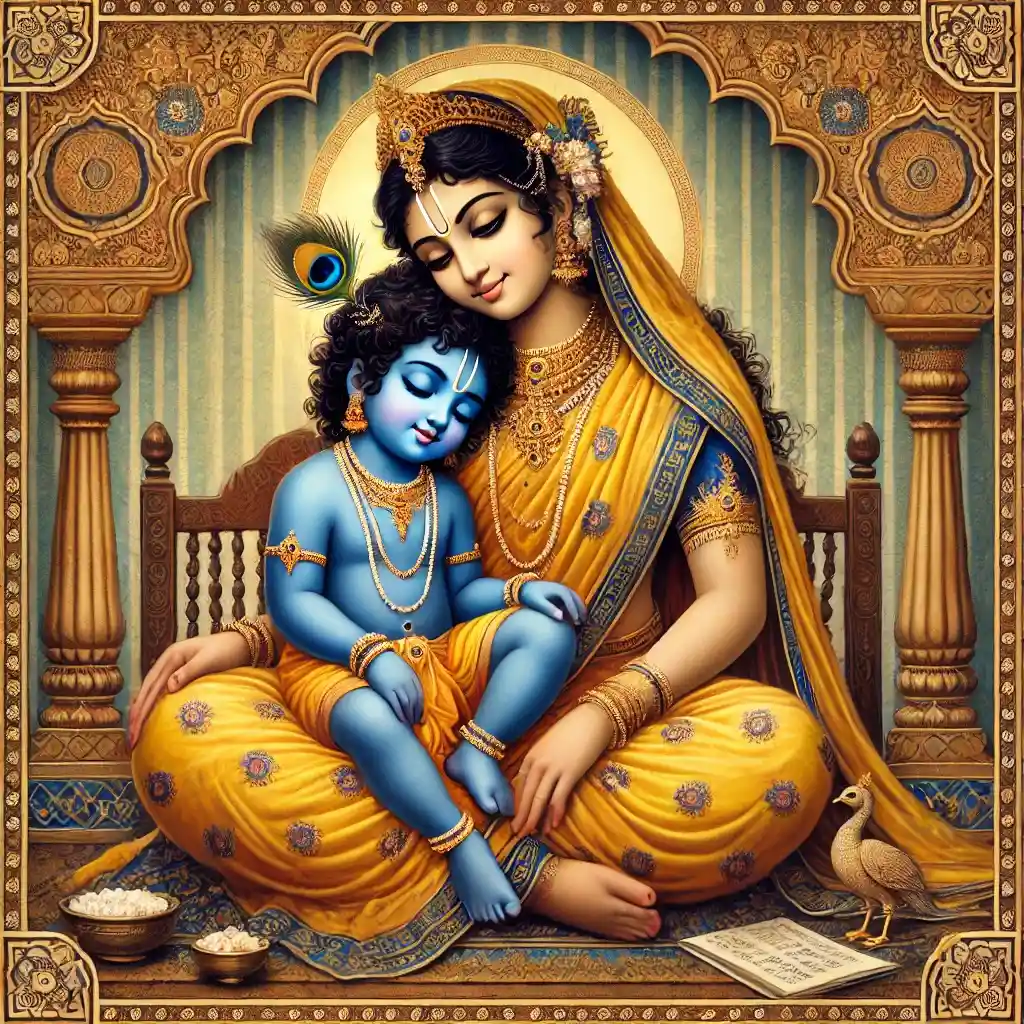
In the cozy kitchen of Gokul, Mother Yashoda churned yogurt while thinking of her her child, Shree Krishna. Intent on feeding Him butter, her thoughts radiated pure maternal love. Shree Krishna, ever the affectionate child and playful deity, toddled into the kitchen and climbed onto her lap. In response, Mother Yashoda began feeding Him her own milk, overflowing with love and devotion.
Yet, as it often happens in divine pastimes, a test emerged. In the next room, a pot of milk began to boil over. Torn between Shree Krishna in her arms and the milk wasting away, Mother Yashoda chose to preserve the milk and left Shree Krishna behind. This moment, though seemingly minor, carried great significance.
Lessons
- Material distractions, even those tied to duty, can sometimes draw us away from the Divine.
- Even the love of the most devoted souls is tested by God, not to punish but to elevate.
The Tantrum, the Butter, and the Monkeys
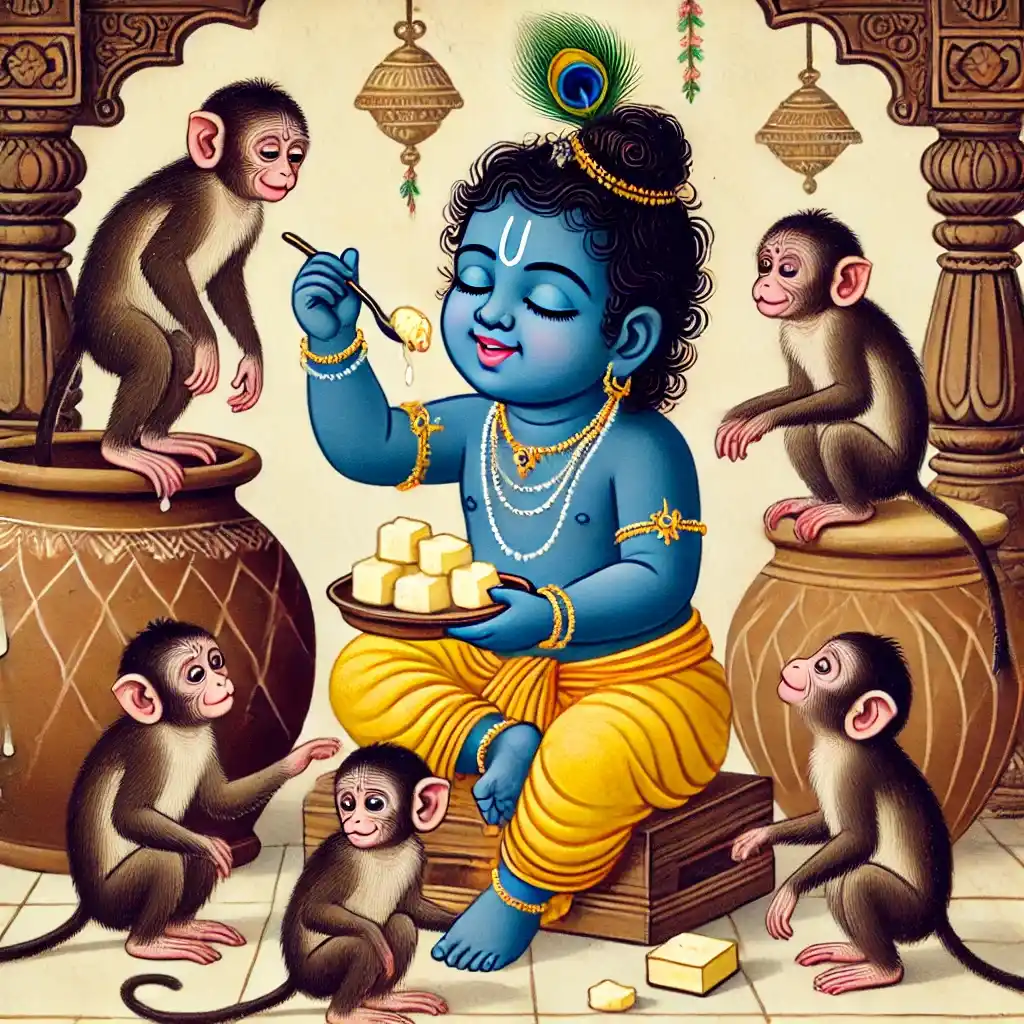
Feeling slighted by His mother’s departure, Shree Krishna decided to express His displeasure. He picked up the churning rod and began breaking pots in the kitchen. His mischief escalated as He grabbed butter and started feeding it to the monkeys.
Mother Yashoda returned to a scene of chaos, realizing that her beloved Shree Krishna had created a small battlefield in the kitchen. Infuriated, she picked up a stick and chased after Him. What followed was a divine game of hide-and-seek between God and His devotee. Shree Krishna, though tiny, ran swiftly. Mother Yashoda, though larger, could not catch Him at first. Yet, seeing her tired and breathless, Shree Krishna slowed down willingly, allowing her to catch Him. This was not submission, but compassion.
Lessons
- God reacts not with punishment but with playful teaching; His pastimes are loving lessons.
- Even God submits to the exhaustion of a loving devotee.
The Rope That Could Not Bind — Shree Krishna Becomes Damodar
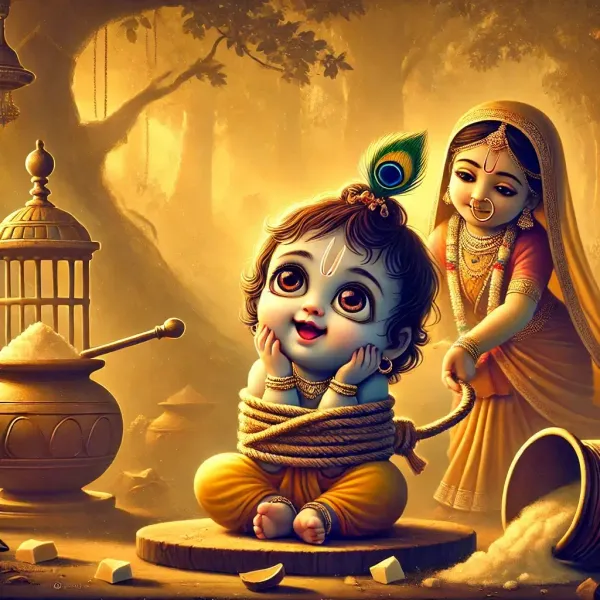
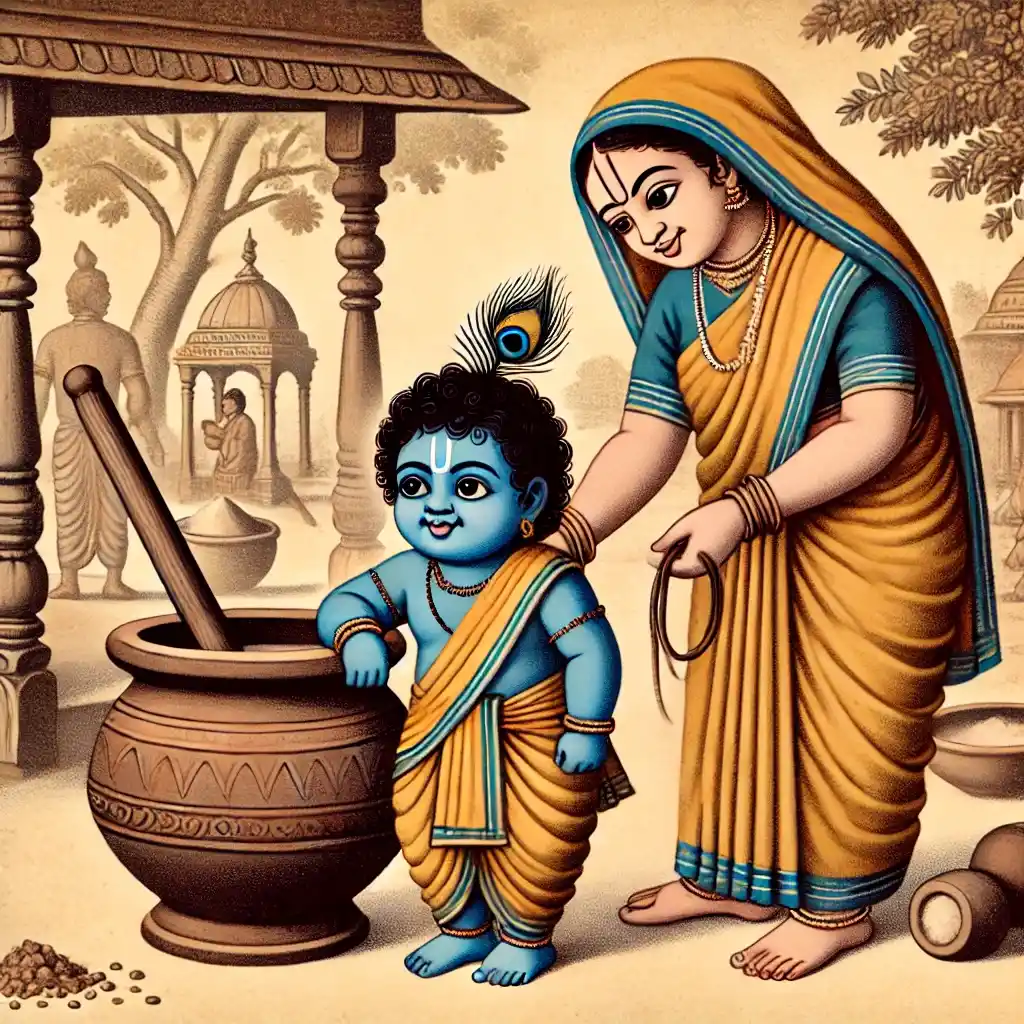
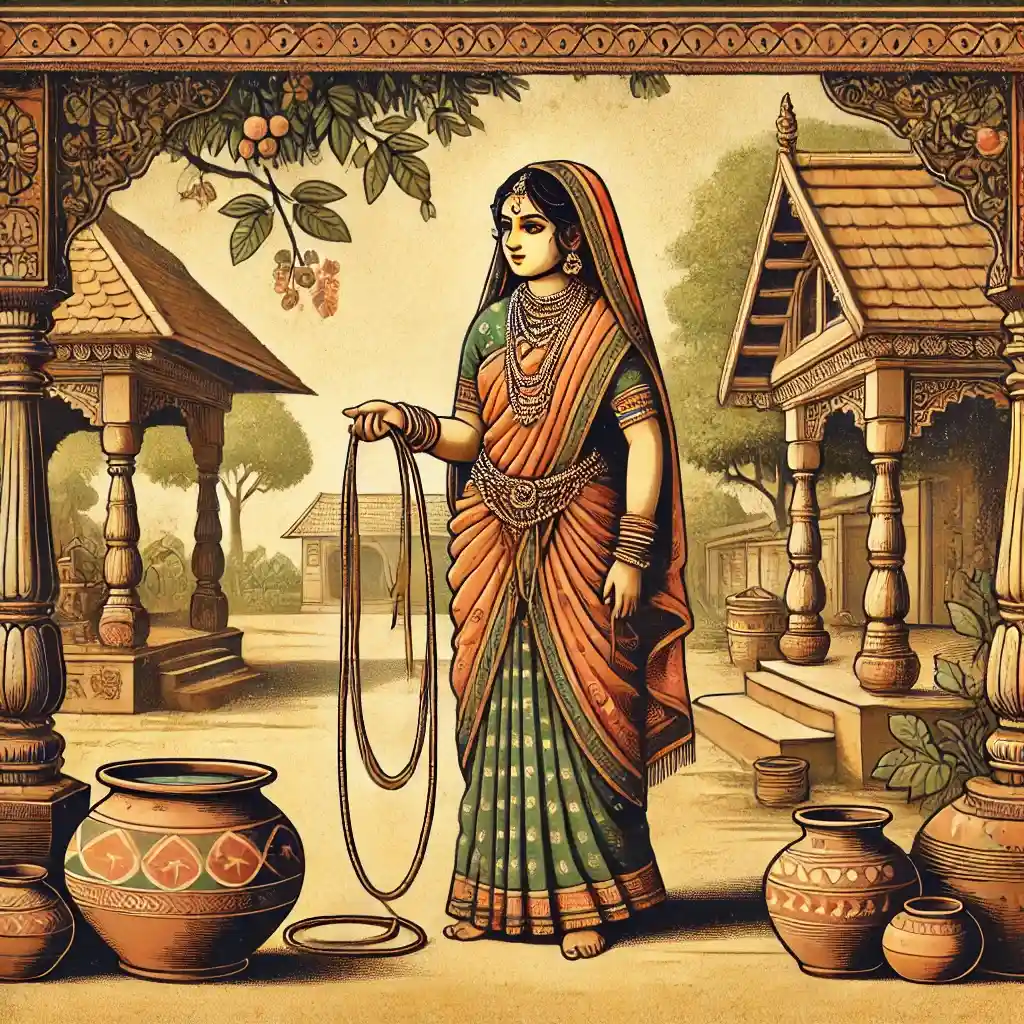
Now determined to discipline Shree Krishna, Mother Yashoda sought to tie Him to a wooden mortar. She commanded her friends to bring rope. But every rope fell short by two fingers, no matter how much was added. This simple yet profound moment revealed the truth of divine nature. Shree Krishna, the infinite one who contains all of creation, could not be bound by physical means. Only when Radha’s symbolic silk thread was added did the rope finally encircle Him. This act earned Shree Krishna the name Damodar, He who is bound around the waist (Dam= Rope, Udar = belly).
Lessons
- God cannot be bound by effort alone; only love and grace can bind God.
- Radha’s presence, even symbolically, completes the act of devotion.
The Cursed Trees
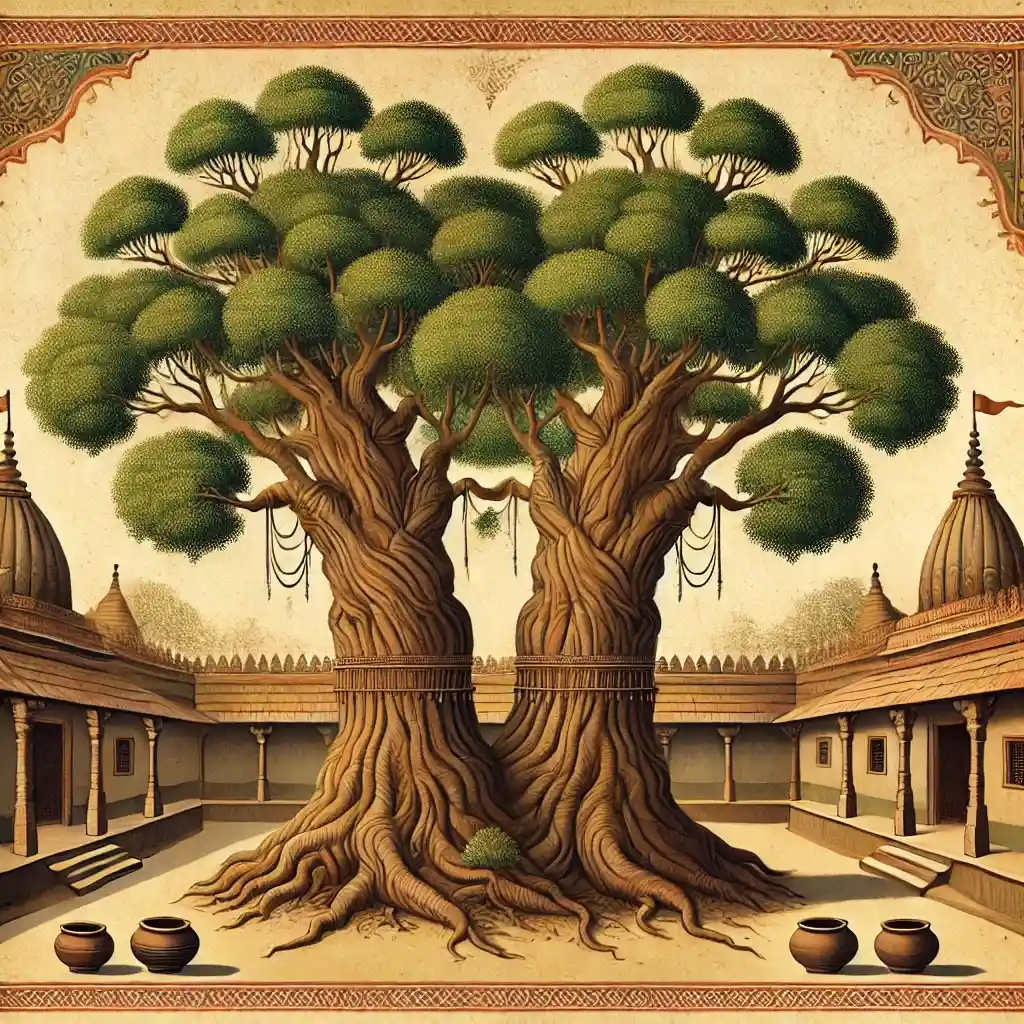
After tying Shree Krishna to the mortar, Mother Yashoda left Him there. The wooden mortar stood between two ancient twin trees—Yamala and Arjuna. These were no ordinary trees. They were once celestial beings—Nalakubera and Manigriva, sons of the wealth god Kuber. Blinded by their immense wealth and power, they became arrogant and indulged in excess. One day, in their intoxicated state, they disrespected the great sage Narad, who happened to pass by while they bathed in the presence of celestial maidens.
Seeing their moral downfall, sage Narad cursed them to become trees. But his curse was veiled with compassion. He arranged that their salvation would come directly from the touch of Shree Krishna. Now, years later, that moment arrived. Shree Krishna dragged the mortar between the trees. The trees crashed to the ground and the brothers emerged, spiritually awakened and humbled.
They offered heartfelt prayers to Shree Krishna, thanked Him for liberating them from their tree forms, and returned to the celestial realms, forever changed by the God's grace.
Lessons
- Excessive wealth without humility can lead to spiritual blindness.
- A sage's curse, born from compassion, can become a blessing in disguise.
- Divine touch is transformational; Shree Krishna’s presence alone can liberate even the most fallen.
Conclusion
The Damodar Leela did more than liberate two cursed souls—it left a deep and lasting impression on the hearts of the people of Gokul. Following this event, concerns grew among the elders. Led by Nanda Baba, they decided to move the community to Vrindavan—a decision rooted in love, protection, and the growing threat posed by Kansa.
But this move was more than just a change of place; it symbolized a timeless truth: that sometimes, we must leave the familiar behind to step into what is better suited for our growth, safety, and deeper connection.
In this pastime, Shree Krishna, the limitless, all-powerful God, allowed Himself to be bound by His mother’s love. He trembled before her raised stick, not out of fear, but to show that pure, selfless love, not force or intellect, is what truly touches the Divine.
This story offers enduring lessons for us today. It reminds us that real influence, whether in parenting, leadership, or relationships, comes not from control or fear, but from genuine love and heartfelt connection. Just as the people of Gokul embraced change for a greater good, we too must sometimes move beyond comfort to grow in purpose and spirit. In a world that often prizes intellect and accomplishment, the Damodar Leela gently points us back to what matters most: sincerity, humility, and devotion. Ultimately, this beautiful pastime invites us not just to understand life, but to love through it—because in the end, it is love that binds even the boundless.
Call to Action
- Immerse yourself in the divine pastimes of Shree Krishna and transform your spiritual journey by listening to Swami Mukundananda's Srimad Bhagavatam sessions on YouTube.
- Embark on a soul-stirring week at the Dallas Life Transformation Program with Swami Mukundananda from August 2nd to 9th, 2025 at the Radha Krishna Temple in Allen, TX. Participate in inspiring evening discourses, rejuvenating yoga and meditation, uplifting kirtans, and intimate morning walks that will ignite inner peace, clarity, and devotion
FAQs
1. Why did Shree Krishna get angry when Mother Yashoda went to save the milk?
Shree Krishna was not angry in a worldly sense but expressed divine discontent to teach a deeper truth. When Mother Yashoda chose to attend to the boiling milk instead of Him, it reflected a momentary lapse in prioritizing the Supreme over material concerns. Though her action came from care and duty, Shree Krishna used this moment to gently remind her (and us) that the Divine should always come first. Even in the smallest choices, devotion and spiritual focus take precedence over worldly duties.
2. What is the significance of the rope being short by two fingers?
The two fingers represent human effort and divine grace. No matter how much effort one puts in, without God's grace, one cannot attain or bind God. The moment love and surrender are complete, God becomes accessible.
3. Why did Shree Krishna feed butter to the monkeys?
This act symbolizes universal love. Shree Krishna, the protector of all beings, extends His affection beyond humans to animals, showing that divine compassion knows no bounds.
4. Who were the trees that Shree Krishna liberated, and why were they cursed?
The trees were Nalakubera and Manigriva, sons of Kuber. Due to their arrogance and indulgence in material pleasures, they were cursed by sage Narad to become trees. Their eventual liberation by Shree Krishna signifies the transformative power of divine contact.
5. What does the name Damodar mean, and why is it important?
Damodar means the One who is bound by a rope around His waist. This name is important because it captures the heart of the Damodar Leela—where the all-powerful God submits to the pure love of His devotee. It symbolizes how divine love is not based on power or control, but on deep affection, humility, and surrender.