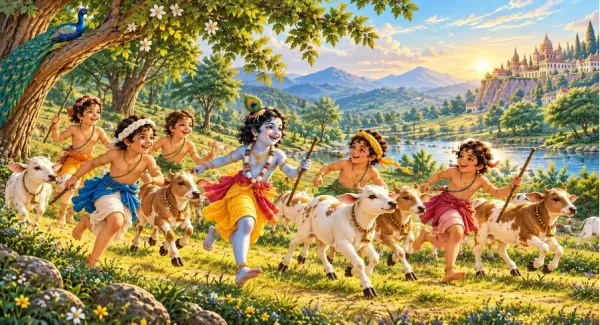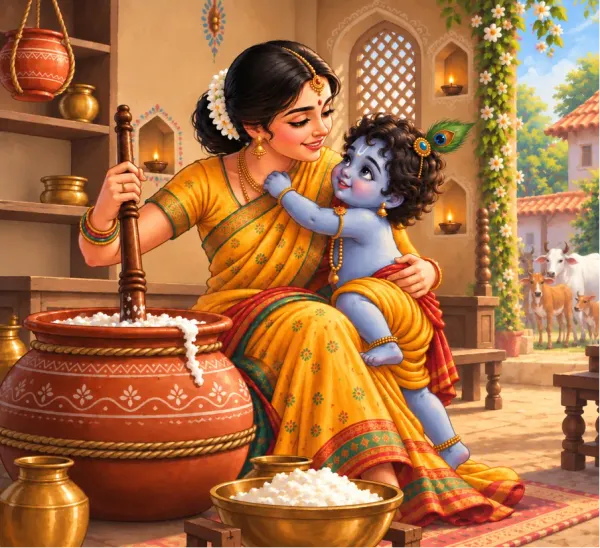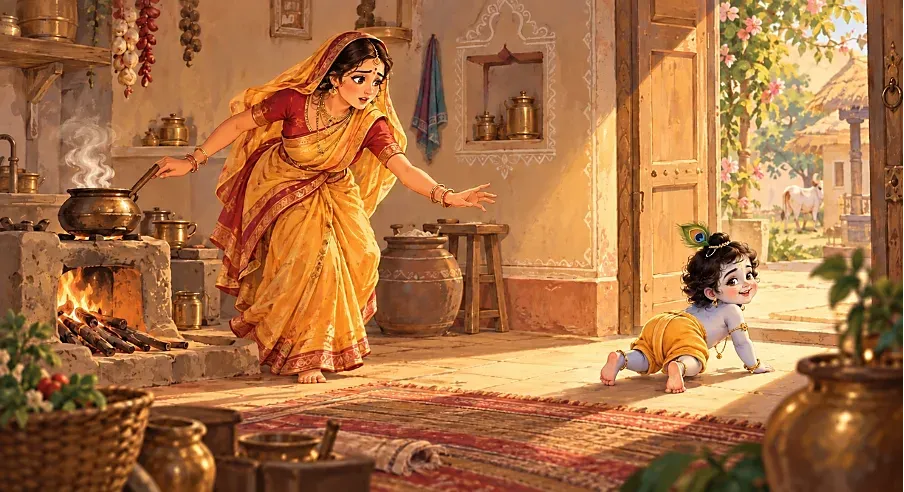

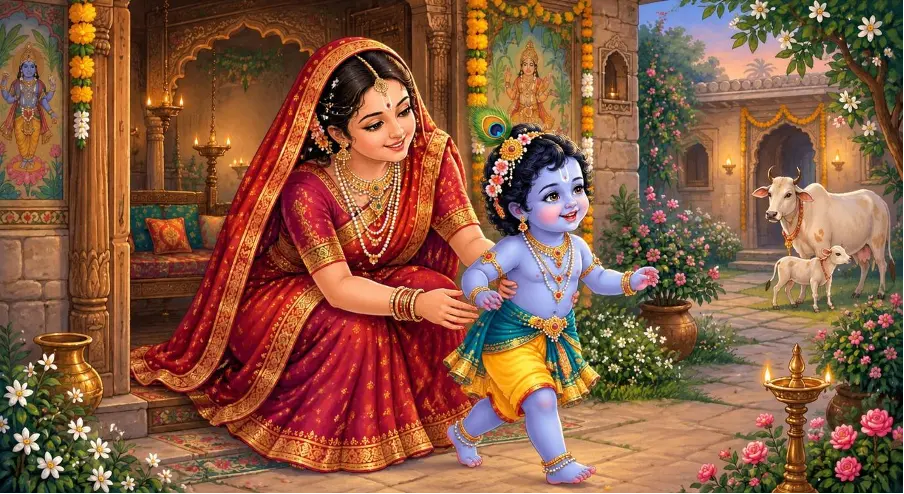
One day, Yashoda nestled her darling baby Krishna on her lap. She brushed His curly hair, adorned Him from head to toe, and poured out all her love upon Him. She then set Him down with a smile. “Go, Lala, go and play.” Beaming with joy, the little one toddled out the door.
The gopis (village maidens) would often gather outside Nand Bhavan, finding every excuse to catch a glimpse of Nandalal. One such excuse was to sell curd. It was an amusing pretext, given that Nand Maharaj owned many cows and his home already overflowed with fresh dairy.
Still, they came, calling out, “Curd! Who will buy fresh curd?” Their minds, however, were immersed in Krishna. Before long, the vendor's cry would melt into chants of longing: “Buy, Shyamsundar! Take, Madhusudan! Who will buy, Nandalal!” Lost in His remembrance, they would forget all else.
Caught in the Mire
These milkmaids of Braj were no ordinary women. They were elevated souls; some eternally liberated, some perfected through devotion, and others great sages reborn to partake in the Lord’s Pastimes. Hence, their hearts were irresistibly drawn to Krishna, though they themselves could not explain why.
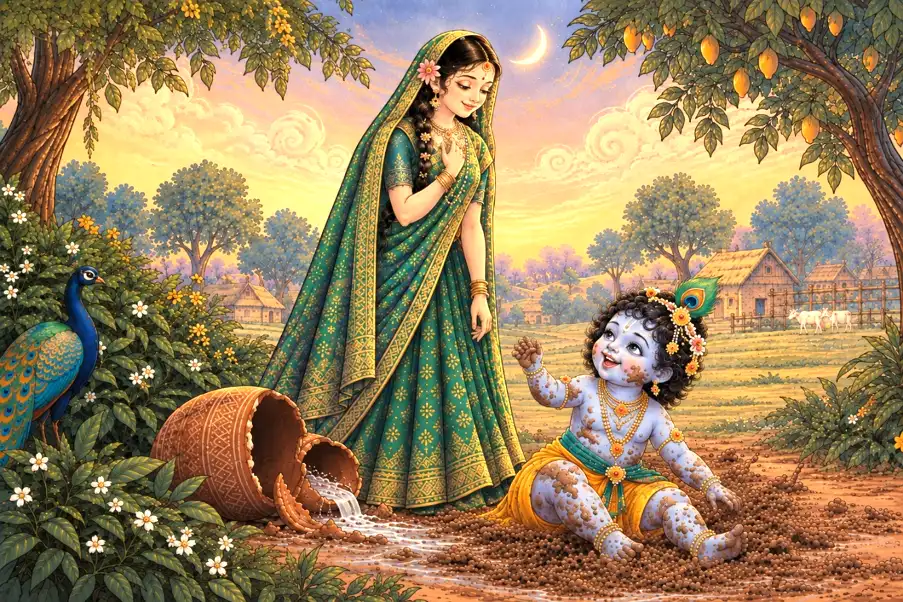
A gopi was walking by with an earthen water pot balanced atop her head when little Krishna crossed her path. Their eyes met. In a flash, a wave of divine love overwhelmed her, sweeping her mind into deep samadhi. In such a state, holding the pot was out of the question. It slipped, fell, and broke. Water spilled across the ground, turning it into slick mud.
Krishna was thrilled. He yearned to be anointed with the dust touched by the gopi’s feet. Such is the glory of those who possess the treasure of divine love that the Lord Himself proclaims in the Bhagavatam:
अनुव्रजाम्यहं नित्यं पूयेयेत्यङ्घ्रिरेणुभिः ~ verse 11.14.16
I walk behind them, hoping their foot dust will fall upon Me, so I may get purified.
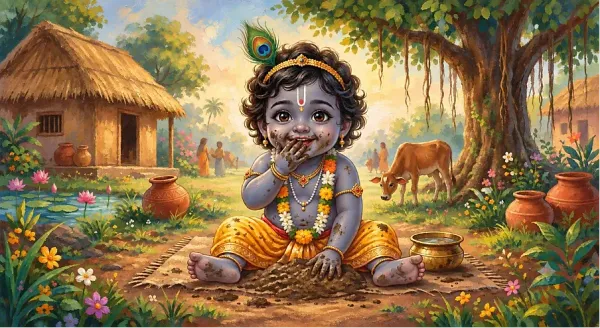
Outwardly, however, Krishna simply carried on like an ordinary toddler who could not resist a muddy puddle. Giggling, He darted straight into it, wallowing about and smearing muck over His hands, feet, and clothes.
The gopi opened her eyes to the scene before her. What a mess! she thought. If anyone comes along, they will surely think I caused all this! Before anyone could catch sight of her, she scurried away, while Krishna gleefully continued reveling in the mire.
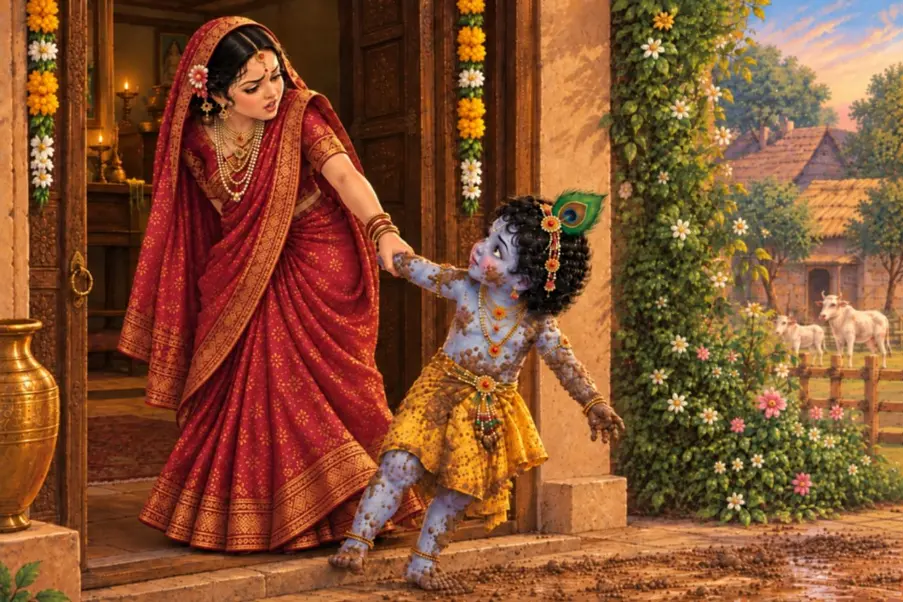
A few minutes later, Mother Yashoda realized the house was way too quiet. “Where has my Lala wandered off?” Stepping outside, she gasped. All of Krishna’s beautiful shringar: His gleaming anklets, bright peacock plume, and fresh silken clothes, was now coated in sludge.
“Every ten minutes, Kanha! Every ten minutes! I have to change Your clothes!” she sighed, swooping in to catch His muddy wrist. “Do You think Your mother has nothing else in the world to do?” Tugging Him indoors, she scolded Him with that fond, helpless exasperation only a mother can feel.
पंकाभिषिक्तसकलावयवं विलोक्य, दामोदरं वदति कोपवशाद्यशोदा ।
त्वं शूकरोऽसि गतजन्मनि पूतनारे रित्युक्तिसस्मितमुखोऽवतु नो मुरारिः ॥
Kanha! I just bathed and dressed You, and here You are, covered in dirt again! Surely You must have been a pig in Your past life!
Krishna knew what she meant, yet pretended not to understand. He knew who He was, yet remained utterly immersed in being Yashoda’s little boy.
Hearing her rebuke, He secretly chuckled: “Maiya is actually right. In My Varaha avatar, I did descend as a boar! Perhaps some old habits have lingered.” A mischievous grin spread across His face. But knowing that laughter now would only invite a spanking, He quickly turned His head away and buried His smile.
The Supreme Lord of the universe willingly submitted Himself to a mother’s scolding. The sweetness of the vatsalya-ras Shree Krishna bestowed upon Yashoda was so profound that it left even exalted sages like Narad Muni spellbound.
Sage Narad Spellbound
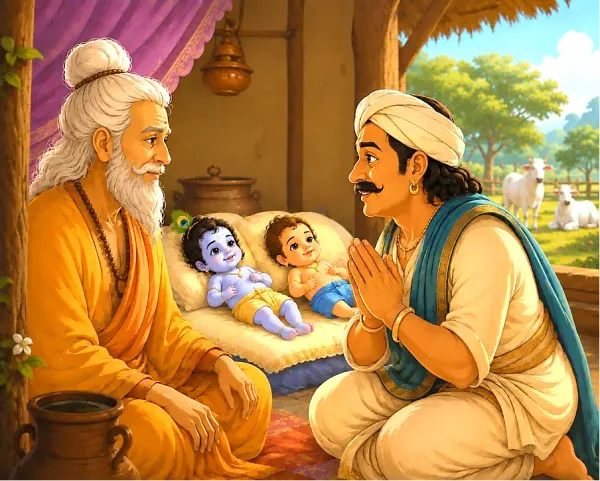
When Sage Narad learned that the Supreme Lord had descended upon the mortal realm, he set out at once for Gokul. Soon, he stood at the home of Nand and Yashoda, eager for darshan of Bhagavan.
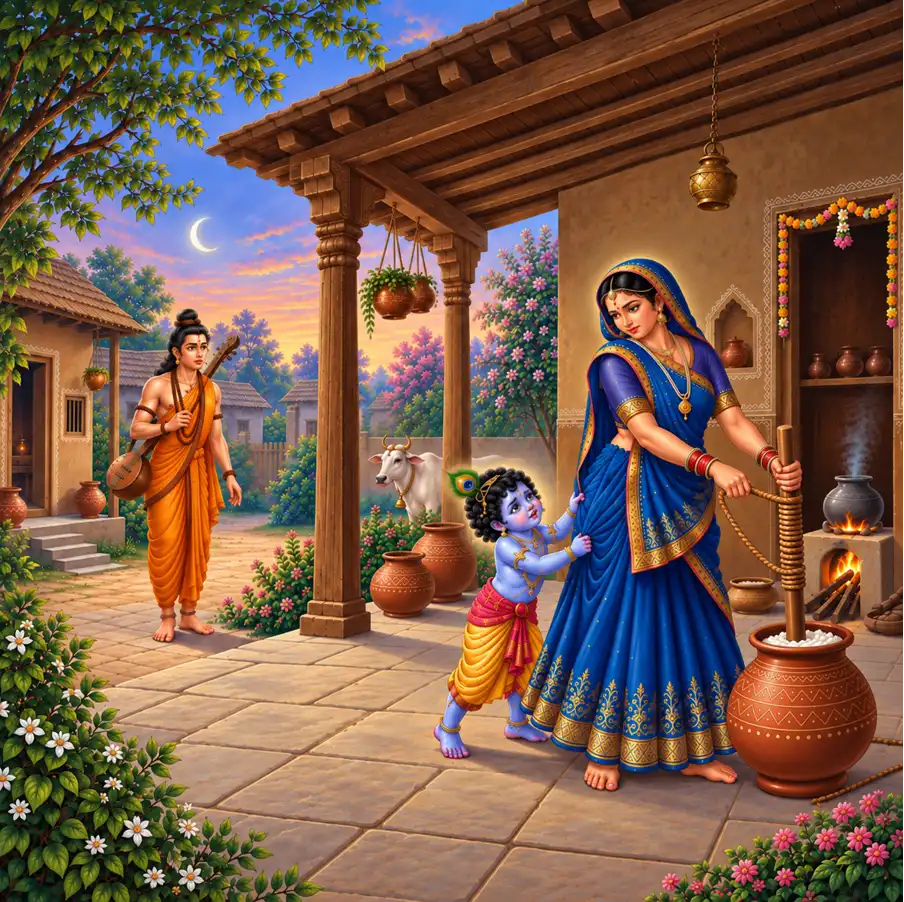
But peering through the doorway, he was greeted by a rather typical, everyday scene: A mother occupied with chores, and a little boy clinging stubbornly to the hem of her saree. Stamping His feet, the boy whined, “Pick Me up! Take Me in your lap!” But Yashoda would not yield. “You mischievous Lala! Whenever You want, You expect me to drop everything and take You into my lap. Not this time—go and play!”
Narad was puzzled. I came to behold the Master of the universe. But which of these two is God? Surely, not this petulant child. Every hymn and scripture declared that it is the helpless soul who begs for the Lord’s embrace.
The Govinda Damodar Stotram (verse 50) states:
संसारकूपे पतितोऽत्यगाधे मोहान्धपूर्णे विषयाभितप्ते ।
करावलम्बं मम देहि विष्णो गोविन्द दामोदर माधवेति ॥
O Lord, I am drowning in the ocean of life and death. Please hold my hand and lift me up, O Govinda, O Damodar, O Madhav!
Yet here was a toddler insisting piteously to be cradled into a mother’s arms. Then the woman must be God, and the child the seeking soul, Narad reasoned. Then suddenly, he corrected himself. No, this is no Mohini avatar. The Lord has descended in a male Form.
That child is God!
In that moment of epiphany, Narad no longer looked at the divine child. He stared instead in wonder at Yashoda. Who on earth is this woman? The Supreme Brahman is pining to be held by her. Narad ji pondered deeply: I have never encountered any sadhana in the sacred texts that results in such a benediction.
After remaining absorbed in samadhi for a while, He exclaimed:
किं ब्रूमस्त्वां यशोदे कति कति सुकृतक्षेत्रवृन्दानि पूर्वं
गत्वा कीदृग्विधानैः कति कति सुकृतान्यर्जितानि त्वयैव ।
नो शक्रो न स्वयम्भूर्न च मदनरिपुर्यस्य लेभे प्रसादं
तत्पूर्णं ब्रह्म भूमौ विलुठति विलपन् क्रोडमारोढुकामः ॥
O Mother Yashoda, how can I extol your good fortune? What pilgrimage sites did you visit in previous lives? What austerities did you undertake? What immeasurable merit did you amass? Neither Indra, nor Brahma ji, nor even Lord Shankar ever received such grace.
This is the glory of Mother Yashoda’s love.
She sees Krishna simply as her little boy. She thinks only as a mother would: I am responsible for Him. He should not develop any bad habits. I have to take care of Him. Captivated by her pure love, Shree Krishna gladly sets aside His godliness and places Himself at her disposal: Do as you please, Mother. I am in your hands.
Krishna’s Playful Victory
While such sweetness rippled through Braj, fear had gripped Kans in Mathura. He lay wide awake night after night, eaten alive by the prophecy that Devaki’s eighth child would bring about his doom.
Putana and Shakatasur had already met their end. Furious, Kans dispatched yet another demon, Trinavart, to destroy Krishna. He arrived as a tornado, intent on whirling the child skyward and dashing Him to the earth. But to little Krishna, he was nothing more than a spinning toy sent by Uncle Kans.
Sensing Trinavart nearby, Krishna devised a quiet trick of His own: He began making Himself impossibly heavy. Yashoda was lovingly carrying her baby when a strange weight settled into His tiny limbs. Just moments ago, He was light as a feather. How has my Lala now become as heavy as a rock? Wondering if passing years had sapped her strength, she gently lowered Him to the ground.
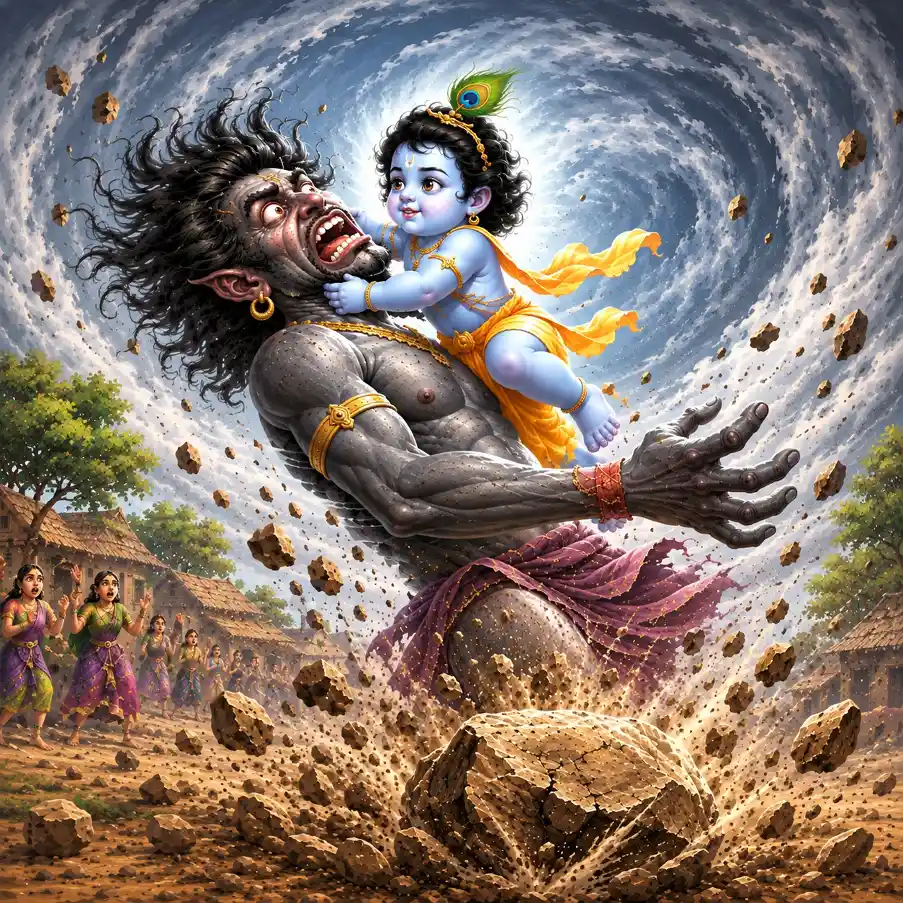
That was the moment Trinavart had been waiting for. A howling gale tore through Gokul, filling the air with blinding dust and eclipsing the midday sun. Amid the turmoil, the whirlwind seized Krishna and shot into the skies. High above the clouds, however, Trinavart’s triumph turned to horror. Krishna began emanating such scorching heat, as though the demon were clutching a blazing fire wrapped in cloth. At the same time, Krishna became heavier than a mountain.
Before Trinavart could fling Him away, Krishna locked His tiny arms around the demon’s throat. Choking and thrashing, Trinavart struggled desperately, his eyes bulging from their sockets. He lost control and hurtled headlong onto the jagged boulders below. His life was crushed out in an instant.
When the dust finally cleared, the Brajvasis rushed to the spot—only to stop in their tracks. There sat baby Krishna merrily perched upon the demon’s chest, as though nothing had happened. Breathing a sigh of relief, Yashoda gathered Him into her arms. “I cannot understand it,” she murmured, waving holy herbs over His head to ward off malicious spirits. “Some wicked demon, some evil eye, will not leave my innocent baby alone!”
Oblivious that the Savior of all was resting in her arms, she enveloped baby Krishna once more in a shower of motherly love.
Frequently Asked Questions
Question: What makes Yashoda’s and the gopis’ devotion different from formal devotional practices?
Answer: Devotion can be done in two styles:
● Vaidhi bhakti is devotion practiced alongside prescribed rules and rituals. For example, sprinkling sacred water, ringing bells, and reciting mantras before offering food to the Lord.
● Raganuga bhakti emphasizes love over ritual. For example, offering food to the Lord just as a mother would feed her child.
Vaidhi bhakti often carries an element of self-interest. The devotee worships God seeking relief from worldly suffering and liberation. There is also a fear that without such worship, these may remain out of reach. Raganuga bhakti, by contrast, is marked by intimacy and spontaneity. There is no calculation, no thought of what may be gained in return—only the pure, unbounded joy of loving the Lord.
The fruits of these two paths are also distinct.
Through Vaidhi bhakti, one receives Dwarika ras, where Shree Krishna is surrounded by opulence. He is in the mood of a king, and the relationship is marked by formality and reverence. Whereas, through Raganuga bhakti, one gets Braj ras, where Shree Krishna does not remain God. He is the Beloved of the gopis, the Child of Yashoda, and the Friend of the cowherds.
▶️ Relish the sweet Pastime of little Krishna whining for Mother Yashoda’s lap through Swami Mukundananda’s pad-vyakhya on the kirtan “झगड़त सुंदर श्याम गोद हित,” composed by Jagadguru Shree Kripalu Ji Maharaj.
Question: What should be our approach to the Leelas of God?
Answer: Some people do not regard God’s Pastimes as divine. They argue, for instance, that the Ramayan never actually took place, that Sita is merely a symbol of devotion, or that Ayodhya exists within the human body. In reducing these divine Pastimes to figurative interpretations, they miss their very essence. In Bhagavad Gita verse 4.9, Shree Krishna teaches us to cultivate divine sentiments toward His Leelas to deepen our devotion.
For this, we must understand the difference between God’s actions and ours. We materially bound souls have not yet attained divine bliss, so our actions are driven by self-interest and the desire for personal fulfillment. God, however, is perfectly satiated by the infinite bliss of His own personality and has no personal motive.
Whatever He does, therefore, is for the welfare of materially conditioned souls. Such divine actions are called Leelas, while ours are called “work.” If we wish to savor the bliss of divine love, we must set aside the urge to interpret the Lord’s Pastimes and simply rejoice in them.