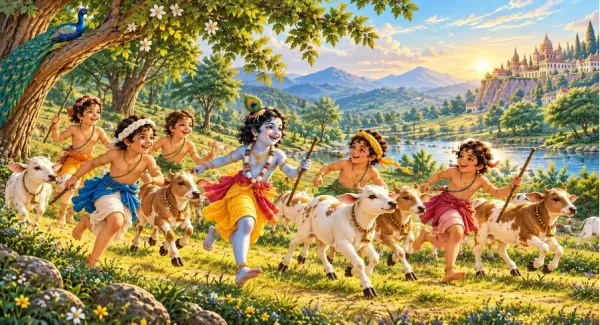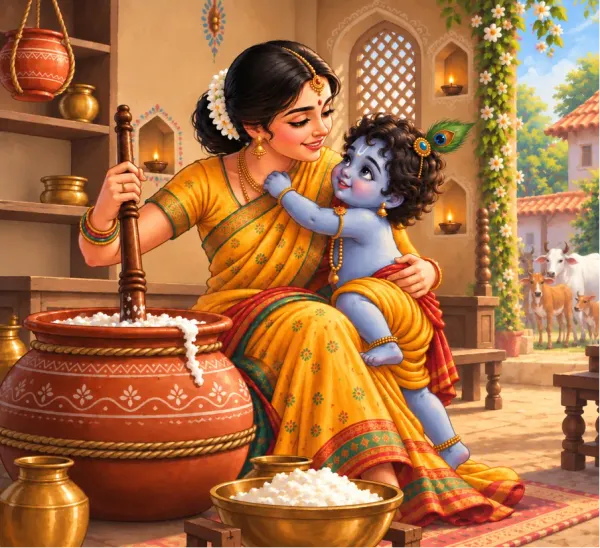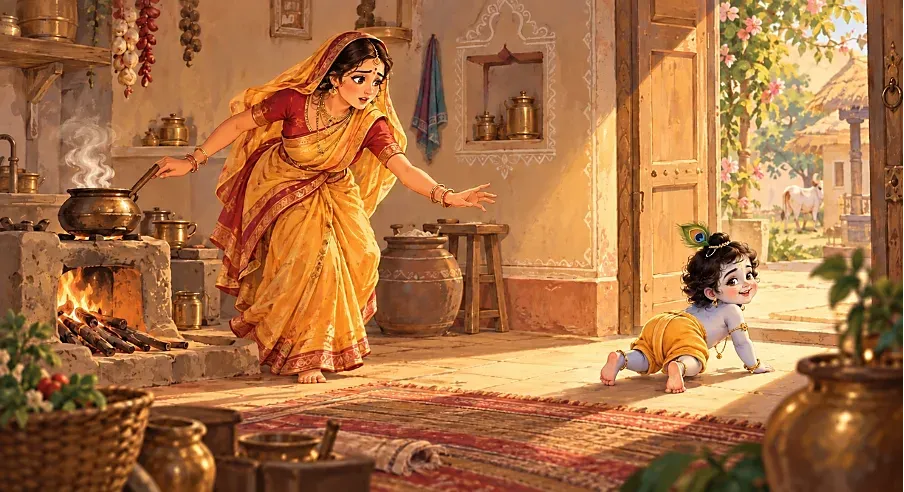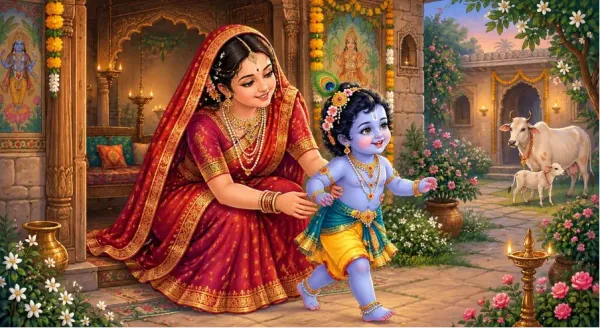
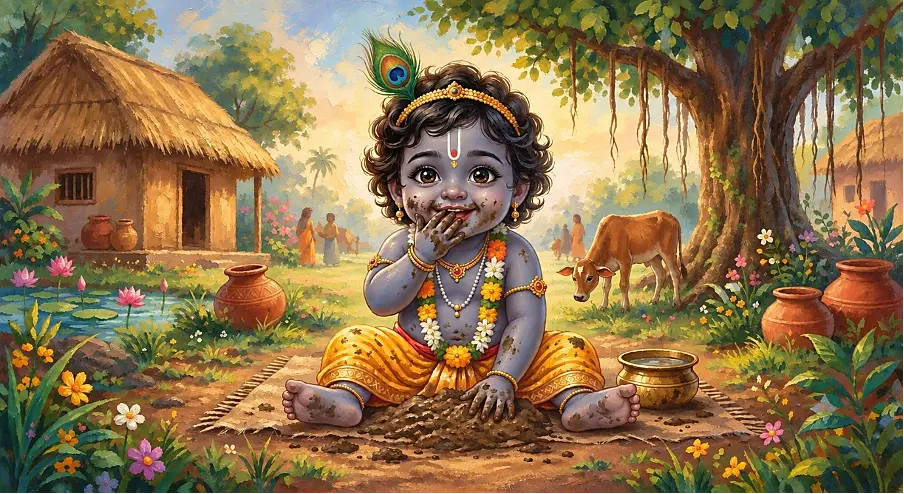
Shree Krishna was still in the tender years of childhood. Having descended to steep the world in the bliss of bhakti, He constantly spun ever-new Pastimes. No sooner had Yashoda caught on to His butter-stealing ways than the little one took to yet another mischief: eating mud. His cowherd companions would come sprinting across the courtyard, exclaiming, “यशोदा, तेरे लाला ने माटी खाई!” Yashoda, your Lala ate mud again!
Day after day, the same complaint reached Yashoda’s ears. Concerned for His health, she finally turned to her Lala. “Kanha, did you eat mud?” Krishna thought: If I deny it with unblinking confidence, Maiya will surely believe me. And so, without the faintest flicker of guilt in His eyes, He boldly declared, “Maiya, I did not eat any mud!”
The Muddy Dilemma
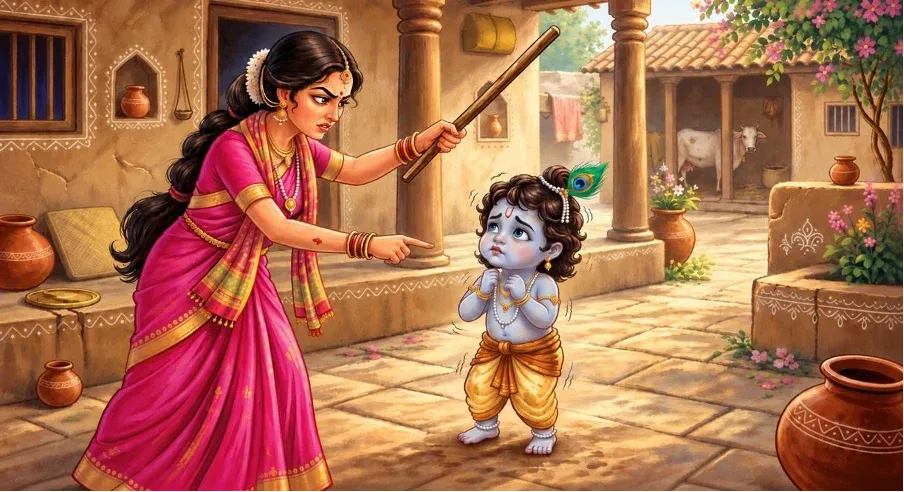
“You claim you ate no mud. But your friends are saying that you did!” Yashoda countered, her voice edged with suspicion.
Krishna sprang to His own defense, “Maiya, let me tell you what really happened! Just the other day, Shridama asked me for a sip of buttermilk while I was drinking it. I refused to give him any, and now he is cooking up stories about me.”
“And what about your elder brother?” Yashoda asked, folding her arms. “Balaram says the very same thing.”
Unfazed, Krishna cried out, “Maiya, they are all liars! Every single one of them!” Yashoda arched an eyebrow, unconvinced. “Is that so? Everyone in Braj is a liar, and you alone are the avatar of Raja Harishchandra himself? Tell me, why should I take your word over theirs?”
Seeing He was backed into a corner, Krishna played His trump card.
नाहं भक्षितवानम्ब सर्वे मिथ्याभिशंसिन: ।
यदि सत्यगिरस्तर्हि समक्षं पश्य मे मुखम् ॥ ~ Verse 10.8.35
My dear mother, I have never eaten dirt. All My friends complaining against Me are liars. If you think they are being truthful, you can directly look into My mouth and examine it.
Krishna gambled that if he willingly invited Yashoda to inspect his mouth, she would assume that no guilty child would dare make such an offer. She would simply drop the matter.
Mother Yashoda, however, was no novice. She knew her mischievous Lala all too well. “Fair enough, Lala,” she replied evenly. “In that case, open your mouth.” Krishna froze. The bluff had failed. He had indeed gorged on mud, and it was plastered all over his gums and tongue. Yashoda reached for a stick. “Open your mouth, Kanha!”
At the sight of the stick, Krishna began to tremble. Today, I am surely going to be beaten! Squeezing His eyes shut, His mind raced in circles: Should I open My mouth? Should I keep it shut? If I refuse to open My mouth, it will be an outright confession of guilt. Maiya will take it as proof that I have eaten mud. But if I open it, she may only take a cursory glance. And if luck is on My side and she overlooks the telltale traces, perhaps I could get off scot-free!
Clinging to that slender hope, He tipped His chin up and opened His mouth.
Yet the moment Yashoda peered inside, the ground shifted beneath her feet.
A Mouthful of Wonder
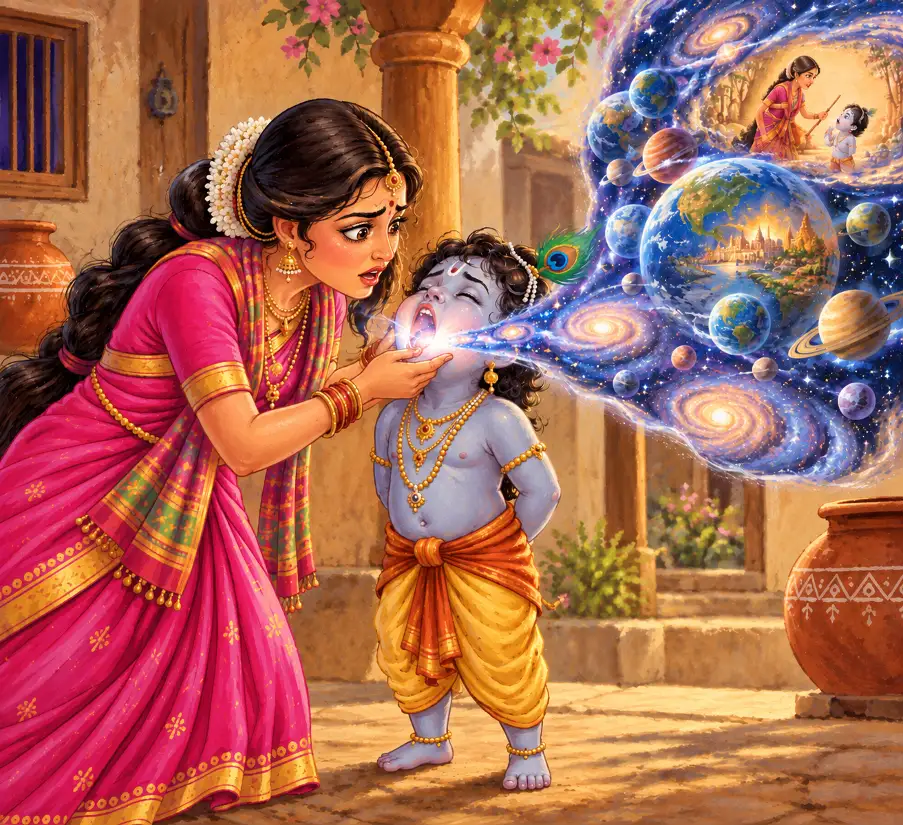
There was not a grain of mud in sight. Instead, within that tiny mouth, suns blazed, stars shimmered, and oceans stretched endlessly. Galaxies whirled through space, countless planetary systems floated in their orbits, and there was the Earth, with Mathura and Braj resting upon its crust. And there, too, was Yashoda herself, standing with a stick in her hand, gazing into Krishna’s mouth.
In the split second before the stick fell, an unexpected force had intervened.
In Braj, the Almighty had banished His supreme opulence, His Aishwarya Shakti. "You are not to come here. In this land, I am not God. Let My mother scold Me as her little boy, and let My friends treat Me as their equal."
Yet Aishwarya Shakti is, above all, the Lord’s devoted servant. An unfaithful servant walks away the moment they are dismissed, thinking, If He does not want me, I don’t need Him either. But a true devotee never strays. They remain ever-ready to serve their Master. Thus, even though exiled from the pastures of Braj, Aishwarya Shakti lingered quietly in the background, watching over Shree Krishna.
The moment little Krishna opened his mud-smeared mouth before Mother Yashoda, Aishwarya Shakti grew frantic: My Lord is about to be beaten! This cannot be. She rushed straight into Krishna’s mouth and unleashed the staggering magnificence of the cosmos.
Dazed and unmoored, Yashoda swayed from side to side, nearly buckling under the sheer weight of the spectacle before her. Oh my God, what did I just see? Her mind reeled in utter confusion.
Meanwhile, little Krishna kept His lips parted and His eyes squinted tight, bracing for the blow. Where is the stick going to land? On My back? On My palms? Seconds ticked by in silence. Surprised that the blow had not fallen, He peeked open one eye. There stood Yashoda, pale and bewildered.
Krishna realized what had transpired. His awe-inspiring Aishwarya Shakti had stepped in. Where did you come from? He waved it away and gently touched His mother to restore her sweet, ordinary world. At once, by the virtue of His Yogmaya Shakti, Yashoda returned to her natural state of motherly affection.
वैष्णवीं व्यतनोन्मायां पुत्रस्नेहमयीं विभु: ~ Verse 10.8.43
The supreme master, by the influence of the internal potency, Yogmaya, inspired her to become absorbed in intense maternal affection for her son.
The cosmic vision vanished. Yashoda rubbed her eyes and shook her head, trying to make sense of what she had witnessed. What was that? Infinite universes inside my Lala’s mouth? Impossible! Surely my senses deceived me. It must have been nothing more than a fleeting illusion. She looked down at her scared little boy and cast the stick aside, pulling Him into a warm embrace.
This is the Vatsalya Bhav; the devotional mood in which one relates to God as one's own child.
The Feeling of “Mine”
People often ask, “How can we develop love for God?” The answer lies in developing a single conviction: “He is mine.” When someone becomes ours, affection naturally follows.
Traditionally, a bride and groom often never saw each other until the wedding day. Their marriage was arranged by their parents, and the couple would sit before the sacred fire, chant the mantras, and take the seven rounds around it. The bride’s face might still be covered by her ghunghat. She had never known the man beside her, yet an unspoken bond was created. How? Her intellect had decided, “He is my husband. He will protect me and care for me all my life. He is mine.” The moment she accepted him as “mine,” love began to awaken.
This feeling of “mine-ness” is powerful. We cultivate it in worldly relationships. Yet with God, we need not create it. He dwells within us. He is already ours, and we are eternally His. We have merely forgotten this bond. Spiritual practice is the conscious process of remembering what has always been true.
There are five bhavs, or devotional sentiments through which one can relate to the Divine.
In Shant bhav, one thinks, “He is my King.” It is like watching a monarch pass by in a royal procession. One bows with deep reverence, but the relationship retains a certain distance. In Dasya bhav, the bond becomes more intimate. “He is my Master, and I am His servant.” This was the sentiment of Hanuman towards Shree Ram. The devotee finds joy in serving the Lord with love and devotion.
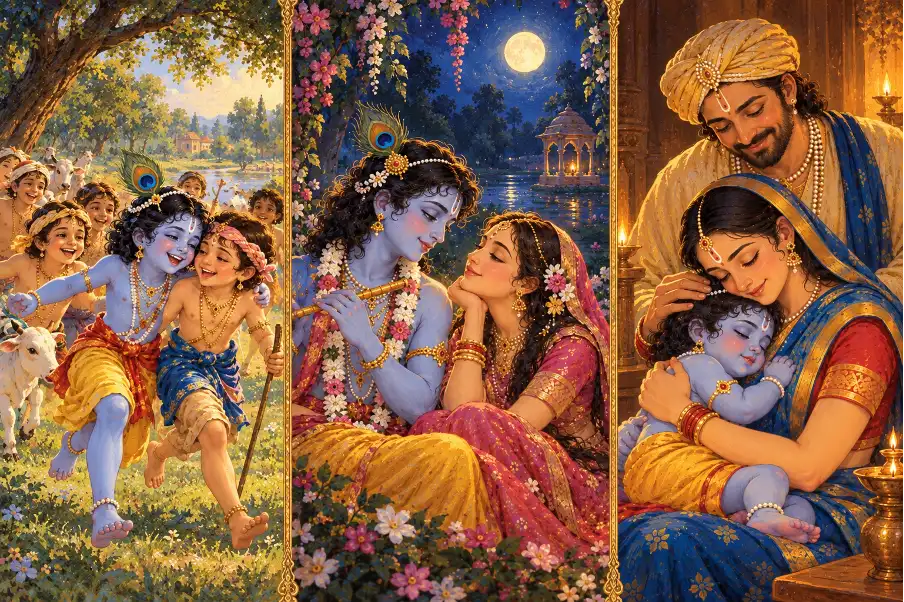
Step into Braj, the heartland of Rasik bhakti, and formality dissolves completely. In Sakhya bhav, one says, “He is my friend.” God is seen as a playmate, a trusted confidant who shares your laughter and your secrets. In Madhurya bhav, the devotee sees God as “My beloved” and relates to Him with conjugal intimacy. And in Vatsalya bhav, the sentiment is “He is my child.” This is the maternal and paternal affection of Mother Yashoda and Nand Baba towards Shree Krishna. They scold Him, feed Him, cradle Him, and care for Him as though He were entirely dependent upon them.
This prayer captures the wonder of Vatsalya bhav.
श्रुतिम् अपरे स्मृतिम् इतरे भारतं अन्ये भजन्तु भवभीताः ।
अहम् इह नन्दं वन्दे यस्यालिन्दे परं ब्रह्म ॥ ~ Padyāvalī 126
Others may worship the Supreme through the Vedas, the Smritis, or the Mahabharat. But I bow to Nand Baba, in whose courtyard the Supreme Brahman Himself plays.
It also reflects the highest known quality of God. He is Bhaktvatsal: He loves His devotees dearly. Expressing to His friend Uddhav, Shree Krishna says in the Bhagavatam,
न तथा मे प्रियतम आत्मयोनिर्ण शंकर:।
न च सङ्क्रानो न श्रीनैवात्मा च यथा भवन् ॥ ~ Verse 11.14.15
Neither my son Brahma, nor Lord Shiv, nor my brother Balaram, nor my consort Lakshmi, nor even My own soul is as dear to Me as my devotee is.
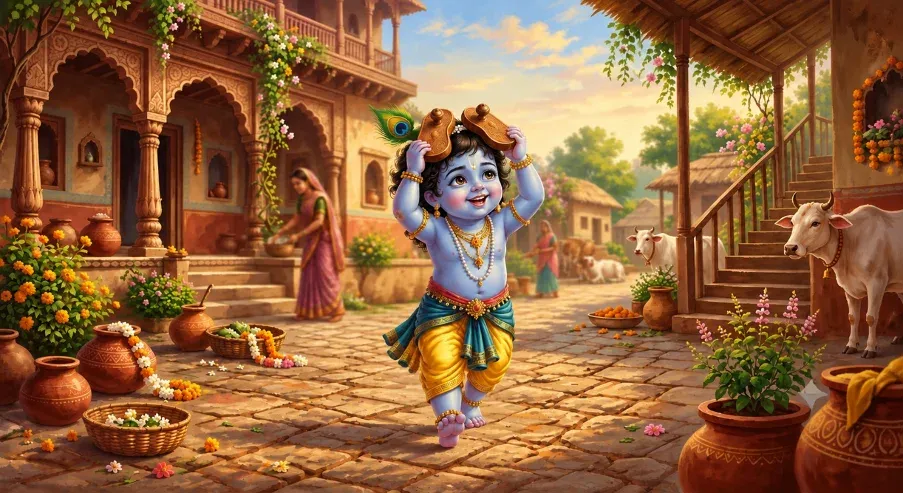
But Jagadguru Shree Kripaluji Maharaj describes an even higher quality of God. He says, the Lord is Bhaktavashya: He becomes enslaved by His devotees. Such is the sweetness of bhakti. The Supreme Brahman, whom the Vedas glorify as the Almighty, becomes a little child in the home of Nand and Yashoda. He even carries their charan padukas and walks around with them!
Frequently Asked Questions
Question: Shree Krishna steals butter and lies to Mother Yashoda. How can these actions be reconciled with the teachings of dharma that God imparts?
Answer: God is the ultimate goal of all dharmas; He cannot be under the dictates of dharma Himself. Moreover, His every act is with the intention of uplifting the souls. Since His motive is pure, even if He steals butter or lies to Mother Yashoda, it is all for jiva kalyan (welfare of the souls), and He cannot be faulted for it. Hence, no punishment for breaking the rules of dharma applies to the Lord. Bhagavad Gita Verse 4.14 also states God’s transcendence to dharma and adharma:
न मां कर्माणि लिम्पन्ति न मे कर्मफले स्पृहा ।
इति मां योऽभिजानाति कर्मभिर्न स बध्यते ॥ 14॥
na māṁ karmāṇi limpanti na me karma-phale spṛihā
iti māṁ yo ’bhijānāti karmabhir na sa badhyate
BG 4.14: Activities do not taint Me, nor do I desire the fruits of action. One who knows Me in this way is never bound by the karmic reactions of work.
Question: Shree Krishna is God. How then does He transcend His awareness of His own divinity in His Leelas?
Answer: If Shree Krishna were constantly aware, “I am God, merely acting as Yashoda’s son,” Yashoda would sense the pretense and would never be able to develop the natural love that a mother has for her child. She would know that He is only acting. Therefore, by virtue of God’s Yogmaya Shakti, both the devotee and Bhagavan forget their originality. Only then does the Leela unfold in its fullness. Enslaved by the love of His devotee Yashoda, who thinks, “Krishna is my baby,” God too forgets His divinity, and actually begins to think, “I am her little baby.” That is the extraordinary sweetness of the Leelas of Bhagavan.