
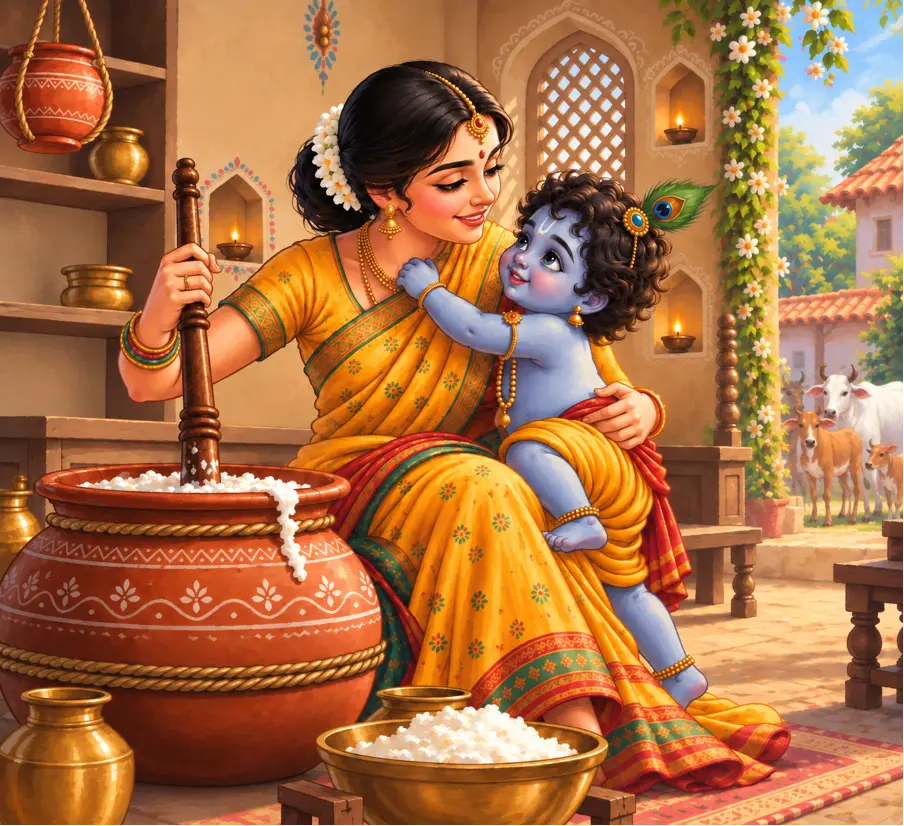
Now a little over two years old, Krishna was as playful and charming as ever. In the quiet of the morning, Mother Yashoda sat churning yogurt, thinking lovingly of her Lala. “When my baby wakes up, I will feed him this sweet butter. He will relish every bit of it,” she mused with a tender smile.
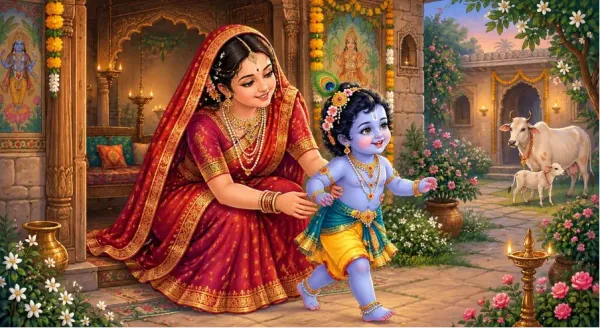
Just then, tiny footsteps pattered into the kitchen. Krishna toddled over and climbed onto Yashoda’s lap. With all her maternal warmth, she cradled him close and began to nurse Him. The milk flowed freely, stirred by her love.
Yet, divine love is never without a crucible. God often tests the depth of devotion, sparing not even His highest of devotees. And in that moment of pure, serene affection, a test arose for Yashoda.
The Testing Moment
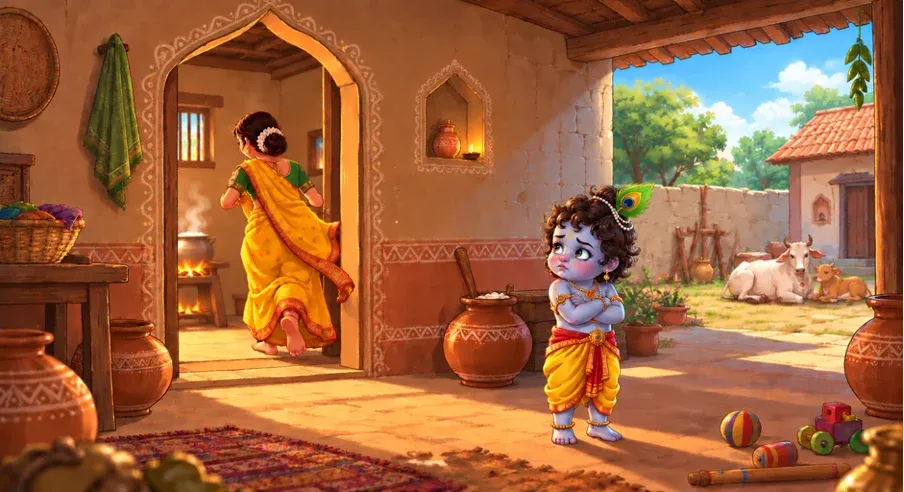
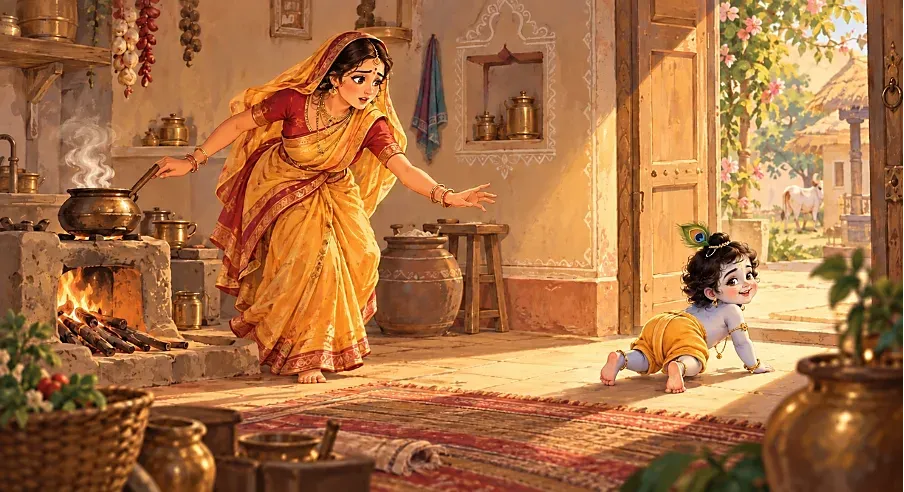
Earlier that morning, Yashoda had placed a cauldron of milk to simmer on the hearth in an adjoining chamber. As she nursed Krishna, she suddenly heard the hiss and bubbling of milk boiling over. Her heart leapt. The milk! I must save it. Without a second thought, she set her Lala down and hurried to tend to it.
Even a soul as devoted as Yashoda faltered. God calls for undivided devotion. Even with the supreme treasure of her life nestled in her arms, her attention had momentarily shifted toward the milk. Krishna watched her disappear past the doorway. His lips curled into a faint pout. Has a vessel of hot milk taken precedence over the very breath of her life? That would not do. And so, He threw a little tantrum of His own.
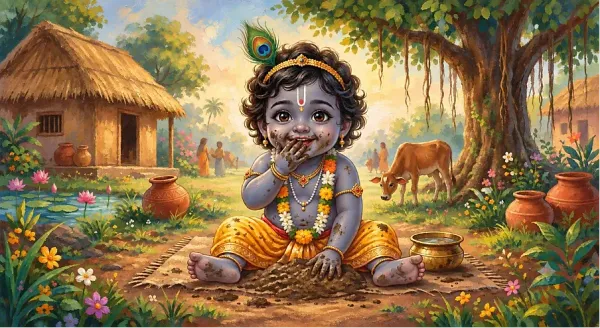
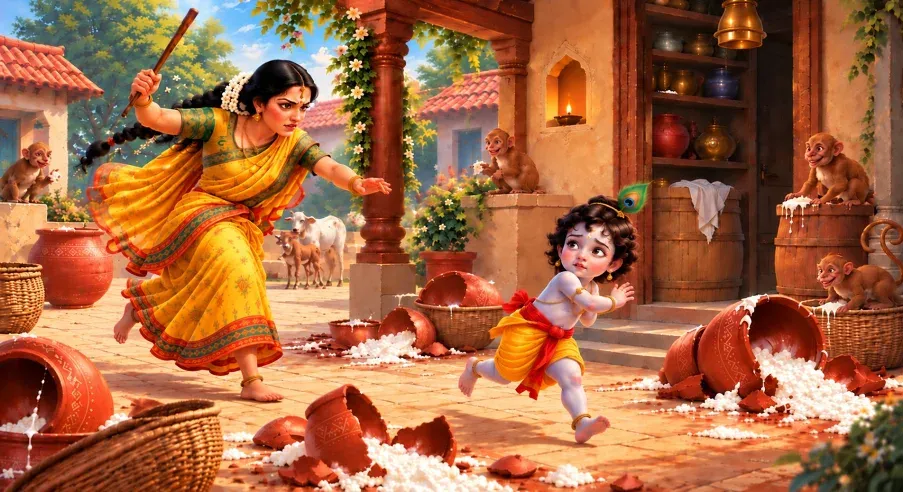
He seized the churning rod and smashed the earthen pots around Him, turning the room into a miniature battlefield of splintered pots and spilled curds. Then, whisking away a mound of fresh butter, He dashed into the courtyard and gleefully fed fistfuls to an eager troop of monkeys.
Meanwhile, having saved the milk, Yashoda returned to the kitchen—and stopped in shock. Pots lay shattered, curds pooled across the floor, and the butter was gone. Her Lala was nowhere to be seen. But a trail of buttery footprints told her everything. “My Lala has wreaked havoc!” Determined to teach her little bandit a lesson, Yashoda grabbed her stick and set off after Him. As soon as He saw her approaching, all of Krishna’s bravado vanished. He dropped His pot and took off running.
It was an astounding paradox—one that Queen Kunti witnessed and later recalled in her prayers.
वक्त्रं निनीय भयभावनया स्थितस्य
सा मां विमोहयति भीरपि यद्बिभेति ॥ ~ Verse 1.8.31
My dear Krishna, I could not believe what I saw. You were afraid, though fear personified is afraid of You. This sight is bewildering to me.
Even the Upanishads declare,
भयादस्याग्निस्तपति भयात्त्पति सूरयः।
भयादिन्द्रश्च वायुश्च मृत्युर्धावति पञ्चमः।। ~ Kathopanishad Verse 2.3.3
It is from the fear of God that the fire burns and the sun shines. It is out of fear of him that the wind blows and Indra causes the rain to fall. Even Yamraj, the god of death, trembles before him.
Yet here, the Master of the universe sprinted like a startled deer. For every brisk stride Yashoda took, Krishna took four quick steps, always an inch beyond her fingertips. Round and round the blooming trees of Gokul they raced. Krishna dodged left and swerved right until He glanced back over His shoulder.
His mother was gasping for breath. Beads of sweat glistened across her brow, and flowers were slipping from her loosened braid. The sight tugged at His heart. I have not come to trouble My mother. I have come to give her bliss. Softening His pace just enough, the uncatchable Lord allowed Yashoda’s outstretched hand to finally catch Him.
Bound by Love
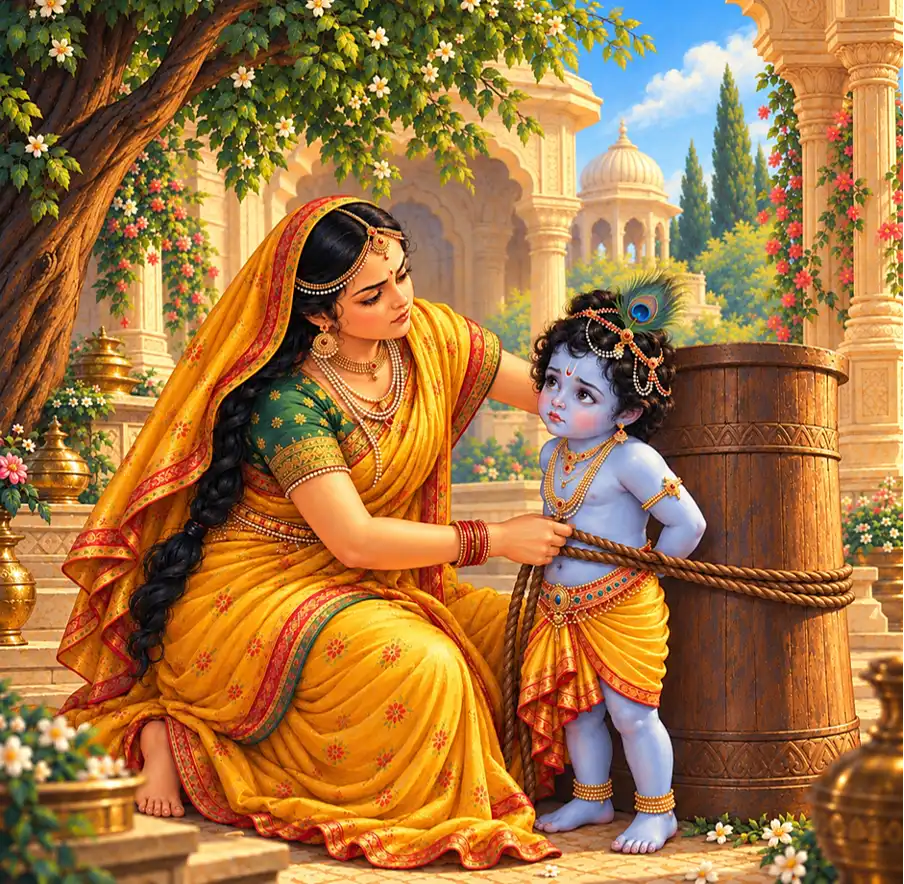
Her motherly forbearance at an end, Yashoda decided that Krishna’s antics had gone far enough. This time, she would not let Him off so lightly. She brought forth a mortar wheel and called out, “Lala, stand against it.”
Docile and obedient, little Krishna complied without a word. Yashoda then turned to her sakhis. “Bring me a rope.” The sakhis promptly fetched one. Yashoda wound it around Krishna and the mortar, pulling the ends together to cinch a knot. But to her surprise, the rope fell short by two fingers.
She called for more rope. The sakhis brought another length and tied the two together. Yashoda wrapped the lengthened rope around Him once again, but it fell short by the very same measure. “Add another,” she insisted. Rope after rope was joined, yet the mystery remained: every attempt came up short by precisely two fingers.
At this point, Shukadev ji marvels at the wondrous nature of the Lord whom Yashoda sought to bind. How could she ever tie her Lala? The entire cosmos resides within Him.
न चान्तन बहयस्य न पूव नाप चापरम् ।
पूवापरं बहश्चान्तजगतो यो जगच्च य: ॥ ~ Verse 10.9.13
The Supreme Divine Personality is eternal and limitless, having neither beginning nor end, no exterior nor interior, no front nor rear—He pervades all existence. Untouched by the constraints of time, He does not distinguish between past, present, and future, for He eternally exists in His transcendental form. Absolute and beyond all relativity, He transcends the dualities of cause and effect, even though He is the ultimate origin and conclusion of everything.
Soon, incredulous whispers rustled through Gokul. “What kind of boy is this Nandlal? No rope can bind Him!” News of Yashoda’s loving struggle eventually reached Radha ji. Smiling knowingly, Radharani drew a silken thread from her braid and placed it in the hands of the sakhis. "Take this to Maiya," she said softly. “With this, He will get tied.”
The maidens rushed back to Yashoda with the thread. At last, the rope encircled Him and pulled taut. From this beautiful Pastime, Shree Krishna came to be known as Damodar—Dam meaning rope and udar meaning stomach: He whose belly was bound with a rope.
Capturing the sweetness of this Leela, Jagadguru Shree Kripalu Ji Maharaj writes,
काहे खोजत ब्रह्म को, श्रुतिन ऋचन भरमाय ।
यशुमति कर ऊखल बंध्यो, देखहु ब्रज महँ जाय ॥ ~ Bhakti Shatak Verse 91
Why are you pointlessly searching for the Supreme Brahman, within the verses of the Vedas? Instead, you can discover Him, tied to an "ukhal", situated within the very courtyard of Mother Yashoda. If you doubt my words, I urge you to embark on a journey to Braj and witness this divine spectacle with your own eyes.
Having tied her mischievous Lala, Yashoda dusted off her hands with a sigh, “Let him stay right here for a while,” and walked back inside the house.
A Tale of Two Trees
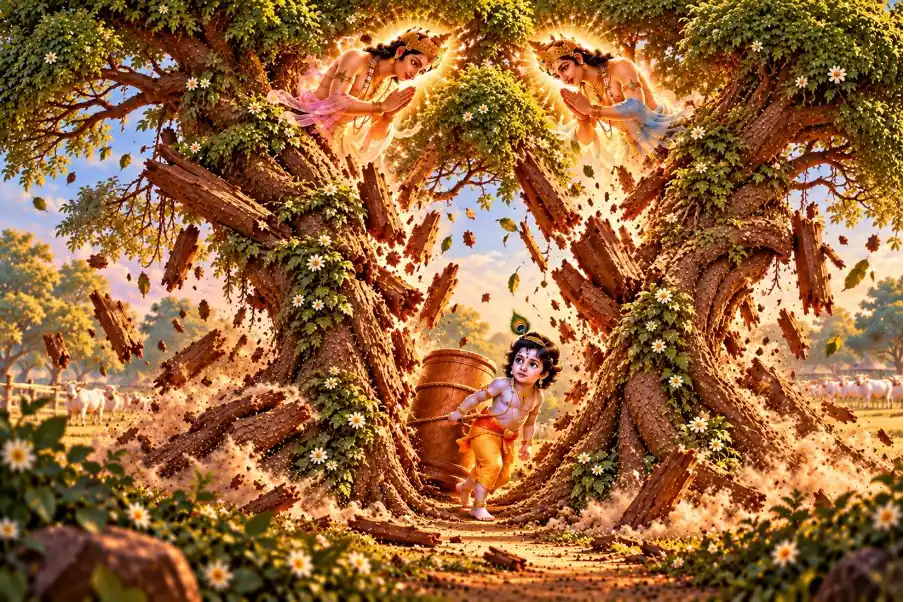
As Mother Yashoda went back indoors, little Krishna remained standing alone, tethered to the mortar. Not far off stood two towering trees, known together as the Yamalarjun. But they were no ordinary trees. They were the cursed forms of Nalakuber and Manigriv, sons of Kuber.
Children born into fortune are often vulnerable to being spoiled. Surrounded by abundance without ever having to strive for it, they can easily succumb to vanity. And who across the three worlds possessed greater riches than Kuber, the god of wealth?
His two sons had become intoxicated by luxury and power. One day, they were drinking and frolicking openly with women in a lake when Narad Muni happened to pass by. Absorbed in their revelry, they remained completely unabashed. Seeing how deeply their opulence had blinded them, Narad ji cursed them to become trees—to stand rooted and bare beneath the open sky.
असत: श्रीमदान्धस्य दारिद्रयं परमञ्जनम् ।
आत्मौपम्येन भूतानि दरिद्र: परमीक्षते ॥ ~ Verse 10.10.13
Who are very much proud of wealth fail to see things as they are. Therefore, returning them to poverty is the proper ointment for their eyes so they may see things as they are. For a person who is blinded by the pride of wealth and material opulence, poverty is the best ointment or remedy to open their eyes and bring them back to spiritual reality.
Yet the curse of a saint is invariably a disguised benediction. Beneath Narad’s stern words lay a blessing: the Lord Himself would one day liberate them.
After years of silent waiting, that hour arrived. Krishna gazed upon the twin Yamalarjun trees. He dragged the mortar between them until it lodged tight against the bark. With a single tug, He sent both trees toppling down. From the riven trunks emerged Nalakuber and Manigriv, freed at last. Offering their obeisance to Shree Krishna, the two Yakshas departed.
The crash brought the villagers hurrying to the spot. Surveying the wreckage, Nand Baba addressed the elders. "One calamity after another has befallen us in Gokul," he said gravely. "I fear the reach and malice of Kans. It is no longer safe for our children here." He then proposed, “Not far from here lies the beautiful forest of Vrindavan. Let us take our families and cattle there.” The community agreed. Gathering their belongings and herds, the Brajwasis bid farewell to Gokul.
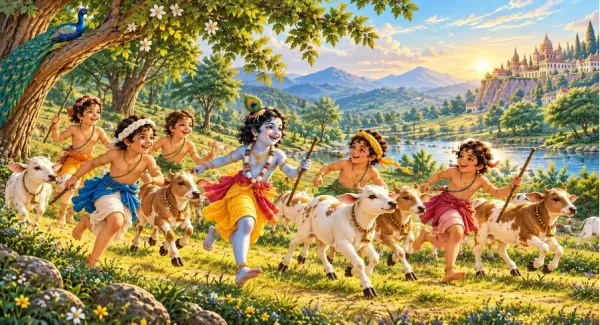
Ahead, the flowering groves of Vrindavan waited in full bloom, their meadows lush and green, ready for the sweetest days to come.
Frequently Asked Questions
Question: In the Damodar Leela, why did the rope always fall short by two fingers when Krishna was being tied? What is the significance of this?
Answer: The rope falling short by two fingers symbolizes the essential interplay between human effort and divine grace. The first represents our sincere endeavor to strive on the path of devotion; the second signifies the descent of God’s grace, which ultimately helps us reach Him. No amount of intellect or self-will alone suffices. We must strive with all our might, yet recognize that our efforts bear fruit only through humility and surrender.
As the Shvetashvatar Upanishad beautifully states,
तपःप्रभावाद् देवप्रसादाच्च
Your intense effort and the grace of God will together effect the attainment of the attainment of your supreme goal.
Sri Aurobindo stated it so perfectly in his book, ‘The Mother’, "There are two powers that alone can effect in their conjunction the great and difficult thing which is the aim of our endeavor, a fixed and unfailing aspiration that calls from below and a supreme grace from above that answers.”
Question: Why does God test His devotees?
Answer: Just as a teacher tests a promising student to help them grow, God tests sincere devotees to deepen their wisdom, surrender, and love. He wants us to realize that we do not need to be perfect—only sincere.
Saint Kabir says,
तीर तलवार से जो लड़े, सो शूरवीर नहीं होय।
माया तजि भक्ति करे, शूर कहावे सोय॥
Those who fight with swords are not necessarily truly brave. The one who renounces the allurements of Maya and walks the path of devotion is the one who deserves to be called courageous.
Hanuman ji was tested when he leapt across the ocean. One obstacle after another appeared before him, yet he remained steadfast. His selfless service was so profound that Shree Ram declared Himself indebted to him. King Bali faced a different test when Vaman Bhagavan asked for three paces of land, ultimately taking everything he possessed. Bali surrendered himself completely, and Bhagavan went on to become his gatekeeper in the nether regions. Ultimately, divine tests are not meant to make us fail, but to mold us, refine our bhakti, and draw us closer to God.