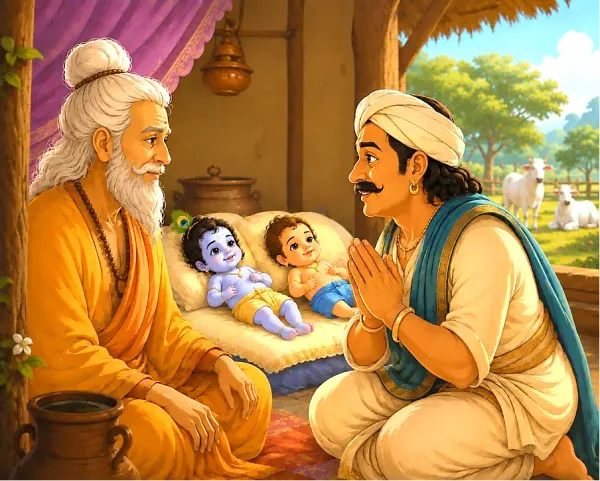

In Vrindavan, Nand Baba made his home in the place now known as Nandagaon. His palace stood at the center, with the dwellings of the other Brajbasis clustered around it.
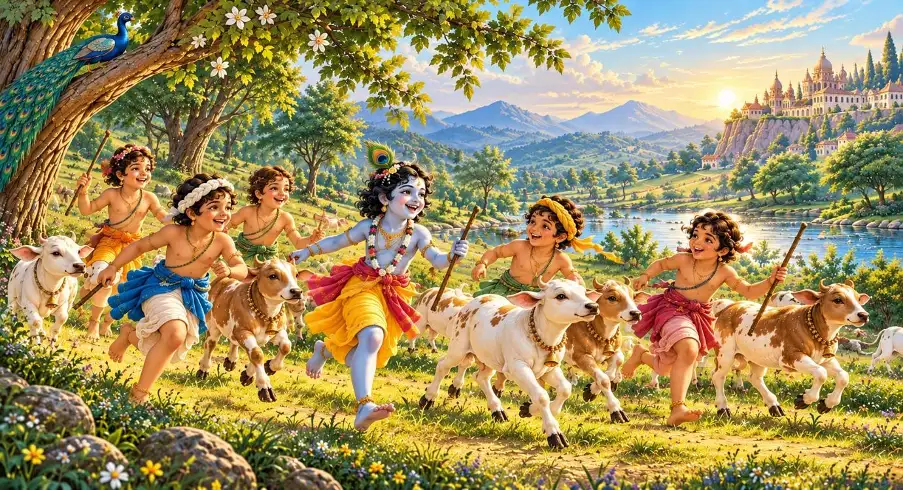
By now, Shree Krishna had blossomed into a spirited four-and-a-half-year-old. Each morning, the cowherd men would head afield with their herds, accompanied by some of the older boys. Krishna, too, longed to take the cows to graze in the lush pastures. But He was still very young to tend the herd. So His parents said, “All right, little one, you may go—but only to look after the young calves.”
How delighted Krishna was! He and His companions would spend their days in the sunlit meadows, tending the calves, chasing one another through the groves, and conjuring up games beneath the open skies.
Gopal, the Cowherd
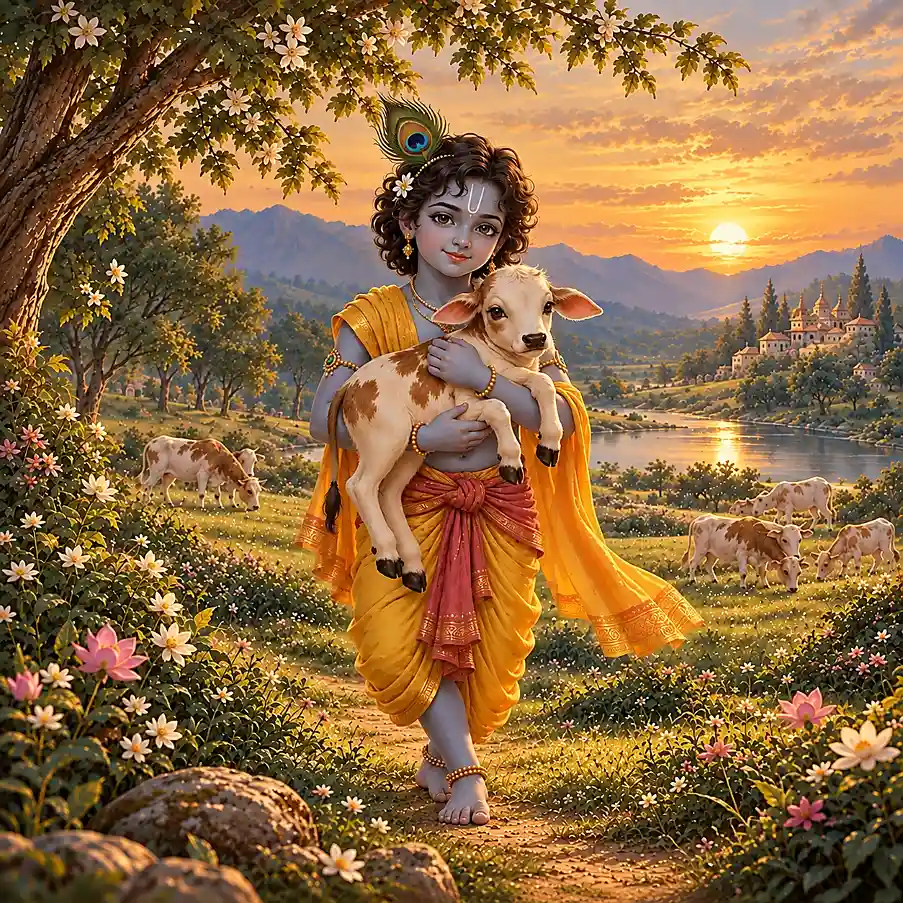
One of the many Names of Bhagavan Krishna is Gopal—the protector and keeper of cows. Yet Bhagavan watches over all beings—the soaring bird, the crawling insect, the trees, the pigs, and us humans. He is, after all, the sustainer of the entire cosmos. Why is He then especially celebrated as Gopal?
This is His Rasik name.
In Indian culture, Gau Mata is revered as a mother who gives generously without asking for anything in return. When Shree Krishna descended to earth, He could have chosen any Pastime. Instead, the Lord of infinite universes set out to care for cows, revealing the depths of humility and compassion. Therein lies the sweet wonder, expressed most beautifully in His Gocharan Leelas.
One morning, Mother Yashoda noticed Him preparing to venture barefoot into the pastures, as was customary among the cowherds. Concerned for her little boy, she said, “Lala, the trails are uneven and jagged. The region is full of wild brambles, and their thorns will prick Your tender feet. Please, my child, put on a pair of shoes before You go.”
Shree Krishna looked at her and gently replied, “Maiya, the cows are my worshipable deities—my Ishtadev. Each day, they traverse these rugged trails unshod, braving every stone and thorn. If my Ishtadev treads barefoot, how could I ever put shoes upon my own feet? In serving them, I must walk as they walk.”
When He returned at dusk, He glowed like the evening star. The sacred godhuli—the dust raised by the hooves of His beloved cows—adorned His limbs and curly hair in soft hues of gold and gray.
As popularly quoted by Acharyas:
गोधूलिधूसराङ्गो नृत्यति वेदान्तसिद्धान्त:॥
The Supreme Reality of Vedant, whom sages seek across lifetimes just to glimpse, dances in Nand Baba’s courtyard, bathed in the dust rising from the cows’ hooves.
While in Vrindavan, Krishna revealed different shades of divine love through His Leelas. As He was now growing up, a thrilling new chapter began: the unfiltered, shoulder-to-shoulder camaraderie of Sakhya Bhav.
The Sweet Theft
Among Krishna’s companions were Shridhama, Dhansukh, Mansukh, Stokakrishna, and Madhumangal. Though they appeared to be ordinary cowherd boys, they were, in truth, elevated devotees.
When a soul’s devotion reaches fruition, it is blessed with the rare opportunity to participate in the Lord’s Pastimes during His earthly descent. This becomes the final stage of its preparation. Having engaged in these Leelas with pure, selfless devotion, the soul eventually enters Krishna’s eternal Abode to take part in His Nitya Leela.
Yet these sakhas did not see Krishna as God. To them, He was simply Kanhaiya, their playmate, their dearest friend. And the kind of bliss the Lord showered upon them shone through the everyday moments they spent together.
It would all begin at daybreak. Mother Yashoda would lovingly prepare Krishna’s lunch and remind Him, “Lala, I have packed your tiffin. Take it with You.” The sakhas, too, would arrive with food lovingly cooked by their Maiyas.
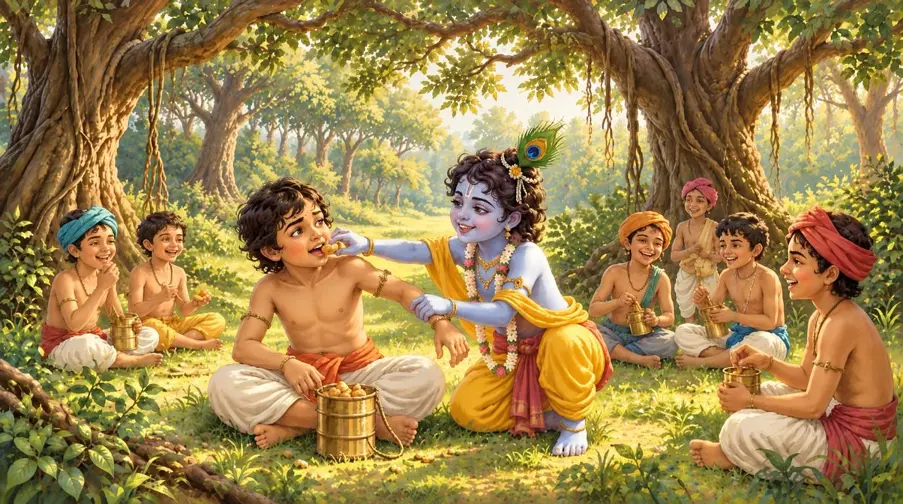
Come midday, beneath the cool forest boughs, the boys would gather to unpack their meals. But Krishna’s eyes rarely stayed on His own food. Elbowing His friend playfully, He would coax, “What did your Maiya make? Let me have a bite.” The boy would shove Him away, “You greedy fellow! Eat your own food. Why are you always eyeing mine? Bhukha, bhikmanga!”
Imagine the Almighty being chided as a beggar! Far from feeling offended, Krishna was enchanted.
When the sakha turned his shoulder to shield his meal, Krishna would swiftly lunge and catch the boy’s wrist. Determined not to yield a single crumb, the friend would use his free hand to pop the morsel into his own mouth. Undeterred, Krishna would deftly take the half-chewed bite right from the boy's mouth and savor it with glee. Licking His fingers, Krishna would exclaim, “Ah, marvelous! Your Maiya makes such delectable food. I will tell my Maiya to take lessons from her!”
Such thefts were only part of the fun. Often, He would purposely provoke His companions, tossing out a cheeky remark just to ruffle their feathers. Why would the Lord do that?
Jagadguru Shree Kripalu Ji Maharaj portrays this endearing quirk in Prem Ras Madira:
कबहुँक दै रिसाय सखन कहा। पुनि तिन सुनत मधुर गारी॥
देखो देखो री ग्वाल-बालन यारी, देखो देखो री॥
At times, He playfully riles His sakhas, only to relish the sweet reproaches that flowed from their lips. Behold the wondrous friendship shared by these cowherd boys!
How hungry God is, not for food, but for the unalloyed love of His devotees!
Kick of Love
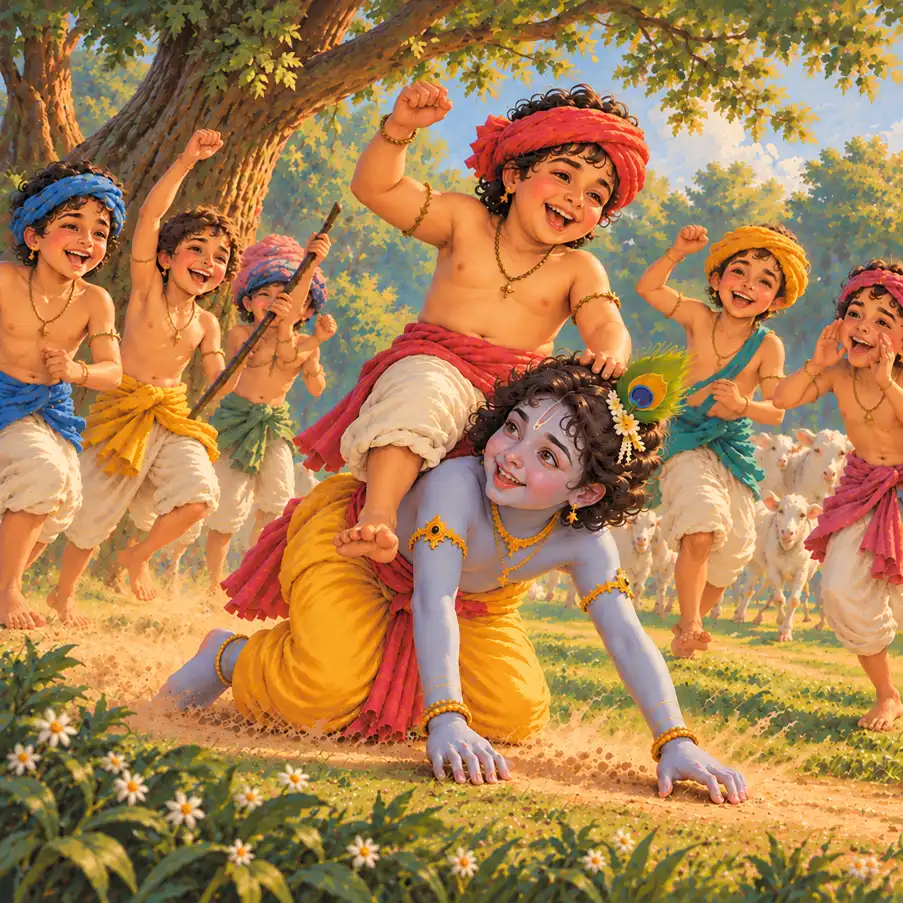
One afternoon, the sakhas gathered for one of their favorite games. The rule was simple: whoever won would ride, and whoever lost would become the horse. As fate would have it, Krishna lost.
“Your turn, Kanhaiya! Down on all fours—become the horse!” the boys whooped.
But these were no lightweight riders! Shridhama and Dhansukh were sturdy, burly boys, and carrying them was no small task. Yet a rule was a rule, and a game was a game. Having lost, the Supreme Lord cheerfully accepted His defeat.
Describing this heart-melting spectacle, Kripalu Ji Maharaj writes:
रिझवत खेल जिताए सखन को, घोड़ा बनी-बनी बनवारी, देखो देखो री।
Behold the wonder! To delight His friends, Banwari lets them win and gladly becomes their horse.
The very Lord worshipped in temples across the world, praised through Vedic mantras, and offered oblations in sacred yajnas was down on His hands and knees, with a sakha perched upon His back.
“Chal ghode chal!” the rider cheered, bubbling with excitement.
But the play had only just begun.
What good is a horseback ride if the horse merely ambles along? The real thrill begins when it breaks into a gallop! That is why riders nudge their ponies with their heels to spur them on. Krishna, however, was dawdling at His own pace. So, His sakha gave Him a kick.
Krishna paused, taken aback. What kind of devotee is this? He wondered. Others worship Me with solemn hymns. And this one? He kicks Me! Yet that sakha was so immersed in the ocean of love that the knowledge ‘He is God’ had drowned in it.
This mood cannot be imitated artificially. Simply thinking, ‘Shree Krishna is my friend’, does not mean we can walk up to the deity and kick Him. Such an act would be an offence, for our intellect has not yet drowned in love. Until this state awakens naturally, we must honor the boundaries of devotion and reverence. Yet, inwardly, we can begin nurturing the sentiment, ‘Krishna is my dearest friend.’ And one day, by His grace, we too may be blessed with a taste of such bhakti ras.
Meanwhile, Krishna was touched beyond words!
That unexpected kick had sent a wave of bliss through Him. He sprang forward, His eyes brimming with tears of joy at the sheer, uninhibited affection of His beloved friend.
But after a little while, Krishna slowed down again. The boy leaned forward. “What is the matter, Kanhaiya? Are you tired?” Krishna glanced back. “No! It is just that…” His eyes sparkled as He confessed, “That kick you gave Me was so sweet! I want another one!” The sakha burst out laughing and promptly obliged. Another kick. Another surge of bliss. Such is the nectar of Braj ras.
And in this extraordinary bond, the sakhas sought nothing for themselves; their sole desire was to bring happiness to Krishna. Knowing how much He cherished friendship, they strove to be the best friends they could be!
Frequently Asked Questions
Question: What is the significance of Gopashtami in Shree Krishna’s Gocharan Leela?
Answer: Gopashtami commemorates the day Krishna transitioned from herding calves to becoming the caretaker of the entire herd of cows. It symbolized His coming of age as a young cowherd. As He played His enchanting flute, the cows would follow Him, captivated by His love and charm. The festival of Gopashtami is a beautiful reflection of the deep devotion and affection that can exist between the Divine and His devotees, both human and animal.
Question: Can an ordinary soul develop the kind of bond with Krishna as the sakhas in Vrindavan?
Answer: The Braj Leelas give the soul tremendous encouragement. They show us that we too can develop a loving relationship with Bhagavan. He may be infinitely exalted, yet there is one thing that captures His heart: selfless devotion.
Consider trying to meet a powerful person in this world. How difficult would it be even to gain access to them! The difference between Bhagavan and the individual soul is infinitely greater. Yet love is the great equalizer. It bridges that distance and draws God close to the soul.
The Gopis attained a place in the Maharas not due to any external qualification but because of the depth of their love. Even Shankar ji did not attain that position. Such is the power of Nishkam Bhakti. In this talk by Swami Mukundananda, explore the rules of divine love: How close do you wish to be to God?