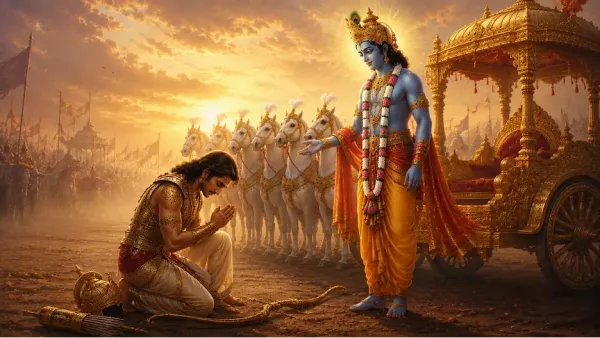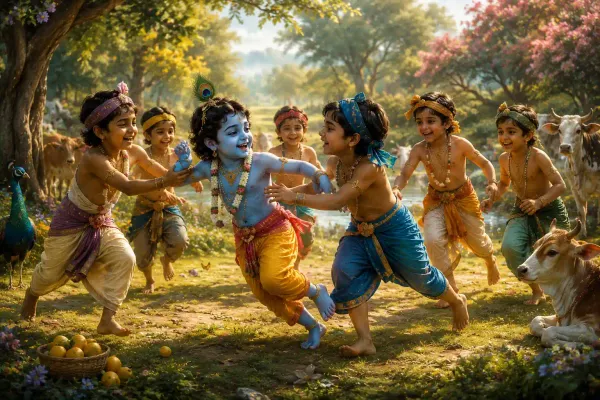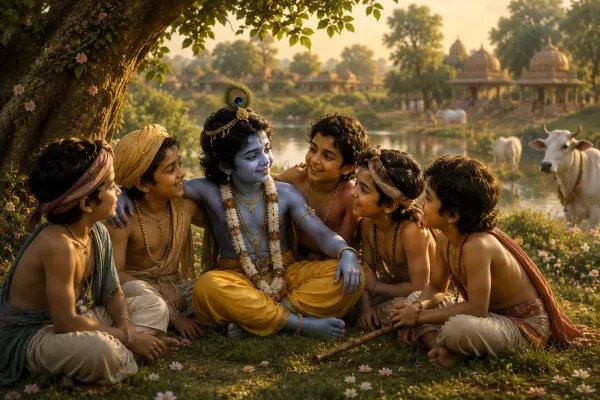
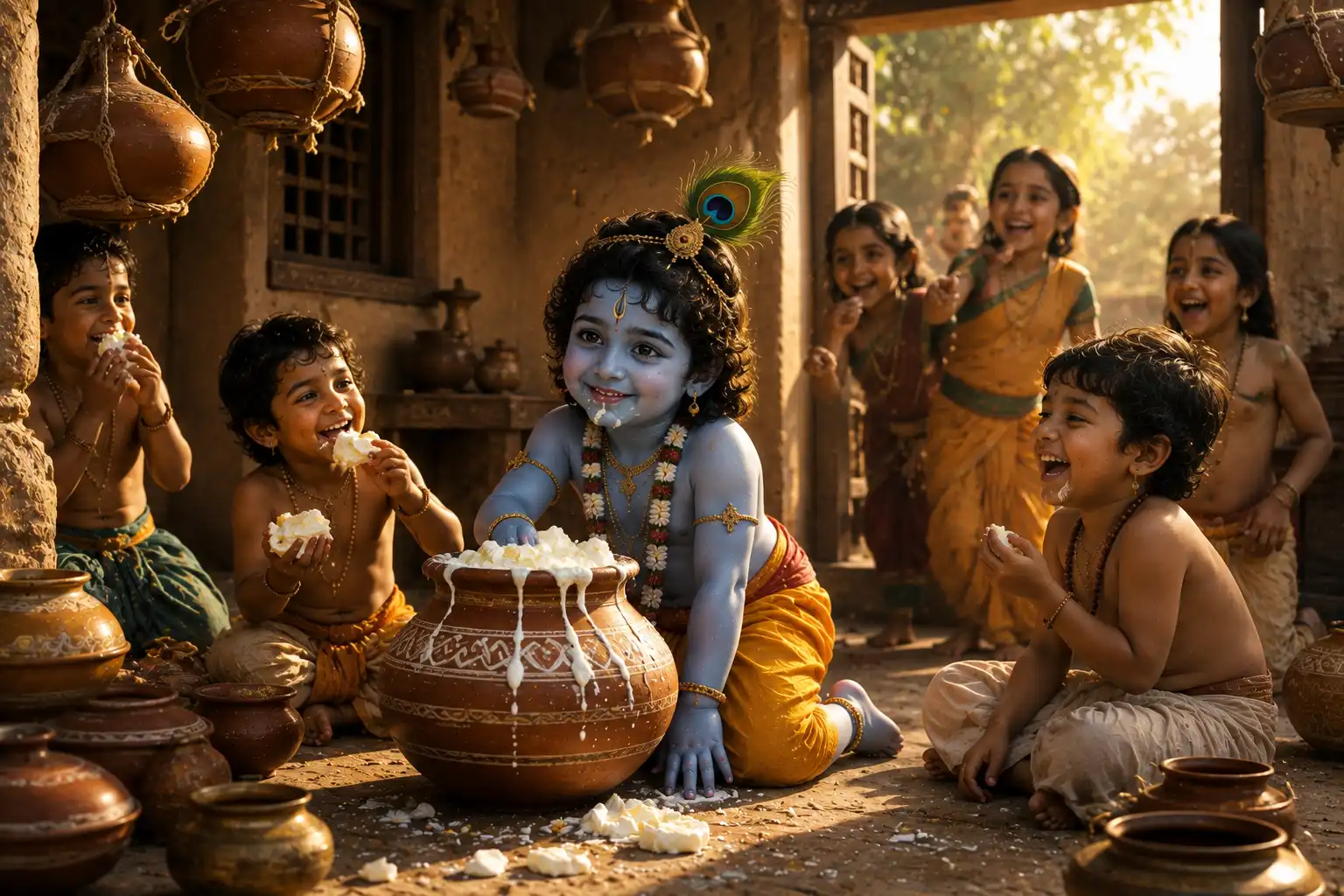
"The Lord who owns countless universes chooses to become a butter thief, not because He desires butter, but because He longs to steal the love hidden within the hearts of His devotees."
Introduction: Why Does God Become a Butter Thief?
Among the countless enchanting pastimes of Shree Krishna, none has captured the imagination of devotees quite like His playful habit of stealing butter from the homes of the Gopis in Braj. Generation after generation has smiled at the image of the mischievous blue-hued child sneaking into village homes, climbing onto the shoulders of His friends, breaking hanging pots, sharing butter with monkeys, and then escaping before anyone could catch Him. These stories are lovingly narrated in homes and temples across the world, especially during Janmashtami, filling hearts with joy and childlike wonder.
Yet the saints tell us that these delightful incidents are far more than charming childhood tales.
The Supreme Lord does nothing without purpose. Every smile, every word, every glance, and every playful pastime carries profound spiritual significance. If Krishna had merely wished to eat butter, He certainly did not need to steal it. Mother Yashoda's home overflowed with freshly churned butter, cream, and yoghurt. The Lord who sustains innumerable universes had no need for the food of the cowherd women. Why then did He secretly enter their homes, break their carefully stored pots, and lovingly "steal" what already belonged to Him?
The answer lies at the very heart of Bhakti.
Swami Mukundananda explains that Krishna's butter-stealing Leelas were never about butter. They were about love. Through these seemingly ordinary childhood adventures, the Lord revealed the extraordinary intimacy He wishes to share with every soul. His purpose was not to satisfy hunger but to awaken devotion, deepen loving relationships with His devotees, and leave behind divine pastimes that would continue to melt hearts thousands of years after His earthly appearance.
The Srimad Bhagavatam repeatedly demonstrates that Krishna's childhood in Braj cannot be understood through ordinary logic. The Infinite assumes the role of a helpless child. The Supreme Controller allows Himself to be scolded by His mother. The Creator of all wealth becomes a playful thief. Every apparent contradiction conceals a deeper spiritual truth, inviting devotees to look beyond external actions and discover the boundless compassion hidden within them.
As we celebrate Janmashtami 2026, Krishna's butter-stealing Leelas invite us to ask a beautiful question: What was the Lord really seeking when He entered the homes of the Gopis? The answer reveals not only the mystery of Makhan Chor but also the deepest longing of the Divine Heart.
Krishna's Childhood Leelas Are Never Ordinary
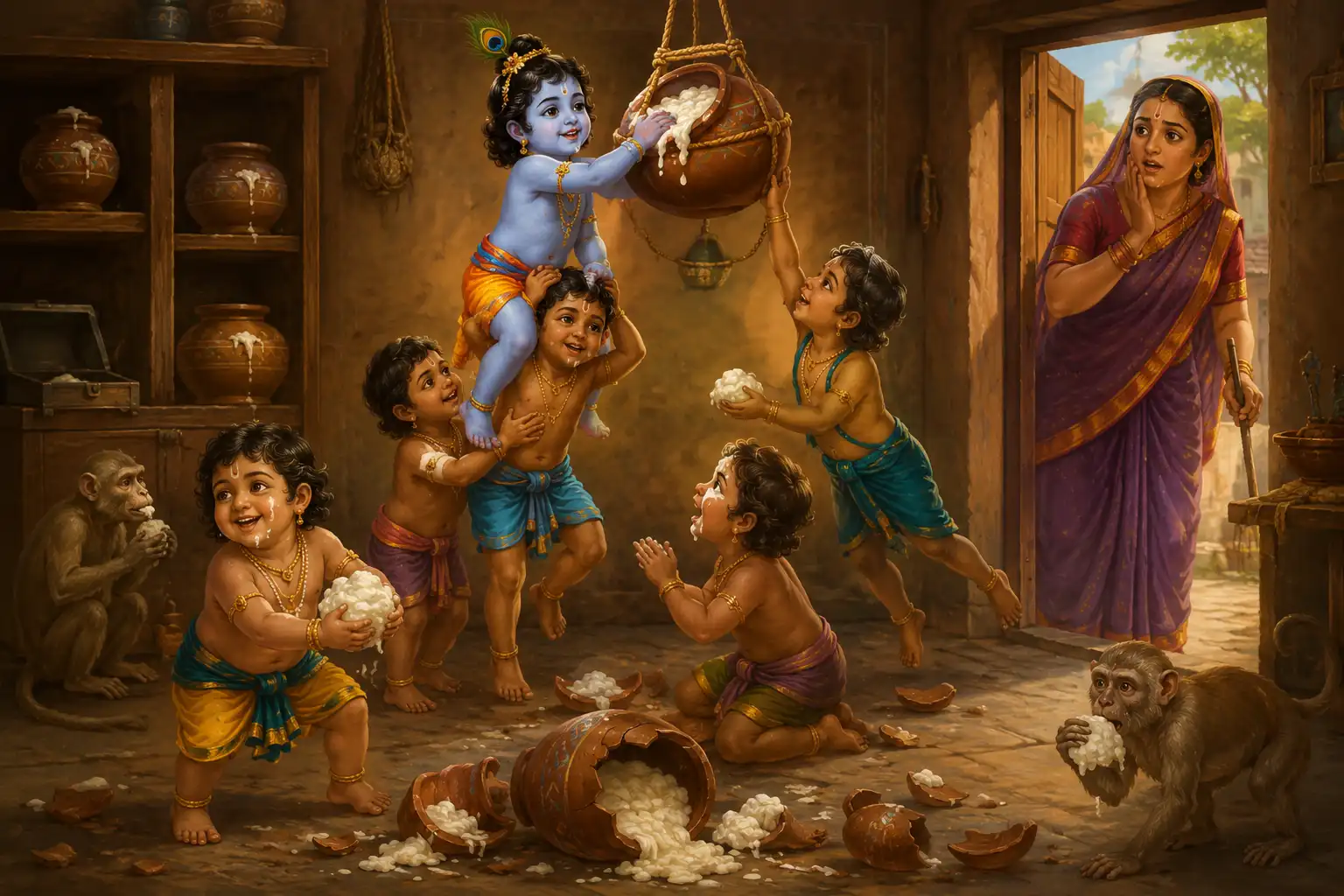
One of the greatest mistakes we can make while reading the childhood pastimes of Shree Krishna is to judge them according to ordinary human standards. If we see them merely as amusing stories about an unusually mischievous child, we miss the profound spiritual wisdom hidden beneath their sweetness.
The Bhagavad Gita reminds us that everything connected with the Lord is transcendental. Krishna Himself declares:
जन्म कर्म च मे दिव्यमेवं यो वेत्ति तत्त्वत: ।
त्यक्त्वा देहं पुनर्जन्म नैति मामेति सोऽर्जुन ॥ 9॥
janma karma cha me divyam evaṁ yo vetti tattvataḥ
tyaktvā dehaṁ punar janma naiti mām eti so ’rjuna
BG 4.9: Those who understand the divine nature of My birth and activities, O Arjun, upon leaving the body, do not have to take birth again, but come to My eternal abode.
Notice that Krishna does not simply ask us to admire His activities. He invites us to understand their divine nature. His birth is divine. His actions are divine. His childhood is divine. Even His apparent mischief is divine.
Swami Mukundananda explains that every Leela performed by Krishna serves as a spiritual teaching expressed not through formal instruction but through loving interaction. While the Bhagavad Gita teaches eternal truths through philosophical dialogue, the Srimad Bhagavatam reveals those same truths through enchanting pastimes that capture the heart before illuminating the intellect.
This is one of the unique features of Krishna's avatar. Rather than remaining distant upon a majestic throne, He enters the daily lives of His devotees. He plays in their courtyards, accepts food from their hands, grazes cows in their fields, dances beneath the moonlit skies of Braj, and fills every ordinary moment with extraordinary sweetness. In doing so, He demonstrates that God is not merely to be worshipped with reverence but also loved with intimacy.
Every butter pot He breaks, every playful prank He performs, and every complaint the Gopis bring to Mother Yashoda becomes another opportunity to strengthen this loving relationship. What appears outwardly as mischief is, in reality, the language of divine affection.
The saints therefore caution us not to read these Leelas as historical anecdotes alone. They are revelations of God's personality. They show us not only that Krishna is the Supreme Lord but also the astonishing tenderness with which He reciprocates the love of His devotees. The sweetness of Braj lies precisely in this intimacy, where the all-powerful Bhagavan joyfully allows Himself to become the beloved child of simple village families.
The Lord Who Steals Hearts Before Butter
Krishna is lovingly known throughout the world as Makhan Chor, the Butter Thief. Yet this affectionate title points towards a much deeper reality. Long before He stole butter from the homes of the Gopis, He had already stolen something infinitely more precious: their hearts.
The residents of Braj did not love Krishna because He performed miracles. Many had witnessed extraordinary events surrounding His birth and childhood, yet these wonders gradually faded into the background. What remained was an overwhelming affection for the enchanting little boy whose laughter filled their homes and whose innocent smile dispelled every sorrow.
This is one of the greatest mysteries of Krishna's avatar.
The Supreme Lord, who inspires awe and reverence throughout the heavenly planets, chose to conceal His majesty beneath the irresistible charm of childhood. Instead of demanding worship, He invited affection. Instead of inspiring fear, He awakened tenderness. Instead of asking to be served as the Almighty, He allowed Himself to be embraced, fed, protected, scolded, and even chased through the streets of Gokul.
Swami Mukundananda beautifully explains that Krishna's purpose in these childhood Leelas was to intensify Vatsalya Bhav, the devotional mood of parental affection.
Every mischievous act gave Mother Yashoda, Nanda Baba, and the Gopis another opportunity to think about Him, speak about Him, laugh with Him, and love Him even more deeply.
In worldly relationships, mischief often creates irritation. In Braj, Krishna's playful antics produced exactly the opposite effect. Every complaint the Gopis carried to Mother Yashoda only increased their remembrance of Krishna. Every broken butter pot became another treasured memory. Every prank became another excuse to utter His name.
Even those who appeared annoyed secretly longed for His next visit.
The Lord had already accomplished His true purpose.
He had become the centre of every heart.
Why Krishna Begins His Butter Leelas in Yashoda's Home
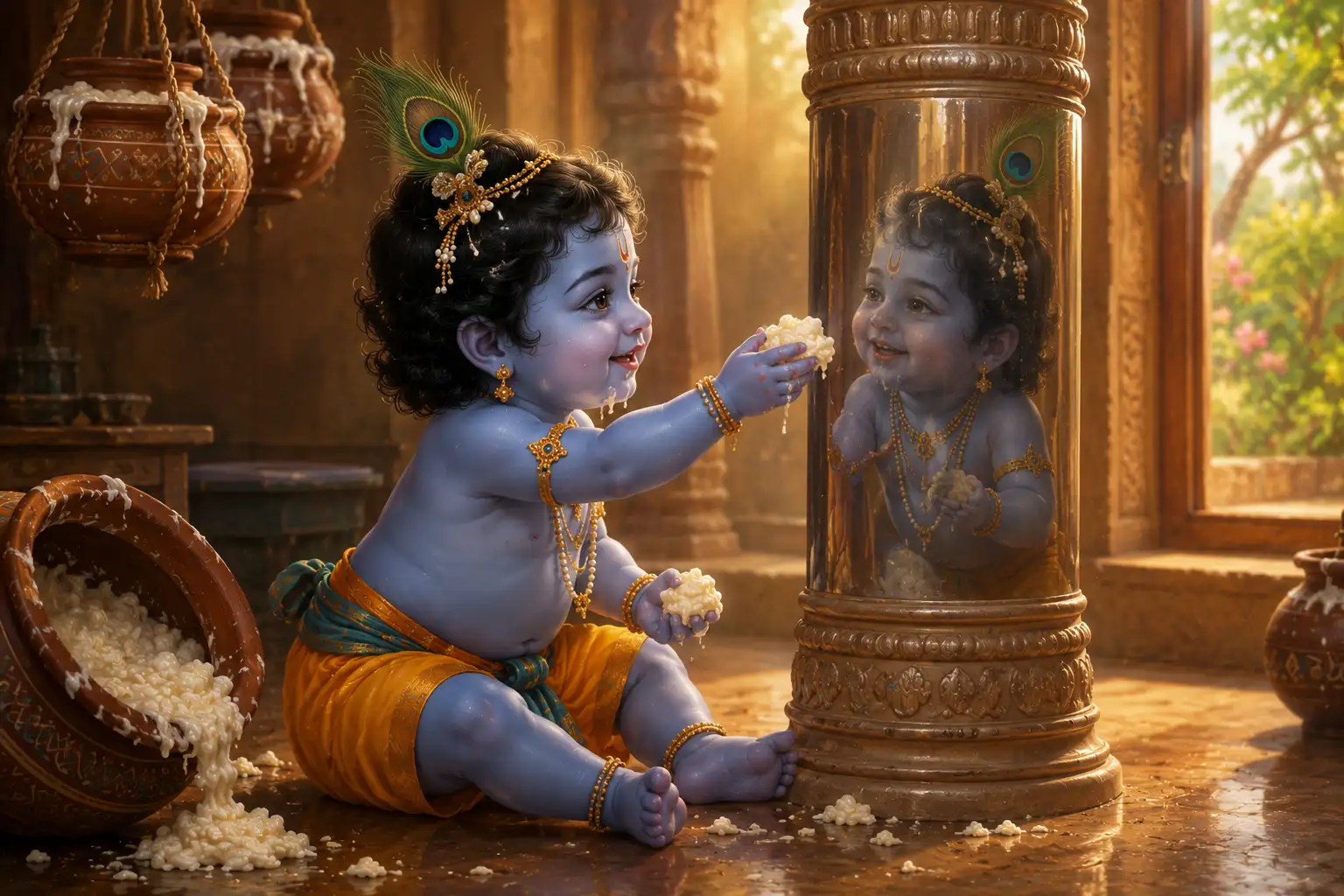
An especially charming detail, lovingly explained by Swami Mukundananda, is that Krishna did not begin His butter-stealing adventures in the homes of the Gopis. His first "thefts" took place in His own home.
Mother Yashoda carefully stored freshly churned butter in earthen pots, believing they were safely out of the reach of her little son. Yet Krishna somehow found His way to them. Climbing onto overturned wooden mortars, balancing upon the shoulders of His friends, or devising ingenious little schemes, He delighted in reaching the precious butter hidden beyond His grasp.
One day, after obtaining the butter, Krishna noticed His own reflection in a polished pillar. Believing another little boy stood before Him, He smiled warmly and began offering butter to His newfound "friend." The scene beautifully captures the innocence of the Lord's childhood and has melted the hearts of devotees for centuries.
These incidents reveal something profoundly significant.
The Lord's Leelas always begin within His own household before extending throughout Braj. Divine love first blossoms in the home of Yashoda and Nanda before overflowing into every corner of the village. Gradually, Krishna begins visiting the homes of the Gopis, where the Leelas assume even deeper spiritual significance.
From an ordinary perspective, the villagers possessed butter while Krishna appeared to take it away. Spiritually, however, the opposite was taking place. The Gopis believed they were losing butter, but they were actually receiving something infinitely more valuable—the priceless opportunity to become participants in the sweetest expressions of divine love.
Little did they realise that the butter was never the true object of Krishna's search.
He had come in search of hearts that had been lovingly churned through devotion.
Why Butter? The Symbolism of Pure Devotion
As the butter-stealing Leelas unfold throughout the Srimad Bhagavatam, a beautiful question naturally arises. Why did Krishna choose butter? If His purpose was to deepen the love of His devotees, why did He not ask for flowers, fruits, or sweets lovingly prepared by the residents of Braj? Why was butter the centrepiece of so many of His childhood pastimes?
The saints explain that butter was never chosen by accident. It is one of the most profound symbols of Bhakti found anywhere in Krishna's Leelas.
Swami Mukundananda beautifully explains that butter represents the purest essence of the heart. Just as butter is not obtained instantly but emerges only after patient effort, loving devotion also does not appear overnight. It is cultivated gradually through sincere spiritual practice, constant remembrance of God, and the purification of the mind.
Milk in its natural state contains butter, yet the butter remains hidden within it. In the same way, every soul possesses the innate capacity to love God because we are eternal parts of Him. However, that divine love lies concealed beneath layers of ego, selfish desires, worldly attachments, and countless impressions accumulated over many lifetimes.
Only through spiritual churning does that hidden treasure begin to emerge. The spiritual aspirant begins by hearing divine knowledge, reflecting upon it, practising devotion, serving selflessly, and remembering the Lord with increasing sincerity. Gradually, the impurities of the heart begin to fall away, and pure love for God rises naturally to the surface.
The butter that Krishna delighted in stealing therefore represents a heart that has been lovingly churned through sadhana until devotion becomes its very essence.
This symbolism becomes even more beautiful when we consider who prepared the butter.
The Gopis did not mechanically churn milk while their minds wandered elsewhere. Their entire lives revolved around Krishna. As they churned butter each morning, their lips sang His names, their conversations revolved around His childhood exploits, and their hearts overflowed with thoughts of the little cowherd who had become the very life of Braj. Every turn of the churning rod became an act of remembrance. Every song became an offering. Every pot of butter became infused with devotion long before Krishna entered their homes.
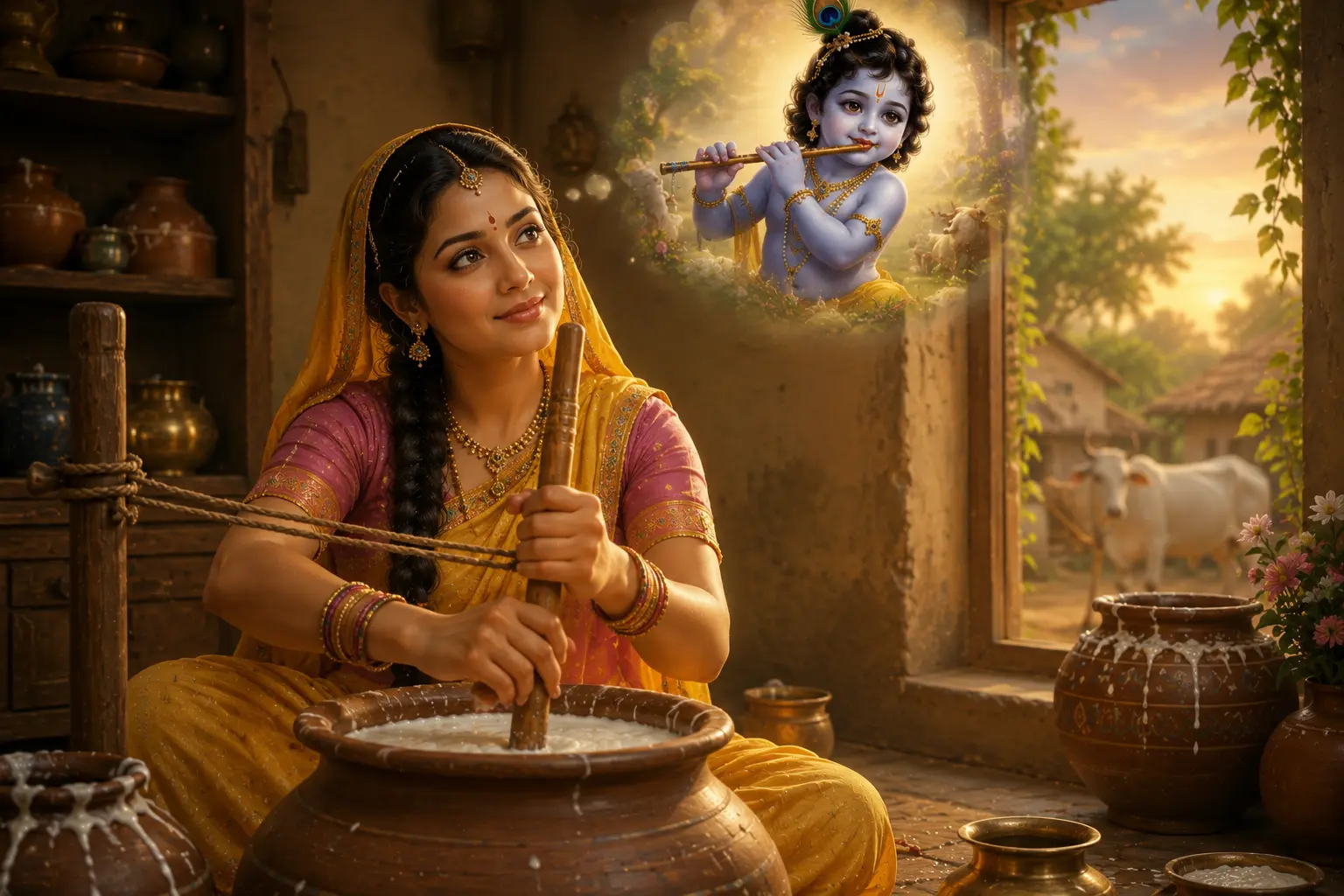
When Krishna stole their butter, He was not accepting dairy products.
He was accepting love.
This is one of the sweetest lessons of Bhakti Yoga. God is never attracted by the external value of an offering. He looks only at the love with which it is given. A simple leaf, flower, fruit, or drop of water offered with devotion delights Him more than the grandest offering made without love. In the same spirit, the butter of Braj became precious because it carried within it the fragrance of unwavering devotion.
Krishna therefore teaches an extraordinary truth without uttering a single philosophical discourse. The Lord is not searching for what our hands can give Him. He is searching for what our hearts have become.
Churning the Heart Through Bhakti
The symbolism of butter extends even further, offering a beautiful blueprint for spiritual life.
Every devotee desires to experience the sweetness of divine love, yet the restless mind rarely becomes pure on its own. Just as butter remains hidden until milk is churned repeatedly, love for God remains concealed until the heart undergoes its own process of transformation.
Swami Mukundananda often explains that spiritual growth requires consistent effort. Hearing scriptural wisdom, chanting the Lord's names, meditating upon His divine form, engaging in selfless service, and keeping the company of saints gradually purify the mind. These practices may appear simple, but together they perform the same function as the rhythmic churning of milk. Slowly and steadily, they separate the eternal from the temporary, the essential from the superficial, and divine love from worldly attachment.
The Gopis beautifully demonstrate this principle. Their devotion was not confined to moments of formal worship. Every aspect of daily life became an opportunity to remember Krishna. Milking the cows, preparing meals, fetching water from the Yamuna, or churning butter all became acts of meditation because their minds never wandered far from their Beloved.
This is the secret of Bhakti.
The goal is not merely to reserve a few moments each day for remembering God but to gradually allow remembrance of Him to permeate every activity. When work becomes worship and ordinary duties become offerings of love, the heart is naturally transformed.
The butter that emerges from such a life is irresistible to Krishna.
He cannot resist entering a heart that has been purified by loving remembrance.
The Gopis Longed for Makhan Chor
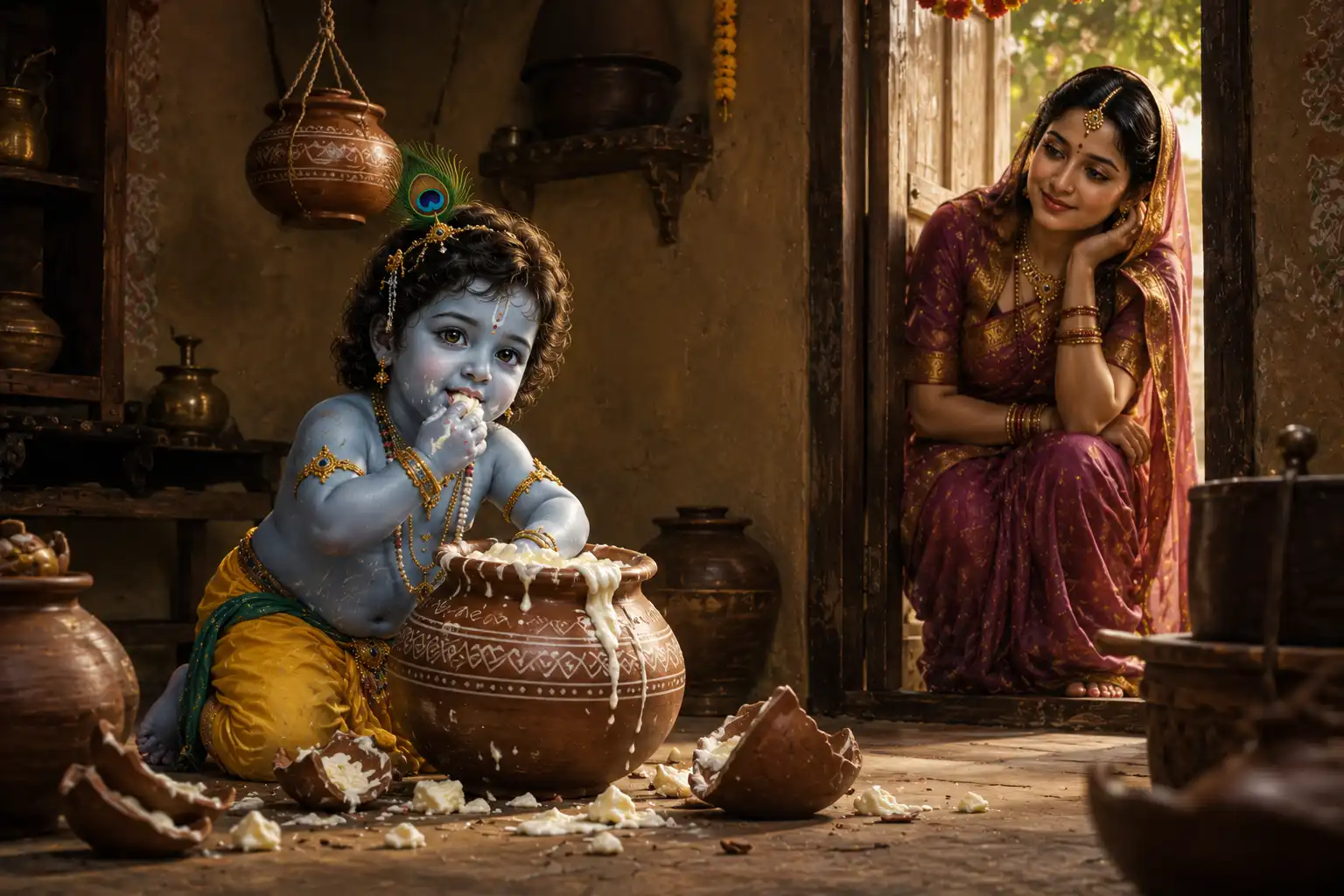
From a worldly perspective, one might imagine that the residents of Braj would have become frustrated by Krishna's constant raids on their homes. After all, the Gopis spent hours preparing butter with great care, only to find their pots broken, their stores emptied, and mischievous little footprints scattered across their courtyards.
Yet the Srimad Bhagavatam and the saints reveal something wonderfully unexpected.
Far from trying to keep Krishna away, the Gopis secretly longed for His arrival.
Whenever Krishna chose another house instead of theirs, disappointment quietly filled their hearts. They would wonder why the little Butter Thief had not visited them that day. Had they done something wrong? Had their devotion become less pleasing? Had Krishna forgotten them?
Even newly married Gopis who had come to Braj from neighbouring villages eagerly hoped that Makhan Chor would someday enter their homes as well. They had heard endless stories about His playful adventures and yearned to become part of those divine pastimes themselves.
Their apparent complaints to Mother Yashoda therefore concealed an entirely different emotion.
Outwardly, they protested.
Inwardly, they prayed that Krishna would return.
This apparent contradiction can only be understood through the lens of divine love. In worldly relationships, people seek possessions and guard them carefully. In Braj, the possessions themselves become secondary because every interaction with Krishna is treasured above material wealth. The butter, the broken pots, the footprints, and the laughter all become sacred reminders that the Lord Himself had chosen to visit their homes.
Swami Mukundananda explains that these Leelas reveal an intimacy between God and His devotees that transcends ordinary religious practice. Krishna does not remain a distant deity receiving formal worship from afar. He becomes the beloved child whose arrival fills every home with joy, whose laughter echoes through every courtyard, and whose playful mischief becomes the greatest blessing imaginable.
The Gopis therefore never measured their wealth by the amount of butter remaining in their homes.
They measured it by how much Krishna had filled their hearts.
The Sweet Intimacy of Krishna's Playful Leelas
Many of the most delightful butter-stealing stories beautifully illustrate this intimate relationship between Krishna and the Gopis.
On one occasion, a determined Gopi decided she would finally catch the notorious Butter Thief and present undeniable evidence before Mother Yashoda. When Krishna entered her home, she quietly approached and firmly seized His hand. Certain that she had succeeded at last, she triumphantly led Him towards Yashoda's house.
Along the way, however, Krishna playfully exchanged places with one of His cowherd friends. Still believing she held Krishna's hand, the Gopi continued walking until she proudly arrived before Mother Yashoda, only to discover that she had brought an entirely different child.
The courtyard erupted in laughter, while Krishna stood nearby wearing His innocent smile as though nothing had happened.
On another occasion, a Gopi attempted to tie Krishna with a rope so He could no longer escape after stealing butter. Patiently and innocently, Krishna offered to show her the proper way to tie the knot. Before she realised what had happened, the clever little Lord had turned the situation around, leaving the astonished Gopi tied up while He cheerfully disappeared with His friends and the freshly stolen butter.
These incidents were never intended to humiliate the Gopis.
Quite the opposite.
Every playful exchange deepened their affection. Every failed attempt to catch Krishna became another treasured memory that they would lovingly recount to one another. Their conversations became saturated with thoughts of Him, and their remembrance of Krishna grew stronger with every passing day.
This is precisely what the Lord desired.
He did not steal butter to satisfy hunger.
He stole opportunities for His devotees to remember Him with ever-increasing love.
The Butter Thief was quietly accomplishing His greatest theft.
With every playful visit, He was stealing away the last traces of ego, possessiveness, and worldly attachment, replacing them with a love so pure that it continues to inspire devotees thousands of years later.
Excellent. This final section should bring together all the sweetness (mādhurya) of the Makhan Chori Leelas and leave readers with a practical spiritual message. Rather than simply explaining Krishna's mischief, it reveals why these Leelas continue to transform hearts today. The conclusion mirrors the devotional style of your previous Janmashtami articles.
The Spiritual Meaning Behind Krishna's Mischief
To an ordinary observer, Krishna's childhood adventures in Braj appear to be the playful antics of an exceptionally clever little boy. He untethers calves before the cows can be milked, climbs onto wooden mortars to reach hanging pots of butter, breaks earthen pots with mischievous delight, shares butter with monkeys, and somehow escapes every attempt to catch Him. Yet the saints remind us that nothing connected with the Supreme Lord is ever ordinary. Every one of these charming incidents carries a deeper spiritual message, gently drawing the soul away from worldly thinking and towards divine love.
Swami Mukundananda explains that Krishna's Leelas are not random acts of childhood mischief but carefully orchestrated expressions of grace. They reveal the Lord's loving desire to free the soul from everything that prevents it from experiencing a relationship with Him. When Krishna untethers the calves before the Gopis are ready, He reminds us that the Lord alone has the power to loosen the bonds that tie us to material existence. When He breaks the carefully guarded butter pots, He symbolically shatters the pride, possessiveness, and ego that imprison the heart. The butter spilling onto the floor is not a loss but an invitation to let go of the illusion that anything truly belongs to us.
Even Krishna's habit of feeding butter to monkeys carries a subtle lesson. The Lord is teaching that divine love is never meant to be hoarded. Love naturally overflows. It delights in sharing, serving, and giving. Just as Krishna freely distributed the butter He "stole," devotees are called to share the wealth of devotion through compassion, kindness, and remembrance of God.
The beauty of these Leelas lies in the fact that they teach profound spiritual truths without sounding like philosophical instruction. Rather than delivering sermons, Krishna enchants the heart. Rather than commanding devotion, He awakens it naturally. The intellect may admire philosophical arguments, but the heart is transformed by love, and Krishna's childhood pastimes are overflowing with that irresistible sweetness.
The Srimad Bhagavatam therefore presents the Leelas of Braj not merely as sacred history but as an ocean of Bhakti. Every pastime becomes an invitation to meditate upon the Lord's personality, His affection for His devotees, and His limitless compassion. The more one hears these divine narratives, the more naturally remembrance of Krishna arises, and where remembrance flourishes, devotion begins to blossom.
The Gopis' Complaints That Were Really Expressions of Love
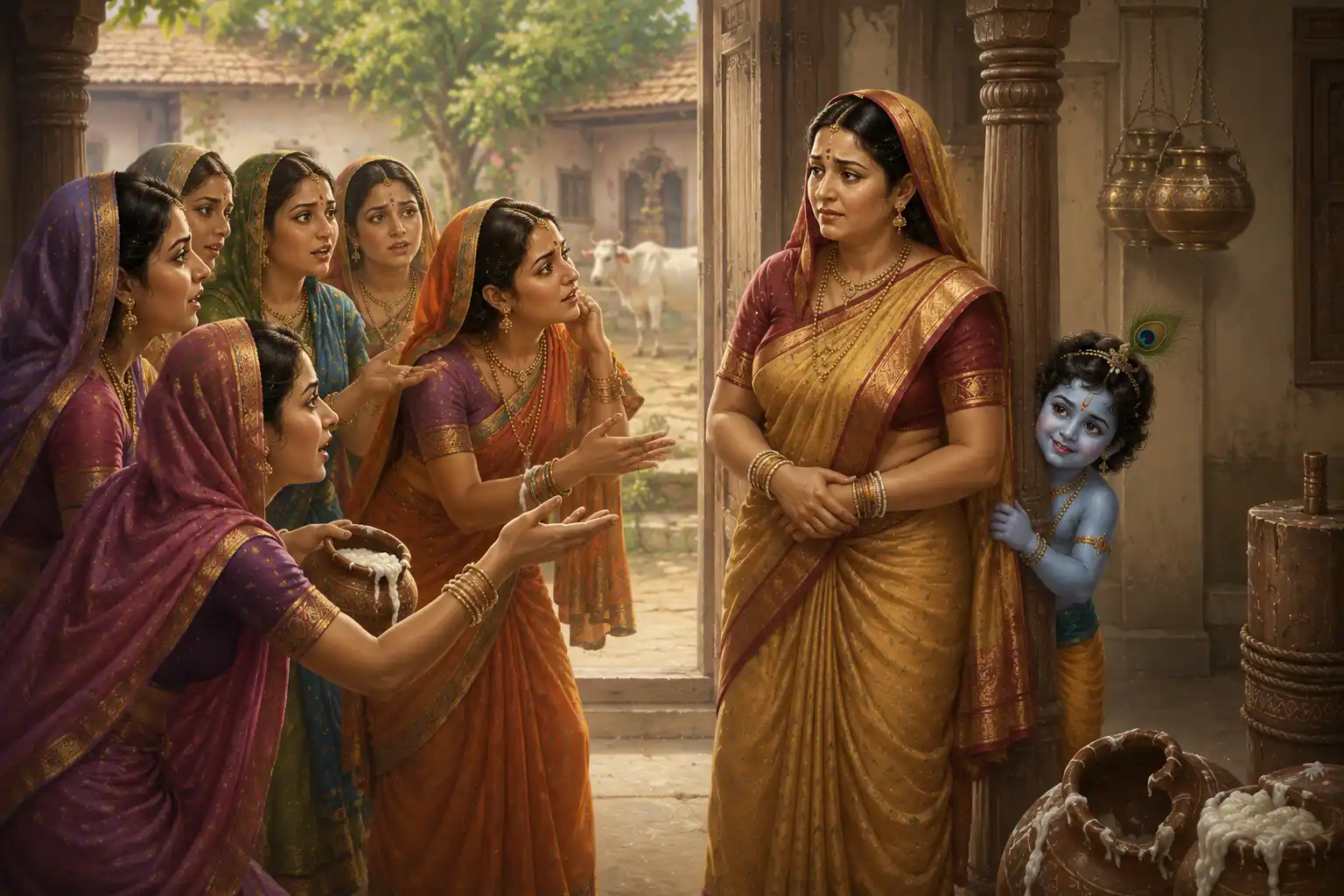
Among the most delightful episodes in the butter-stealing Leelas are the repeated visits of the Gopis to Mother Yashoda. Gathering together with great determination, they would arrive at Nanda Bhavan, eager to complain about the latest exploits of her mischievous son.
They described how Krishna had entered their homes before dawn, untethered the calves, broken the butter pots hanging from the ceiling, scattered yoghurt across the floor, and cleverly escaped every attempt to catch Him. They even explained how they had hidden the butter in the darkest corners of their homes, only to discover that the brilliant jewels adorning Krishna's body illuminated every hiding place. Nothing could remain concealed from the all-knowing Lord.
At one point, their playful frustration reached such heights that they exclaimed to Mother Yashoda, "Either your Lala will live in Braj, or we will!"
On the surface, these appeared to be serious complaints. Yet Mother Yashoda, with the wisdom born of maternal love, recognised what lay beneath their words.
If the Gopis had truly wished Krishna to stop visiting their homes, they could simply have closed their doors or hidden their butter more carefully. Instead, they eagerly gathered together each day to recount His latest adventures. Their conversations revolved entirely around Krishna. His name danced upon their lips, His smile filled their memories, and His playful deeds became the centre of every discussion.
The complaints themselves were another form of remembrance.
Swami Mukundananda beautifully explains that Krishna had already achieved His purpose. The Gopis were thinking of Him constantly. Every broken butter pot reminded them of His laughter. Every footprint left in freshly spilled yoghurt became a sacred symbol of His visit. Even their apparent irritation only deepened their attachment to Him.
Mother Yashoda herself would often smile while listening to these stories. She gently reminded the Gopis that this same little Krishna was the divine blessing for whom they had all prayed. The child who now filled Braj with playful mischief had also filled every heart with immeasurable joy. Gradually, the complaints dissolved into laughter, and once again the Gopis eagerly anticipated His next visit.
Such is the unique nature of divine love. What appears to be inconvenience from the outside becomes a priceless blessing for one whose heart has been touched by God.
Celebrating Janmashtami 2026 Through the Spirit of Makhan Chor
The butter-stealing Leelas are not merely stories from a distant age. They continue to offer practical guidance for every devotee celebrating Janmashtami today.
As we decorate temples, sing bhajans, fast, and rejoice in Krishna's divine appearance, these sweet pastimes remind us that external celebrations find their highest fulfilment when accompanied by inner transformation. The Lord is not searching for elaborate displays of devotion if the heart remains untouched. Rather, He lovingly seeks a heart softened by humility, purified through remembrance, and overflowing with selfless love.
This Janmashtami, let us therefore ask ourselves a simple yet profound question: If Krishna were to visit the home of my heart today, what would He find?
Would He discover a heart cluttered with ego, anxiety, and worldly attachment? Or would He find a heart patiently churned through prayer, scriptural study, meditation, seva, and loving remembrance?
The Gopis did not become blessed because they possessed butter.
They became blessed because they possessed devotion.
Their homes became sacred because Krishna found love waiting for Him there.
The same invitation remains open to every seeker today.
When we remember His names, meditate upon His beautiful form, study His teachings in the Bhagavad Gita, hear His Leelas in the Srimad Bhagavatam, and dedicate our daily actions to Him, our hearts gradually become the kind of treasure that Makhan Chor never fails to seek.
Conclusion: Let Krishna Steal Your Heart
The story of Krishna stealing butter is ultimately the story of God searching for the love of His devotees.
The Lord who possesses everything in creation chooses to become a playful thief because there is one treasure He never forces anyone to give—the freely offered love of the human heart. Every butter pot He breaks reminds us that worldly attachments are temporary. Every handful of butter He joyfully shares reveals that divine love multiplies when it is given away. Every visit to the homes of the Gopis proclaims that God longs not for distant worship but for intimate, loving relationships with His devotees.
This is why the Makhan Chori Leelas have enchanted saints, poets, and devotees for thousands of years. Beneath their laughter lies the highest philosophy of Bhakti. The Butter Thief is, in truth, the Thief of Hearts.
As we celebrate Janmashtami 2026, may we become like the Gopis of Braj. May we patiently churn our hearts through sincere devotion until the butter of pure love naturally rises to the surface. May we invite Krishna into every corner of our lives without reservation. And when the Divine Butter Thief comes searching, may He find a heart so filled with love that He cannot resist stealing it forever.
Boliye Shree Krishna Kanhaiya Lal Ki Jai!
Call To Action: Continue Your Spiritual Journey with JKYog
If this exploration of Shree Krishna's divine avatar has inspired you to deepen your relationship with God, continue your journey through the authentic teachings of Swami Mukundananda and JKYog.
Study the Bhagavad Gita verse by verse through Swamiji's practical commentaries:

Immerse yourself in his illuminating discourses on the Srimad Bhagavatam, and experience guided Roop Dhyan meditations, bhajans, daily inspiration, and spiritual challenges through the Bhagavad Gita & Krishna Bhakti App:

 JKYog
JKYog
If possible, celebrate Janmashtami at your nearest JKYog centre or Radha Krishna Temple. Participating in kirtans, scriptural discourses, abhishekam, and midnight celebrations alongside fellow devotees creates an uplifting spiritual atmosphere that strengthens faith and deepens one's connection with Shree Krishna. The greatest way to honour His appearance is to allow His teachings and His love to become an integral part of our daily lives.


FAQs
1. Why did Shree Krishna steal butter?
Krishna stole butter to accept the love and devotion of the Gopis. The butter symbolises a heart purified through Bhakti.
2. What does butter represent in Krishna's Leelas?
Butter represents the pure essence of devotion, lovingly churned through spiritual practice, remembrance, and selfless love.
3. Why is Krishna called Makhan Chor?
Krishna is lovingly called Makhan Chor because He stole butter from the homes of the Gopis, while spiritually stealing the hearts of His devotees.
4. Why did the Gopis secretly want Krishna to steal their butter?
Although they appeared to complain, the Gopis longed for Krishna's visits because every encounter deepened their love and remembrance of Him.
5. What is the spiritual meaning of Krishna breaking butter pots?
The broken pots symbolise the destruction of ego, possessiveness, and attachment, allowing divine love to emerge.
6. Why did Krishna feed butter to monkeys?
The Leela teaches that divine love is meant to be shared freely and joyfully, never hoarded.
7. How does Swami Mukundananda explain the butter-stealing Leelas?
He explains that Krishna never desired butter itself but the devotion symbolised by it. Every Leela was designed to awaken Bhakti in the hearts of devotees.
8. How can we apply the Makhan Chor Leela today?
By purifying our hearts through prayer, seva, meditation, scriptural study, and loving remembrance, we prepare an offering of devotion that naturally attracts Krishna.
9. Why are Krishna's childhood Leelas important during Janmashtami?
They reveal the sweetness of God's personality and remind devotees that the Lord seeks a loving relationship with every soul.
10. What is the central message of the Butter Leela?
Krishna does not seek what we own—He seeks the love we have patiently churned within our hearts.