
Back in Mathura, Kans was beset with fear. He knew that the one destined to kill him had already been born somewhere in Braj. But he did not know which child it was.
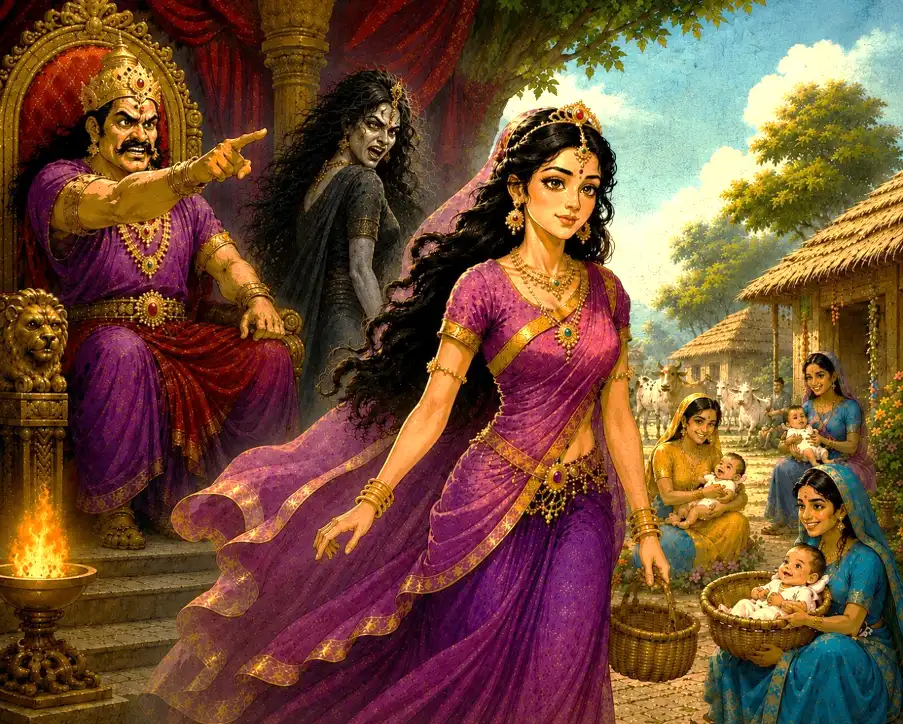
So, Kans summoned one of his demonesses, Putana. He ordered her to go to Braj and slaughter every infant born within the past month. The one destined to end his life, he thought, would perish among them.
Armed with Rakshasi Maya, a sinister power, Putana masked her demonic form and transformed herself into a stunningly beautiful woman. She then glided into Braj undetected, intent on hunting down every newborn in her path.
Death at the Door
Though resting peacefully under Nand and Yashoda’s roof, little Krishna was fully aware of the lurking menace. As the silent witness seated in every heart, He resided even within Putana, reading her lethal intent. Steered by His divine will, Putana skirted the winding lanes of Braj and walked straight to His doorstep. Thus, even before her hunt began, she had been unknowingly led to the very child she meant to destroy.
The hour was perilous. Nand Baba was away in Mathura, paying his annual tax to Kans and visiting his friend Vasudev.
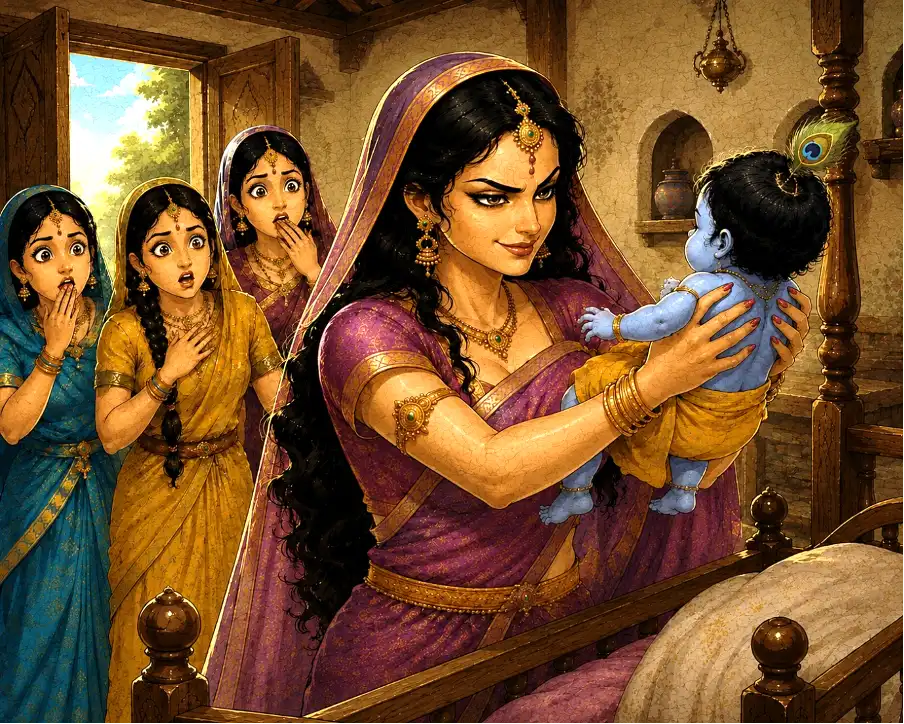
Meanwhile, Putana slipped into the house. Baby Krishna lay in His cradle, with Yashoda and a few sakhis gathered around Him. The moment their gaze fell upon the stranger, they were bewitched by her beauty. Frozen in awe, they pondered: Was this Indrani, Rudrani, or Brahmani? What celestial being had descended upon their rustic abode?
Yet that exquisite visage concealed something deadly. Putana had smeared virulent poison on her breast, potent enough to snuff out life in a single draught. Brushing past the transfixed women, she strode directly to the cot, lifted baby Krishna into her arms, and pressed her poisoned breast in His mouth.
And in that instant, Shree Krishna closed His eyes.
Why did the Lord close His eyes?
In the Bhagavatam, Shukadev Goswami leaves the gesture unexplained. The Acharyas and commentators, however, have offered beautiful interpretations.
Vallabhacharya, in his Subodhini Tika, explains that Putana was avidya-roopi—the embodiment of nescience. If the Supreme Truth looked at ignorance with wide-open eyes, it would disappear. To let the leela proceed, Bhagavan graciously shut His eyes.
Another commentary points to a sense of déjà vu. In the Lord’s previous descent as Ram, the sequence of vanquishing demons had also begun with a woman: Tadaka. Finding Himself face-to-face with a female demon once again, Lord Krishna closed His eyes at the familiar irony.
A more tender perspective highlights God’s compassion. Shree Krishna closed His eyes to peer into Putana’s past lifetimes. He searched for the faintest good deed she might have done, so He could use it as an excuse to bestow grace upon her.
Then there is a sweet, playful insight echoed by Jagadguru Shree Kripalu Ji Maharaj. With His eyes closed, baby Krishna called upon Shankar ji: “O Mahadev, I descended into Braj to relish milk, and instead, there is poison here! You drank the deadly Halahal during the churning of the ocean. Holding it in your throat, you became Neelkanth. There is poison here as well. Please drink it.”
And so, Shankar ji gladly answered the call and siphoned the venom. With the poison gone, only milk remained for the Lord.
The Fall of Putana
As Krishna began to drink the milk, He clamped His tiny fingers around Putana’s breast and pressed with such force that she could bear the pain no longer. She let out a piercing shriek.
सा मुञ्च मुञ्चालमिति प्रभाषिणी निष्पीड्यमानाखिलजीवमर्मणि ।
विवृत्य नेत्रे चरणौ भुजौ मुहु: प्रस्विन्नगात्रा क्षिपती रुरोद ह ॥ ~ 10.6.11
Unbearably pressed in every vital point, the demon Pūtanā began to cry, “Please leave me, leave me! Suck my breast no longer!” Perspiring, her eyes wide open and her arms and legs flailing, she cried very loudly again and again.
The searing agony stripped away Putana’s guise. Her enchanting form vanished, exposing the hideous fiend beneath. Her mouth was sharp as a plough-blade, her teeth dreadful. Her hair whipped around her face, her eyes were sunken like dark wells, and her belly was like a dried lake. Putana’s body swelled to a terrifying size, rising into the sky with baby Krishna still latched onto her breast.
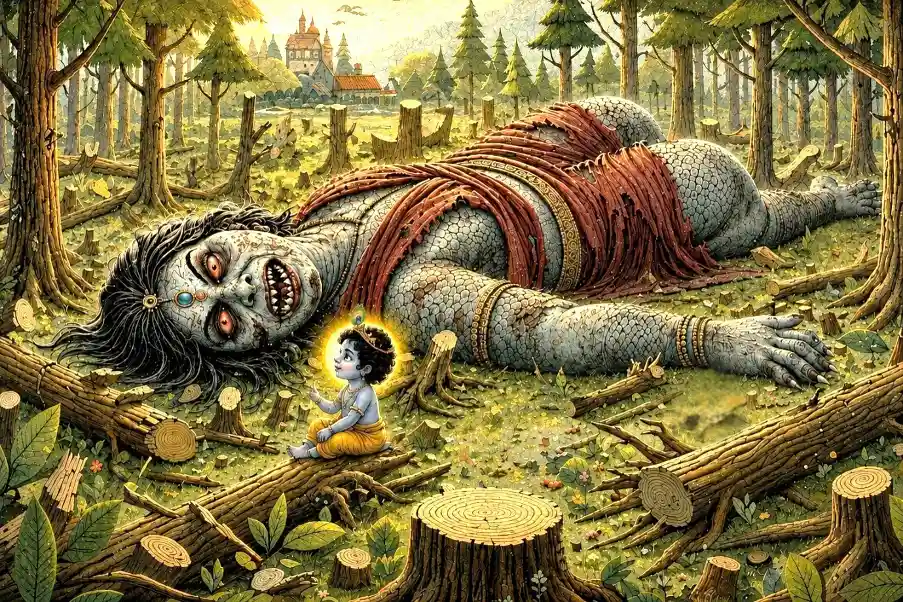
Terror swept through Braj. The gopis scattered in panic. Putana writhed wildly, yet no force could dislodge the infant. He continued drinking the milk and, with it, drew out her very life airs. At last, Putana plummeted to the ground with a deafening thud. Her colossal body uprooted trees across miles. Amid the wreckage lay the lifeless demoness, while little Krishna remained completely unscathed.
Horrified by the spectacle, Yashoda and the gopis rushed to scoop up Krishna. Dreading that some ill omen had come upon Him, they hastened to perform protective rituals. They sprinkled cow urine over Him and brushed a cow’s tail across His body and face.
Now another problem confronted the villagers. What could they possibly do with Putana’s enormous body? The splintered trees were gathered and used to build funeral pyres. With axes, the villagers hewed her gigantic body into pieces and consigned it to the flames.
Mercy Beyond Measure
At that time, Nand Baba was in Mathura meeting Vasudev. Deeply concerned about the danger posed by Kans, Vasudev warned him, “I fear that some calamity may befall Braj. Do not remain here too long. Please return at once.”
Sensing the gravity in his words, Nand Baba immediately began the journey back.
As he approached the borders of Braj, an unexpected, sweet aroma wafted through the breeze. It smelled like fine incense, making Nand wonder who in the village was performing such grand worship. Little did he know that the fragrant smoke was rising from a demoness’s funeral pyre. Touched by the Lord, even her death bore the fragrance of grace.
All this took place on the sixth day of Shree Krishna’s appearance, giving rise to the festival of Chhathi, still celebrated for newborns today.
Yet the true wonder of Putana’s tale lies neither in her murderous mission nor her dramatic fall. It lies in the astonishing fate that awaited her at the hands of the Lord.
पूतना लोकबालघ्नी राक्षसी रुधराशना ।
जघांसयाप हरये स्तनं दत्त्वाप सद्गतम् ॥ ~ 10.6.35
Putana was a demoness thirsting for the blood of children, and came to kill Shree Krishna by offering her breast. But the Lord is so merciful that He sent her to His divine abode.
This outcome left even Brahma Ji perplexed: How could a treacherous demoness be elevated to the highest spiritual abode? To this, Shree Krishna answered, “I drank her milk. In doing so, she became My mother. How could I send My mother to hell?”
Such is the causeless mercy of Bhagavan. Putana came to take His life. Yet the Lord saw the glimmer of motherhood in her wicked act and blessed her soul for eternity.
Frequently Asked Questions
Who was Putana? She never surrendered to God. How, then, did she attain liberation?
In her past life, Putana was Ratnamala, the daughter of demon king Bali. When Lord Vishnu descended as Vaman, the dwarf Brahmin, Ratnamala was enchanted by His beauty. Maternal affection arose within her, and she thought, “If I had a son as beautiful as this child, I would breastfeed him.” Moments later, Vaman stepped across the universe in two strides and bound her father, with one step still remaining. Seeing this, Ratnamala’s affection turned to rage. She thought, “If I had a son like Him, I would give Him poison and kill Him.” Being omniscient, Bhagavan granted both her conflicting desires. In Dvapar Yug, she was reborn as the demoness Putana.
The point to note is that God is supremely pure and purifies whatever comes into contact with Him. Since Lord Krishna drank Putana’s milk, her sins of countless lifetimes were destroyed instantly. Even as her life force was drawn out, the Lord, in His boundless grace, freed Putana from material bondage.
Can even the gravest of sinners be forgiven by God?
The soul is never sinful. It is eternally pure, a fragment of the Supreme. Enveloped by Maya, it identifies with the body and ego, forgetting its true spiritual nature. Thus, sinful actions arise from ignorance; they do not define the soul.
Every soul journeys through countless lifetimes. One may fall into sinful tendencies today, yet through knowledge, devotion, and God’s grace, rise to sublime heights. There is a beautiful teaching attributed to the Buddha. While walking with his disciples, he would sometimes speak of his past lives. Whenever a disciple condemned someone, Buddha would gently remind them, “Forty lifetimes ago, I was like that.”
The scriptures offer powerful examples. Ajamil and Valmiki had sinful pasts, yet both ultimately attained spiritual elevation. No matter how dark the past, when one takes shelter of the Lord, He guides the soul toward its highest potential. Discover what Shree Krishna says about this in Bhagavad Gita Verse 9.30.
अपि चेत्सुदुराचारो भजते मामनन्यभाक् ।
साधुरेव स मन्तव्य: सम्यग्व्यवसितो हि स: ॥ 30॥
api chet su-durāchāro bhajate mām ananya-bhāk
sādhur eva sa mantavyaḥ samyag vyavasito hi saḥ
BG 9.30: Even if the vilest sinners worship Me with exclusive devotion, they are to be considered righteous because they have made the proper resolve.