
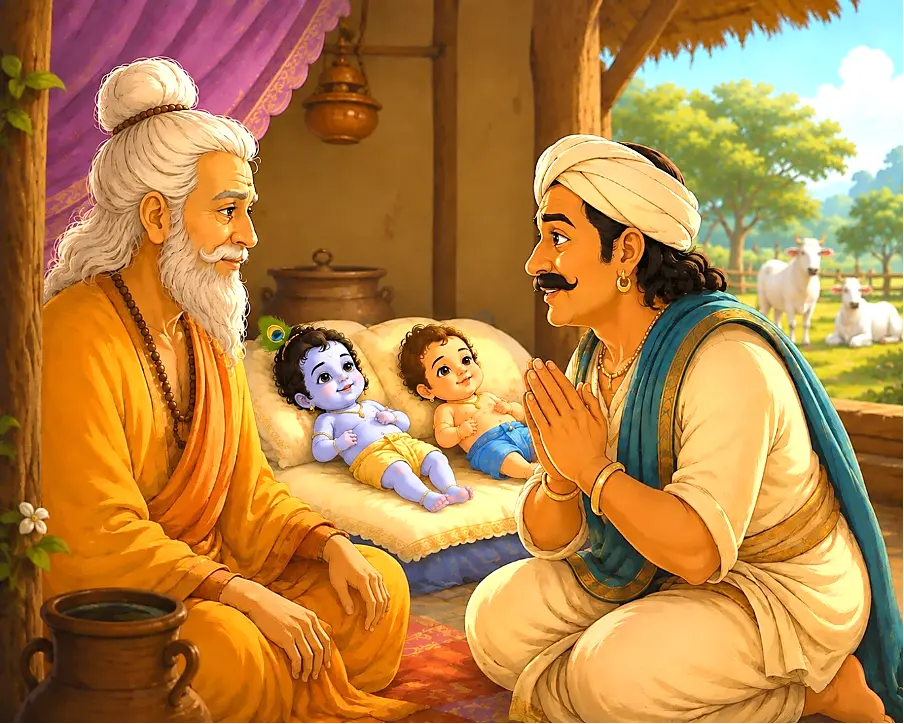
Nand Baba’s heart brimmed with joy. His two sons had grown enough for their Namkaran (naming ceremony), an occasion he had eagerly awaited. Just then, Garga Muni arrived in Gokul. Deeply respectful of the Sage, Nand approached him with a heartfelt plea. “Maharaj, I have been blessed with two sons. What greater fortune could there be than to have you bestow their names?”
Gargacharya demurred. “I would gladly do so, but I am not your family priest; I am the Kulguru of Vasudev. If word reaches Kans that I have named your children, he will at once surmise that Vasudev’s eighth child is here in Gokul, sheltered under your roof.”
Nand reassured him, “We will tell no one, Maharaj. Please come to the Goshala, far from the sight of others.” Nand Baba then accompanied the Sage to the secluded cowshed, and asked Yashoda and Rohini to bring the two children.
Naming the Divine
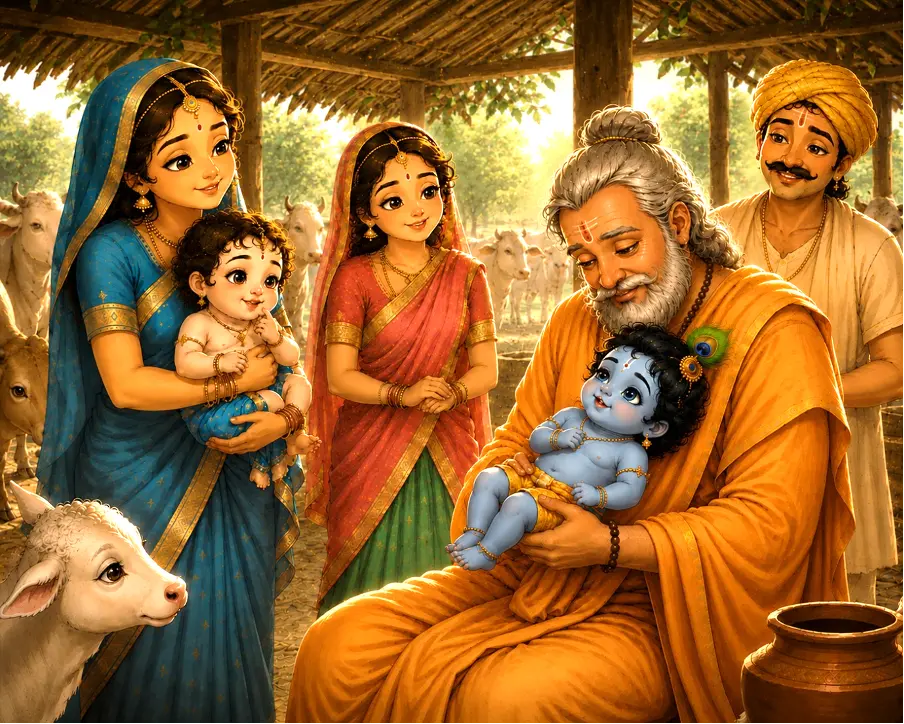
A playful thought struck Yashoda: Let me put Gargacharya to the test. Nudging Rohini, she whispered, “I will carry your son, and you carry mine. We shall see if the Sage can tell them apart.” Amused, Rohini readily assented.
Together they stepped into the cowshed—Yashoda cradling Balaram, and Rohini holding the dark, lotus-eyed Krishna. Nand Baba recognized their light-hearted game at a glance. But he said nothing, curious to see how the venerable Sage would unravel the riddle.
The mothers stepped forward to present the children.
Gargacharya first reached for the child resting in Yashoda’s arms. Gazing upon his radiant form, the Sage proclaimed, “This child is endowed with extraordinary power. He bears the might to support the entire world.” Thus, he is Bala. Yet he shall also bring immense bliss to all who cherish him, and so he is Ram.” Bestowing the name Balaram, Garga Muni turned to the mothers and addressed the boy as Rohini-putra.
Yashoda and Rohini exchanged startled, wide-eyed glances: ‘The Sage knows!’
Next, Gargacharya received the dark-hued boy from Rohini’s arms. As the infant nestled against his chest, the Sage smiled knowingly. “This is Yashoda-nandan.” Drifting into deep reverie, he marveled, “This boy has thousands of names. Age after age, across every yug, He descends in ever-new Forms. At times, He appears red; at times, yellow; at times, white.” With that, Garga Muni fell silent.
Nand gently prompted him, “Maharaj, please give him a name.” Overcome with wonder, Gargacharya then exclaimed,
हन्तास्य नामकरणाय समागतोऽहम्।
आलोपितं पुनरनेन मामैव नाम॥
“Alas! I came here to bestow a name upon this child, but on seeing him I am so thrilled that I have forgotten my own name.”
A swell of divine love crested within Gargacharya. Beholding the luminous eyes of the baby, he continued, “This child possesses an all-enchanting, irresistible beauty. His charm will pull even the minds of the most renounced yogis to His lotus feet.” And for this reason, Garga Muni named Him Krishna.
karṣhati yoginam paramahansānnam chetānsi iti kṛiṣhnah ~ [v25]
‘Krishna is he who forcefully attracts the minds of even the most powerfully-minded yogis and paramahansas.’
Special Charm of Krishna
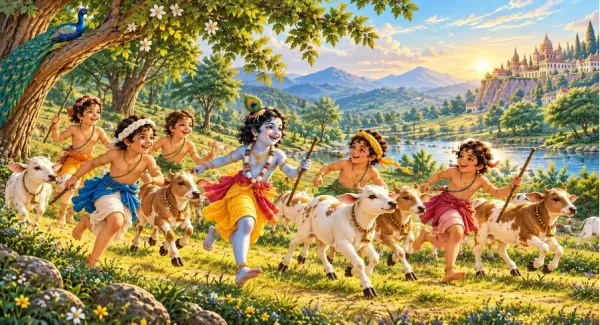
Krishna and Balaram were now growing up amidst the pastoral groves of Gokul. The Supreme Lord, the source of all creation, had become the little child of Nand and Yashoda. Such are the inconceivable Pastimes of the Divine.
In essence, all forms of the Divine are one. None is greater or lesser; each is complete unto itself. As the scriptures affirm:
सर्वे पूर्णाः शाश्वताश्च देहास्तस्य परात्मनः ।
All the forms of that Supreme Self are complete and eternal.
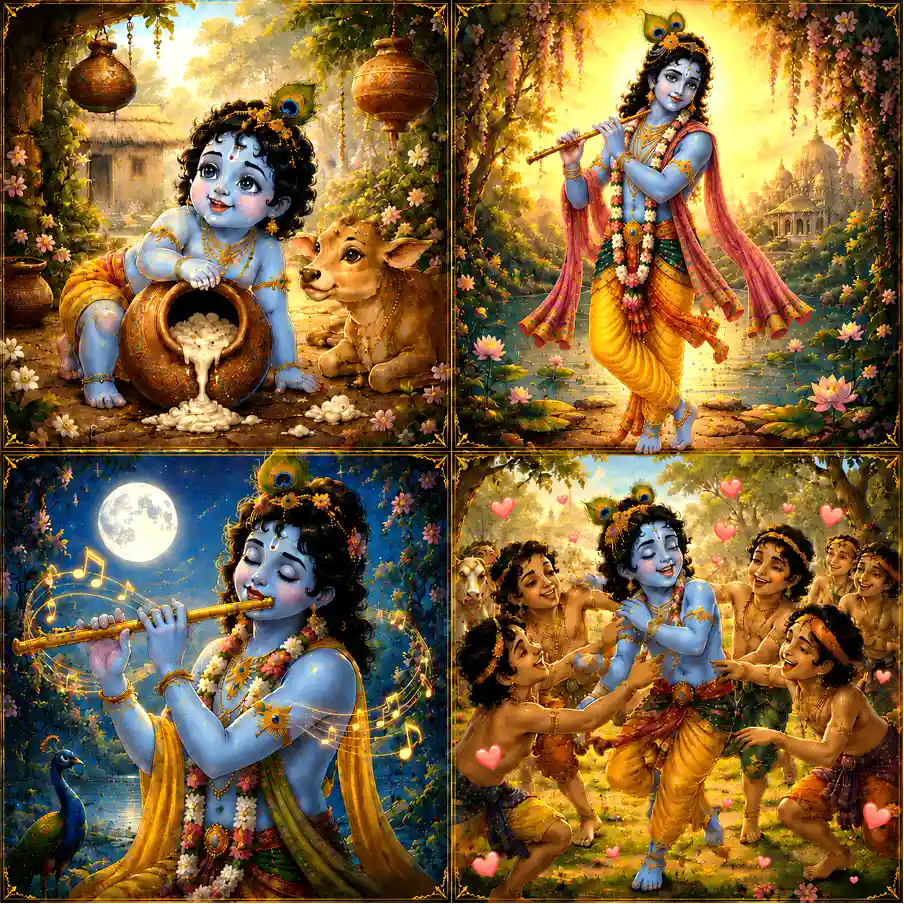
Yet, Shree Krishna manifests four special nectars or Madhuris, above and beyond any other avatar of God.
● Baal Leela Madhuri (The Sweetness of Childhood Pastimes)
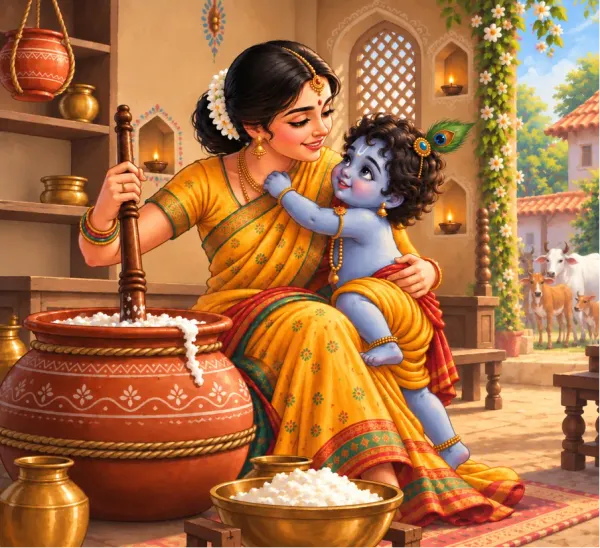
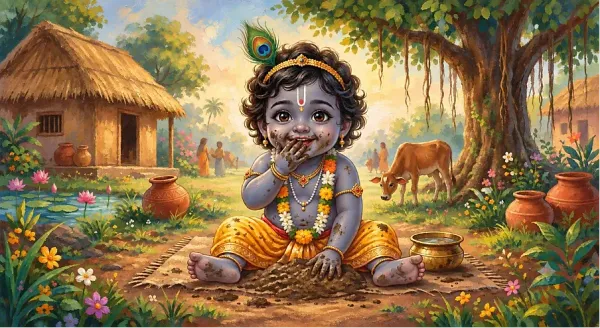
Krishna engages in the most endearing childhood escapades. From innocently stealing butter to swaying artfully for a mere morsel of buttermilk, His delightful frolics melt every heart.
● Roop Madhuri (The Sweetness of Form)
Krishna exudes a beauty so enchanting that the mind is irresistibly drawn toward Him. Most striking is His Tribhangi-Laal pose—curved gently in three places, flute poised at His lips, shimmering with grace.
● Murli Madhuri (The Sweetness of the Flute)
The melody of His flute carries an intoxicating sweetness. It quiets worldly distractions, pierces the soul’s slumber, and awakens a long-forgotten yearning for the Divine.
● Prem Madhuri (The Sweetness of Pure Love)
Leelas displaying the supremacy of devotion reveal how God forgets His almightiness under the spell of His devotees’ love.
And herein lies the divine paradox.
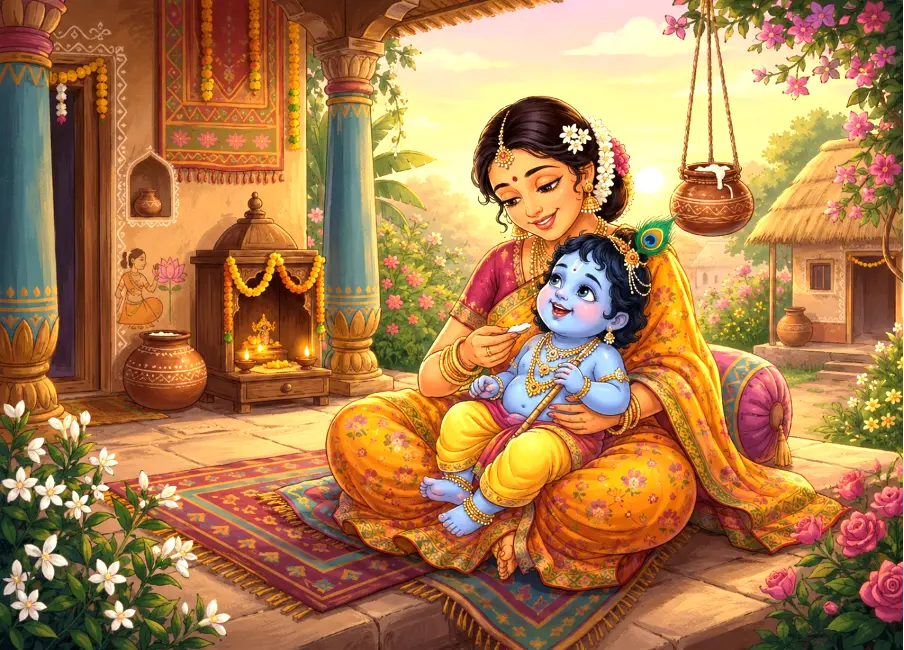
Were you constantly aware that the child before you was God Himself, what would you do? Perhaps you would fold your hands in reverence, bow before Him, and begin reciting mantras in His praise. But that formal distance is precisely what Shree Krishna dispels in Braj.
He makes the devotees forget His divinity, inspiring in their hearts the tender feeling: “Krishna is mine.” He hides His Aishwarya, His sovereignty, so the unreserved sweetness of love can fully blossom. Not only that; under the sway of their love, He Himself forgets that He is God. Such is the rare, peerless charm of Krishna’s Braj Leelas.
Thus, Yashoda does not see Him as the Supreme Lord. She simply thinks, “He is my little child.” She tells the gopis, “O sakhi, I worship Lord Narayan. You should worship Narayan too. It is solely by Narayan’s grace that our Lala was spared from demoness Putana; left to Himself, how could He ever have survived?”
Little Krishna vs. Shakatasur
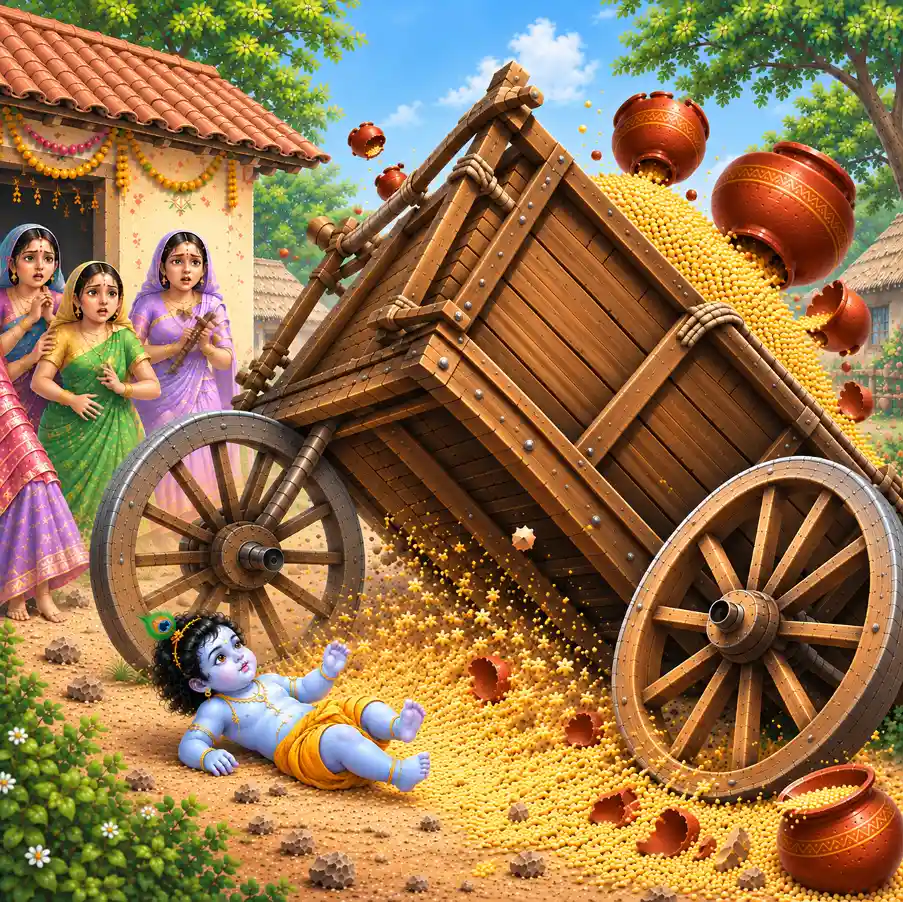
As Yashoda prayed fervently for His protection, baby Krishna had already begun taking matters into His own tiny hands.
When Krishna turned three months old, Mother Yashoda observed His Nishkraman Sanskar—ushering Him beneath the open skies for the first time. Pujas were underway. The courtyard bustled with guests and festive revelry. Seeking to shield her Lala from a sudden gust of wind, Yashoda lovingly settled Him beneath a wooden handcart (shakat).
Unbeknownst to her, danger had already slithered in. Kans had dispatched another demon—this time, Shakatasur. Assuming the form of the shakat, he lay in wait for the right moment to crush little Krishna. Yet nothing escapes the omniscient Lord. A single kick from His tiny foot was all it took. The cart shattered into splinters, leaving Shakatasur lifeless where he lay.
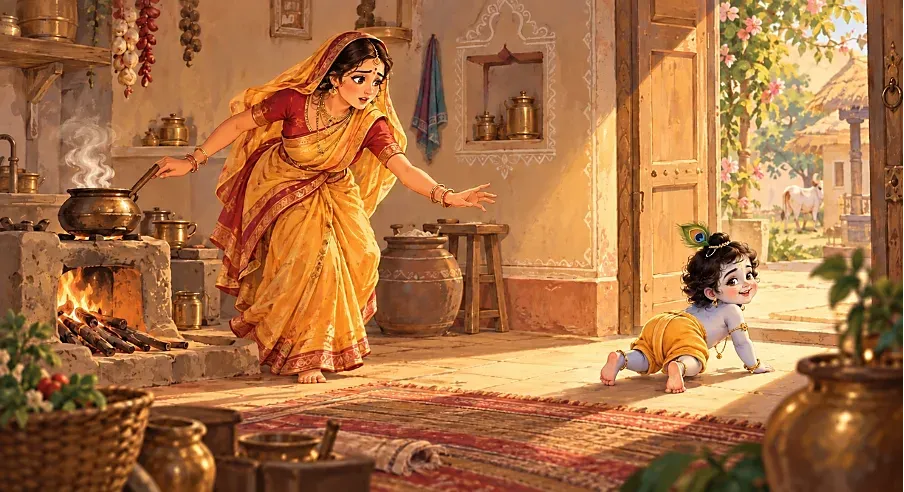
Hearing the crash, Yashoda hurried to the spot. “What has happened?” she cried. The bewildered onlookers could scarcely explain how an infant had overturned a massive cart.
Though pots had tumbled and timbers had fallen, not a single shard had touched Krishna. By God’s mercy, her Lala has been spared, Yashoda thought. Then, murmuring prayers, she sprinkled gomutra over His head and brushed Him with a cow’s tail to ward off evil.
And day after day, she continued to shower her Lala with love without end…
Frequently Asked Questions
Just as Mother Yashoda viewed Krishna as her own child, do we find the same sentiment in the Ram avatar?
Yes. In the Ramayan, Mother Kaushalya, too, saw Lord Ram as her son. She prayed to the village goddess, saying,
पूजी गाम देमी सुर नागा कहें भहोरी देन बली भागा यही
वेदियोय राम कल्याणू हे हुदया कर्सो वर्दानू ~ Ramcharitmanas
O Mother, grant me this blessing—that my Ram may live a long life.
The village goddess herself was but a servant of the All-Powerful Lord, and yet Kaushalya prayed to her for her son’s welfare. Because, in Kaushalya’s eyes, Ram was simply her child.
Similarly, Dasharath Maharaj regarded Bhagavan Ram as his son. When Sumantra returned and informed him that Ram would not return for fourteen years, Dasharath could do nothing but cry out, “Ram! Ram! Ram!”
राम राम कहि राम कहि राम राम कहि राम।
तनु परिहरि रघुबर बिरह राउ गए सुरधाम॥ ~ Ramcharitmanas
Calling out Ram’s name again and again, he gave up his life. He just could not bear the pain of separation from his beloved son.
If Shree Ram and Krishna are the same Supreme Lord, what explains the striking difference between Their Leelas?
The difference lies in the purpose of Their Pastimes.
Bhagavan Ram descended to teach humanity ideal conduct, righteous behavior, and the fulfillment of social duty (Dharma). He followed Maryada at every step. For this purpose, He performed Nar-Leela—portraying Himself as a human being. He allowed Himself to experience human grief, struggle, and limitation.
Bhagavan Krishna, on the other hand, is Leela Purushottam, not Maryada Purushottam. He would occasionally reveal His divinity, vanquishing demons like Shakatasur even as an infant. At other times, He concealed His almightiness, allowing His devotees to relate to Him with the intimacy of a beloved, a child, or a friend. Through His enchanting Pastimes, He not only draws the minds of countless souls toward divine consciousness but also reveals the sweetness of divine love.
For clear, incisive answers to more questions like these, read Spiritual Dialectics by Swami Mukundananda.